


Influence of a Moderate-Intensity Exercise Program on Early NK Cell Immune Recovery in Pediatric Patients After Reduced-Intensity Hematopoietic Stem Cell Transplantation
- PMID: 27903841
- PMCID: PMC5739144
- DOI: 10.1177/1534735416679515
Influence of a Moderate-Intensity Exercise Program on Early NK Cell Immune Recovery in Pediatric Patients After Reduced-Intensity Hematopoietic Stem Cell Transplantation
Abstract
Introduction: After allogeneic hematopoietic stem cell transplantation (HSCT), NK cell reconstitution, which is crucial for positive outcomes, is dominated by the CD56bright subset with low NK cell cytotoxicity (NKCC) activity. Moderate exercise has been described as a potent NK cell stimulus in adults with cancer.
Purpose: To determine the effects of a moderate-intensity exercise program on NK cell recovery early after HSCT and the feasibility of this intervention.
Methods: Six children undergoing allogeneic HSCT were randomized to an exercise program (EP) or control (CT) group. The EP group performed a 10-week training combining in-hospital and home-based EP.
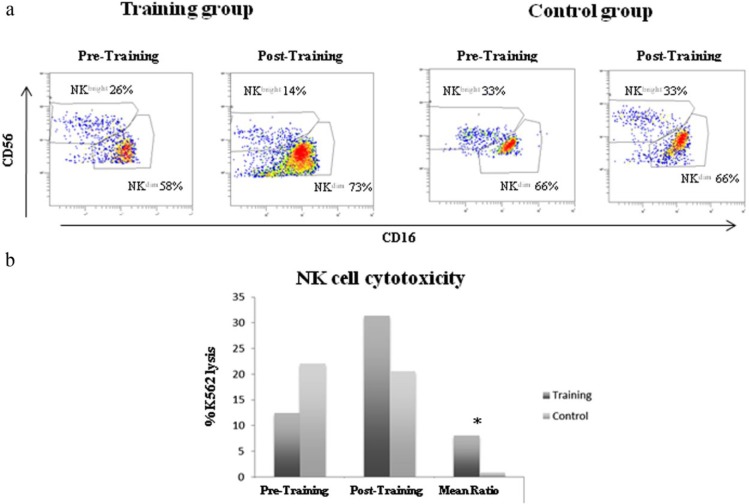
Results: We observed a significant increase in the posttraining/pretraining ratio of the CD56dim subset (EP = 1.27 ± 0.07; CT = 0.99 ± 0.08; P < .005) of the EP group. The ratio of NKCC was 8 times greater in the EP group.
Conclusion: Data suggest that a moderate-intensity EP program performed early after HSCT is feasible and might redistribute the CD56dim/CD56brigh NK cell subset, improving NKCC. The results are still preliminary and must be interpreted with caution.
Keywords: allogeneic stem cell transplantation; moderate-intensity exercise; natural killer cell cytotoxicity; natural killer cells.
Conflict of interest statement
Figures
Comment in
-
Immune Response to Exercise During Growth.Pediatr Exerc Sci. 2017 Feb;29(1):49-52. doi: 10.1123/pes.2017-0003. Pediatr Exerc Sci. 2017. PMID: 28271813
References
-
- Miano M, Labopin M, Hartmann O, et al. Haematopoietic stem cell transplantation trends in children over the last three decades: a survey by the paediatric diseases working party of the European Group for Blood and Marrow Transplantation. Bone Marrow Transplant. 2007;39:89-99. - PubMed
-
- Bosch M, Khan FM, Storek J. Immune reconstitution after hematopoietic cell transplantation. Curr Opin Hematol 2012;19:324-335. - PubMed
-
- Crisafulli A, Tocco F, Melis F, Milia R, Concu A. Natural killer cells responsiveness to physical exercise: a brief review. Open J Immunol. 2013;3:190-200.
-
- Imai K, Matsuyama S, Miyake S, Suga K, Nakachi K. Natural cytotoxic activity of peripheral-blood lymphocytes and cancer incidence: an 11-year follow-up study of a general population. Lancet 2000;356:1795-1799. - PubMed
-
- Nagler A, Lanier LL, Cwirla S, Phillips JH. Comparative studies of human FcRIII-positive and negative natural killer cells. J Immunol. 1989;143:3183-3191. - PubMed
Publication types
MeSH terms
Substances
LinkOut - more resources
Full Text Sources
Other Literature Sources
Medical
Research Materials
