


Discordance between self-reported arthritis and musculoskeletal signs and symptoms in older women
- PMID: 27905906
- PMCID: PMC5133957
- DOI: 10.1186/s12891-016-1349-4
Discordance between self-reported arthritis and musculoskeletal signs and symptoms in older women
Abstract
Background: Arthritis is a gendered disease where women have a higher prevalence and more disability than men with arthritis of the same age. Health survey data is a major source of information for monitoring of the burden of arthritis. The validity of self-reported arthritis and the determinants of its accuracy among women have not been thoroughly studied. The objectives of this study were to: 1) examine the agreement between self-report diagnosed arthritis and musculoskeletal signs and symptoms in community-living older women; 2) estimate the sensitivity, specificity, and predictive values of self-reported arthritis; and 3) assess the factors associated with the disagreement.
Methods: A cross-sectional survey of women was undertaken in 2012-13. The health survey asked women about diagnosed arthritis and musculoskeletal signs and symptoms. Agreement between self-reported arthritis and musculoskeletal signs symptoms was measured by Cohen's kappa. Sensitivity, specificity, and predictive values of self-reported arthritis were estimated using musculoskeletal signs and symptoms as the reference standard. Factors associated with disagreement between self-reported arthritis and the reference standard were examined using multiple logistic regression.
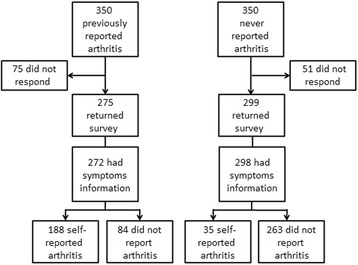
Results: There were 223 participants self-reported arthritis and 347 did not. A greater number of participants who self-reported arthritis were obese compared to those who did not report arthritis. Those who reported arthritis had worse health, physical functioning, and arthritis symptom measures. Among the 570 participants, 198 had musculoskeletal signs and symptoms suggesting arthritis (the reference standard). Agreement between self-reported arthritis and the reference standard was moderate (kappa = 0.41). Sensitivity, specificity, and positive and negative predictive values of self-reported arthritis in older women were 66.7, 75.5, 59.2, and 81.0% respectively. Regression analysis results indicated that false-positive is associated with better health measured by the Short Form 36 physical summary score, the Health Assessment Questionnaire disability index, or the Western Ontario and McMaster University Osteoarthritis Index total score; whereas false-negative is negatively associated with these variables.
Conclusion: While some women who reported diagnosed arthritis did not have recent musculoskeletal signs or symptoms, others with the signs and symptoms did not report diagnosed arthritis. Researchers should use caution when employing self-reported arthritis as the case-definition in epidemiological studies.
Keywords: Arthritis; Geriatrics; Health survey; Self-report; Validity; Women.
Figures

References
-
- Australian Institute of Health and Welfare (AIHW) A snapshot of arthritis in Australia 2010. Canberra: AIHW; 2010.
-
- Centers for Disease Control and Prevention. Arthritis-related statistics. 2014. http://www.cdc.gov/arthritis/data_statistics/arthritis_related_stats.htm. Accessed 11 Oct 2014
-
- Public Health Agency of Canada . Life with arthritis in Canada 2010. Canada: PHAC; 2010.
Publication types
MeSH terms
LinkOut - more resources
Full Text Sources
Other Literature Sources
Medical
