


Published Erratum
doi: 10.1165/rcmb.556erratum.
Erratum: NAD(P)H Quinone Oxidoreductase 1 Is Essential for Ozone-Induced Oxidative Stress in Mice and Humans
- PMID: 27906558
- PMCID: PMC6835088
- DOI: 10.1165/rcmb.556erratum
Item in Clipboard
Published Erratum
Erratum: NAD(P)H Quinone Oxidoreductase 1 Is Essential for Ozone-Induced Oxidative Stress in Mice and Humans
Am J Respir Cell Mol Biol.
2016 Dec.
No abstract available
Figures
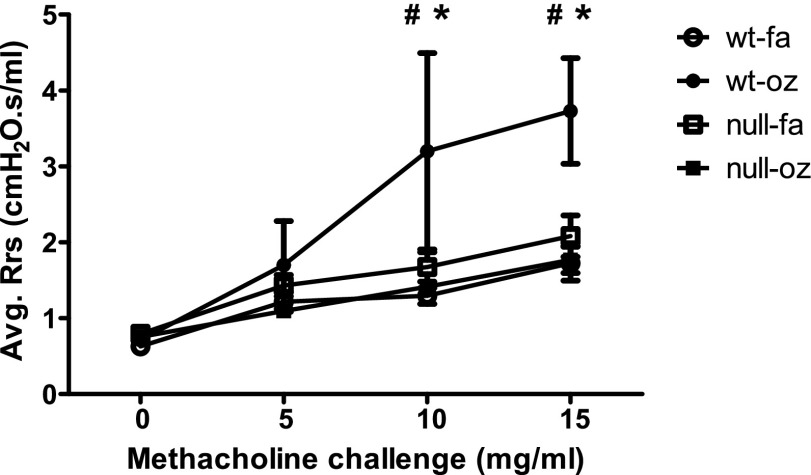
Ozone (OZ)-induced airway hyperresponsiveness is blunted in NAD(P)H quinone oxidoreductase 1 (NQO1)-null (KO) mice. NQO1-null mice on a 129:C57BL6J background (null) and wild-type (WT) mice on the same genetic background (n = 7 mice per group) were exposed to filtered air (FA) or OZ (1 ppm, 3 h). Twenty-four hours after exposure, the mice were anesthetized, intubated with 18-g tracheal catheters, monitored by EKG, and placed on the Flexivent ventilator (SCIREQ, Montreal, PQ, Canada). Total lung resistance (Rrs) was measured after exposure to nebulized methacholine (0–15 mg/ml). Between methacholine challenges, mice received five ventilations to relax smooth muscle. Results demonstrate that WT mice had increased airway hyperresponsiveness after methacholine, while KO mice had no increase in resistance compared with air-treated WT mice or KO mice. Rrs is significantly greater in WT OZ-exposed mice (WT-OZ) compared with NQO1-null OZ-exposed mice (null-OZ) (#P < 0.01) and significantly greater in WT-OZ mice compared with WT air-exposed mice (WT-FA) (*P < 0.01). Experimental data are summarized for 7–12 mice per treatment condition; four experiments (mean ± SEM). Significance was tested by two-way ANOVA with Bonferroni post hoc analysis.
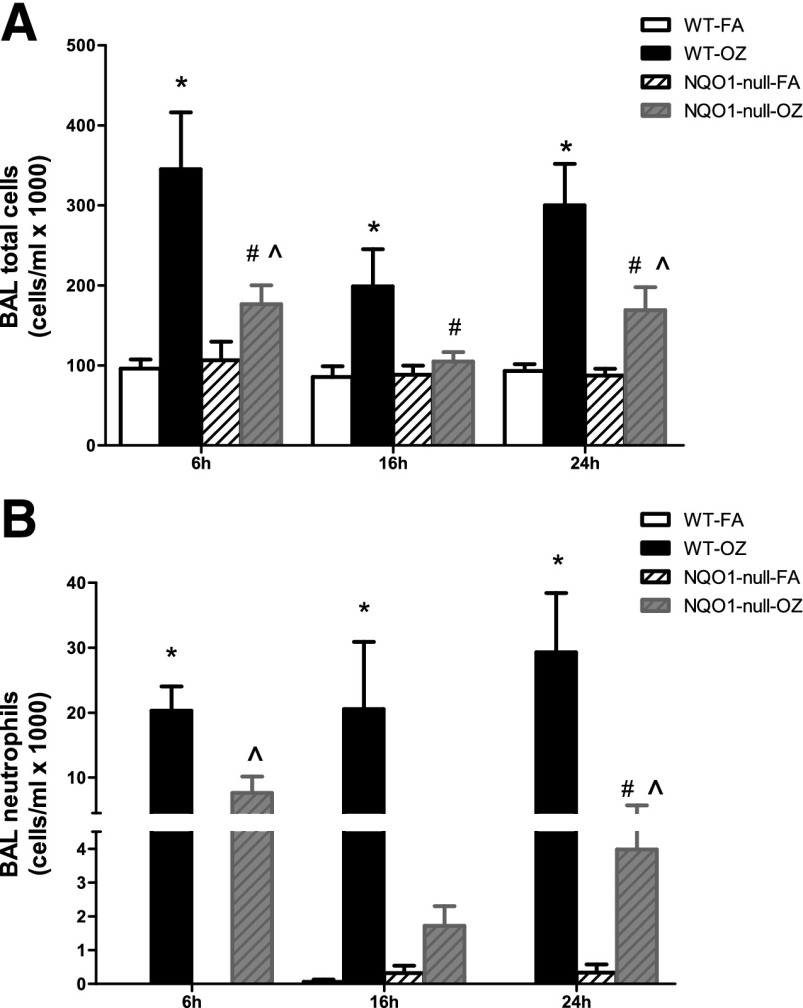
NQO1-null mice have lower total bronchoalveolar lavage (BAL) cell counts and lower neutrophil cell counts compared with WT mice after OZ exposure. NQO1-null mice and WT mice on the same genetic background were exposed to FA or OZ (1 ppm, 3 h). At 6, 16, or 24 hours after exposure, BAL was performed with sterile saline (1 ml). Total cell counts (A) and neutrophil counts (B) were determined and summarized as mean ± SEM (n = 7–10 animals/group). (A) WT OZ-exposed mice had significantly greater numbers of total cells than WT FA-exposed mice (*P < 0.005), and NQO1-null OZ-exposed mice had significantly greater total cells than NQO1-null FA-exposed mice at 6 and 24 hours (^P < 0.05). NQO1-null OZ-exposed mice had significantly fewer total cells compared with WT OZ-exposed mice (#P < 0.05). (B) WT OZ-exposed mice had significantly greater numbers of neutrophils compared with WT FA-exposed mice (*P < 0.01), and NQO1-null OZ-exposed mice had significantly greater number of neutrophils than NQO1-null FA-exposed mice at 6 and 24 hours (^P < 0.005). NQO1-null OZ-exposed mice had significantly fewer neutrophils than WT OZ-exposed mice at 24 hours (#P < 0.02). Significance was tested with Kruskal-Wallis ANOVA and post hoc analysis by Wilcoxon rank sum test.
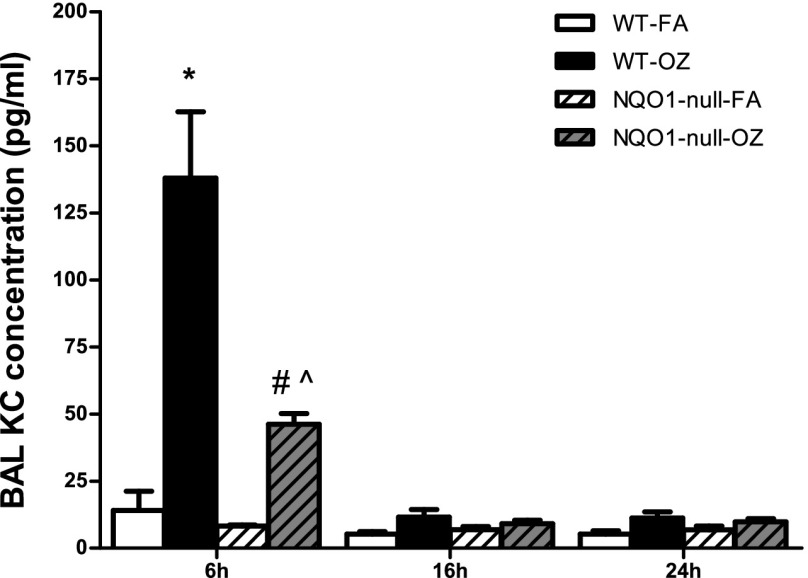
NQO1-null mice had decreased BAL keratinocyte chemoattractant (KC) levels after OZ exposure compared with WT mice. NQO1-null mice and WT mice on the same genetic background were exposed to OZ (1 ppm, 3 h) or FA and BAL (1 ml) was collected 6, 16, or 24 hours after exposure. Aliquots of BAL were used to quantitate KC by ELISA (R&D Systems, Minneapolis, MN) according to the manufacturer's instructions. Data are summarized as mean ± SEM (n = 7–10 animals/group). WT OZ-exposed mice had significantly greater BAL KC levels compared with WT-FA control mice (*P < 0.001). NQO1-null OZ-exposed mice had greater BAL KC levels than NQO1-null FA-exposed mice (^P < 0.001). NQO1-null OZ-exposed mice had lower levels of BAL KC compared with WT OZ-exposed mice (#P < 0.01).
Erratum for
-
NAD(P)H quinone oxidoreductase 1 is essential for ozone-induced oxidative stress in mice and humans.Am J Respir Cell Mol Biol. 2009 Jul;41(1):107-13. doi: 10.1165/rcmb.2008-0381OC. Epub 2008 Dec 4. Am J Respir Cell Mol Biol. 2009. PMID: 19059883 Free PMC article.
References
Publication types
LinkOut - more resources
Full Text Sources
Other Literature Sources
