. 2016 Dec 1;11(12):e0167339.
doi: 10.1371/journal.pone.0167339. eCollection 2016.

Dietary Probiotic Bacillus subtilis Strain fmbj Increases Antioxidant Capacity and Oxidative Stability of Chicken Breast Meat during Storage

Affiliations

Dietary Probiotic Bacillus subtilis Strain fmbj Increases Antioxidant Capacity and Oxidative Stability of Chicken Breast Meat during Storage

Wen Kai Bai et al. PLoS One. .

Abstract

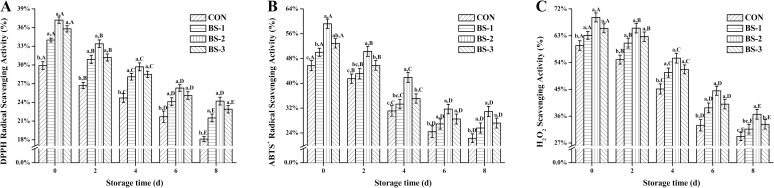
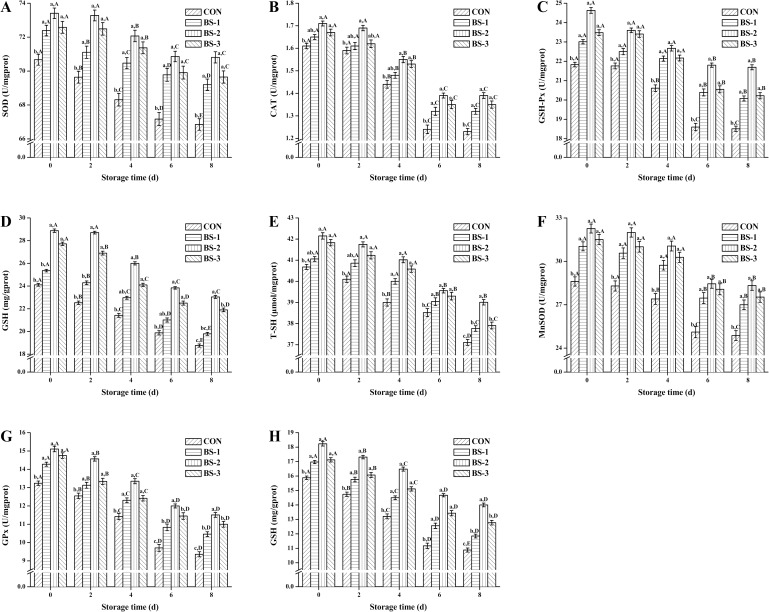
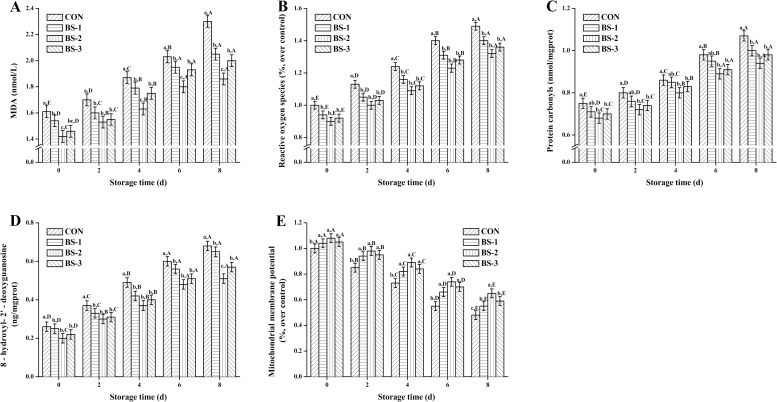
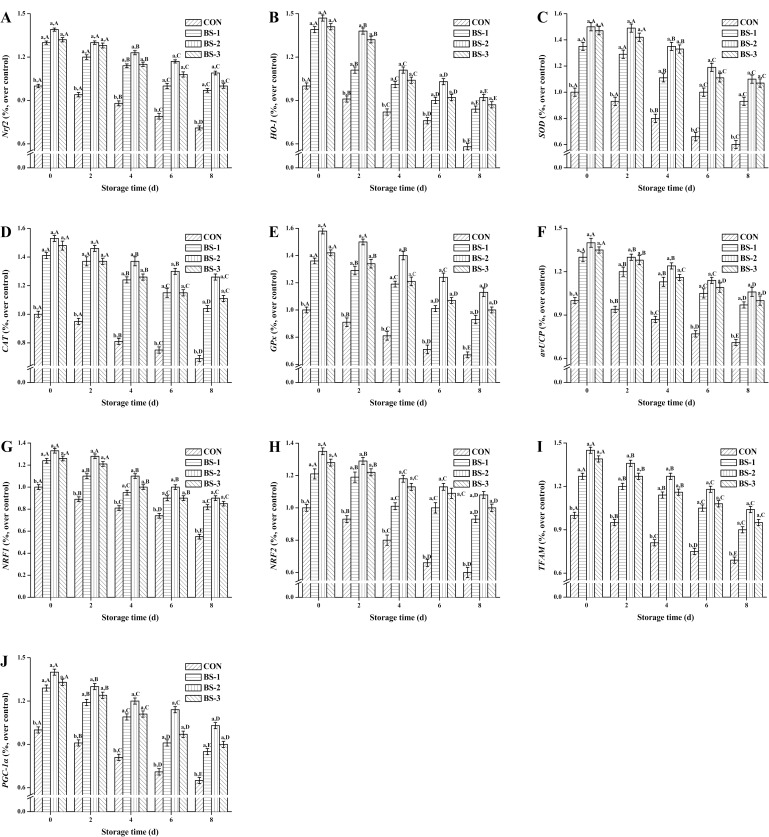
This study was aimed to measure the dietary effects of probiotic Bacillus subtilis strain fmbj (BS fmbj) on antioxidant capacity and oxidative stability of chicken breast meat during storage. Treatment groups were fed the basal diet with BS fmbj at 0 g/kg (CON), 0.2 g/kg (BS-1), 0.3 g/kg (BS-2), or 0.4 g/kg (BS-3) doses without antibiotics. During 8 days of storage at 4°C, BS-2 group showed a significant improvement (P < 0.05) on meat quality (pH, Drip loss, Cooking loss, Shear force, color L*, a*, b*), free radical scavenging activity (DPPH, ABTS+, H2O2), tissues antioxidant enzyme capacity (SOD, CAT, GSH-Px, GSH, T-SH), mitochondria antioxidant enzyme capacity (MnSOD, GPx, GSH), mRNA expression of antioxidant genes (Nrf2, HO-1, SOD, CAT, GSH-Px) and mitochondrial function genes (avUCP, NRF1, NRF2, TFAM, PGC-1α), oxidative damage index (MDA, ROS, PC, 8-OHdG), and MMP level in chicken breast meat as compared to the CON group. These results indicate that dietary BS fmbj in broiler diets can protect breast meat against the storage-induced oxidative stress by improving their free radical scavenging capacity and antioxidant activity during 8 days of storage at 4°C.


Conflict of interest statement

The authors have declared that no competing interests exist.

Figures
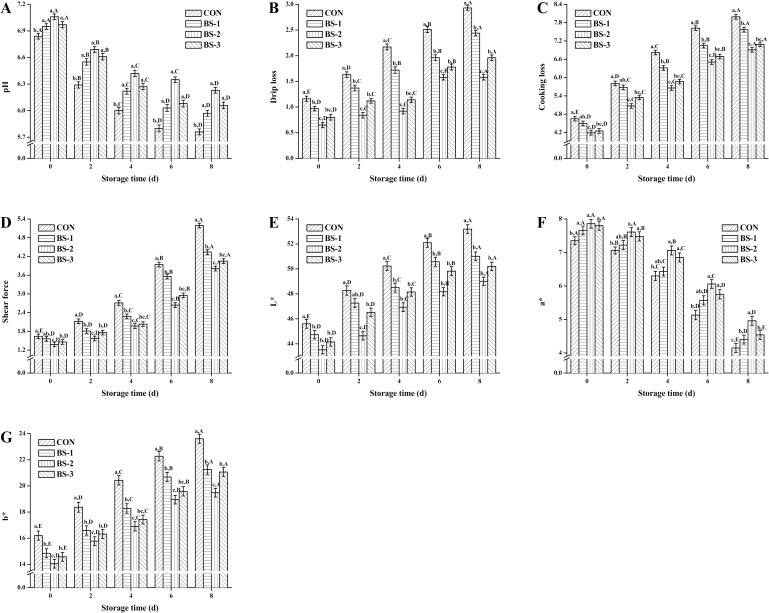
Fig 1
Fig 1
Dietary effects of probiotic Bacillus subtilis strain fmbj on pH (A), drip loss (B), cooking loss (C), shear force (D), L* (E), a* (F), and b* (G) value of chicken breast meat tissue during 8 days of storage at 4°C. Values are mean ± SEM (n = 6). Values on the same storage day with different letters (a—e) were significantly different (P < 0.05), and values in same group with different letters (A—E) were significantly different (P < 0.05). CON, birds fed the basal diet without BS fmbj and antibiotics; BS-1, birds fed the basal diet with 0.2 g/kg BS fmbj without antibiotics; BS-2, birds fed the basal diet with 0.3 g/kg BS fmbj without antibiotics; BS-3, birds fed the basal diet with 0.4 g/kg BS fmbj without antibiotics.
Fig 2
Fig 2
Dietary effects of probiotic Bacillus subtilis strain fmbj on DPPH (A), ABTS+ (B), and H2O2 (C) scavenging activity of chicken breast meat tissue during 8 days of storage at 4°C. Values are mean ± SEM (n = 6). Values on the same storage day with different letters (a—e) were significantly different (P < 0.05), and values in same group with different letters (A—E) were significantly different (P < 0.05). 1,1-diphenyl-2-pierylhydrazy (DPPH); 2,2'-Azinobis- (3-ethylbenzthiazoline -6-sulphonate) (ABTS+); Hydrogen peroxide (H2O2). CON, birds fed the basal diet without BS fmbj and antibiotics; BS-1, birds fed the basal diet with 0.2 g/kg BS fmbj without antibiotics; BS-2, birds fed the basal diet with 0.3 g/kg BS fmbj without antibiotics; BS-3, birds fed the basal diet with 0.4 g/kg BS fmbj without antibiotics.
Fig 3
Fig 3
Dietary effects of probiotic Bacillus subtilis strain fmbj on SOD (A), CAT (B), GSH-Px (C), GSH (D), T-SH (E) activity of chicken breast meat tissue, and on MnSOD (F), GPx (G), GSH (H) activity of chicken breast meat tissue mitochondria during 8 days of storage at 4°C. Values are mean ± SEM (n = 6). Values on the same storage day with different letters (a—e) were significantly different (P < 0.05), and values in same group with different letters (A—E) were significantly different (P < 0.05). Superoxide dismutase (SOD); Hydrogen peroxidase (CAT); Glutathione peroxidase (GSH-Px); Glutathione (GSH); Total mercapto (T-SH); Manganese Superoxide dismutase (MnSOD); Glutathione peroxidase (GPx). CON, birds fed the basal diet without BS fmbj and antibiotics; BS-1, birds fed the basal diet with 0.2 g/kg BS fmbj without antibiotics; BS-2, birds fed the basal diet with 0.3 g/kg BS fmbj without antibiotics; BS-3, birds fed the basal diet with 0.4 g/kg BS fmbj without antibiotics.
Fig 4
Fig 4
Dietary effects of probiotic Bacillus subtilis strain fmbj on MDA (A), ROS (B), PC (C), 8-OHdG (D), and MMP level (E) of chicken breast meat tissue mitochondria during 8 days of storage at 4°C. Values are mean ± SEM (n = 6). Values on the same storage day with different letters (a—e) were significantly different (P < 0.05), and values in same group with different letters (A—E) were significantly different (P < 0.05). Malondialdehyde (MDA); Reactive oxygen species (ROS); Protein carbonyls (PC); 8-hydroxy-2- deoxyguanosine (8-OHdG); Mitochondrial membrane potential (MMP). CON, birds fed the basal diet without BS fmbj and antibiotics; BS-1, birds fed the basal diet with 0.2 g/kg BS fmbj without antibiotics; BS-2, birds fed the basal diet with 0.3 g/kg BS fmbj without antibiotics; BS-3, birds fed the basal diet with 0.4 g/kg BS fmbj without antibiotics.
Fig 5
Fig 5
Dietary effects of probiotic Bacillus subtilis strain fmbj on mRNA expression of Nrf2 (A), HO-1 (B), SOD (C), CAT (D), GSH-Px (E). avUCP (F), NRF1 (G), NRF2 (H), TFAM (I), and PGC-1α (J) of chicken breast meat tissue during 8 days of storage at 4°C. Values are mean ± SEM (n = 6). Values on the same storage day with different letters (a—e) were significantly different (P < 0.05), and values in same group with different letters (A—E) were significantly different (P < 0.05). Nuclear factor erythroid 2-related factor 2 (Nrf2); Heme oxygenase 1 (HO-1); Superoxide dismutase (SOD); Hydrogen peroxidase (CAT); Glutathione peroxidase (Gpx); Avian uncoupling protein (avUCP); Nuclear respiratory factor 1 (NRF1); Nuclear respiratory factor 2 (NRF2); Mitochondrial transcription factor A (TFAM); peroxisome proliferator-activated receptor gamma coactivator 1α (PGC-1α). CON, birds fed the basal diet without BS fmbj and antibiotics; BS-1, birds fed the basal diet with 0.2 g/kg BS fmbj without antibiotics; BS-2, birds fed the basal diet with 0.3 g/kg BS fmbj without antibiotics; BS-3, birds fed the basal diet with 0.4 g/kg BS fmbj without antibiotics.

References

    1. Valko M, Leibfritz D, Moncol J, Cronin MTD, Mazur M, Telser J. Free radicals and antioxidants in normal physiological functions and human disease. International Journal of Biochemistry & Cell Biology. 2007, 39 (1), 44–84. - PubMed
    1. Seifried HE, Anderson DE, Fisher EI, Milner JA. A review of the interaction among dietary antioxidants and reactive oxygen species. Journal of Nutritional Biochemistry. 2007, 18 (9), 567–79. 10.1016/j.jnutbio.2006.10.007 - DOI - PubMed
    1. Subash A, Adoor Gopalan S, Veeraraghavan G, Ganapathy R, Vasanthi HR. In vitro antioxidant and in vivo anti-inflammatory potential of crude polysaccharide from Turbinaria ornata (Marine Brown Alga). Food & Chemical Toxicology. 2010, 48 (1), 187–192. - PubMed
    1. Takahashi M, Sakayori M, Takahashi S, Kato T, Kaji M, Kawahara M, et al. A novel germline mutation of the LKB1 gene in a patient with Peutz-Jeghers syndrome with early-onset gastric cancer. J. Gastroenterol. 2004, 39: 1210–1214. 10.1007/s00535-004-1474-y - DOI - PubMed
    1. Bai K, Qiang H, Zhang J, He J, Zhang L, Tian W. Supplemental effects of probiotic bacillus subtilis fmbj on growth performance, antioxidant capacity, and meat quality of broiler chickens. Poultry Science. 2016. - PubMed