Review
. 2016 Dec 1;8(12):a023754.
doi: 10.1101/cshperspect.a023754.

Genome-Editing Technologies: Principles and Applications

Affiliations
Review

Genome-Editing Technologies: Principles and Applications

Thomas Gaj et al. Cold Spring Harb Perspect Biol. .

Abstract

Targeted nucleases have provided researchers with the ability to manipulate virtually any genomic sequence, enabling the facile creation of isogenic cell lines and animal models for the study of human disease, and promoting exciting new possibilities for human gene therapy. Here we review three foundational technologies-clustered regularly interspaced short palindromic repeats (CRISPR)-CRISPR-associated protein 9 (Cas9), transcription activator-like effector nucleases (TALENs), and zinc-finger nucleases (ZFNs). We discuss the engineering advances that facilitated their development and highlight several achievements in genome engineering that were made possible by these tools. We also consider artificial transcription factors, illustrating how this technology can complement targeted nucleases for synthetic biology and gene therapy.


Figures

Figure 1.
Figure 1.
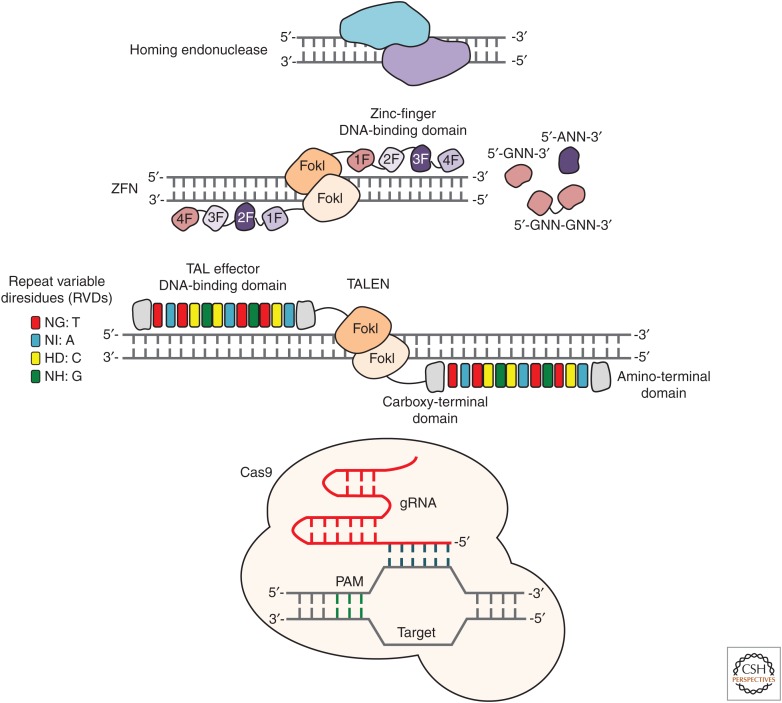
Genome-editing technologies. Cartoons illustrating the mechanisms of targeted nucleases. From top to bottom: homing endonucleases, zinc-finger nucleases (ZFNs), transcription activator-like effector (TALE) nucleases (TALENs), and clustered regularly interspaced short palindromic repeats (CRISPR)-CRISPR-associated protein 9 (Cas9). Homing endonucleases generally cleave their DNA substrates as dimers, and do not have distinct binding and cleavage domains. ZFNs recognize target sites that consist of two zinc-finger binding sites that flank a 5- to 7-base pair (bp) spacer sequence recognized by the FokI cleavage domain. TALENs recognize target sites that consist of two TALE DNA-binding sites that flank a 12- to 20-bp spacer sequence recognized by the FokI cleavage domain. The Cas9 nuclease is targeted to DNA sequences complementary to the targeting sequence within the single guide RNA (gRNA) located immediately upstream of a compatible protospacer adjacent motif (PAM). DNA and protein are not drawn to scale.
Figure 2.
Figure 2.
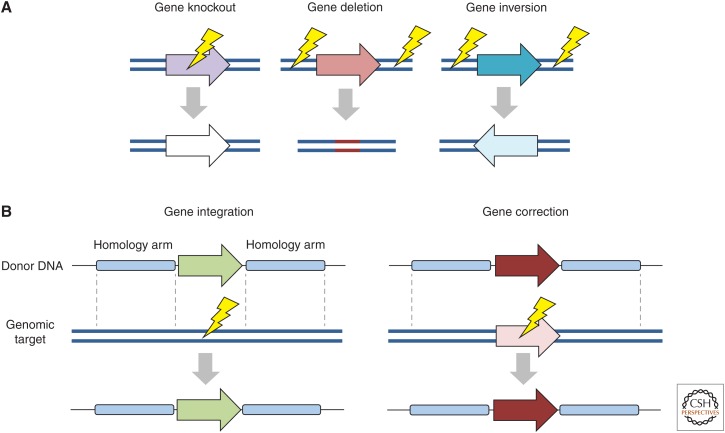
Genome-editing outcomes. Targeted nucleases induce DNA double-strand breaks (DSBs) that are repaired by nonhomologous end joining (NHEJ) or, in the presence of donor template, homology-directed repair (HDR). (A) In the absence of a donor template, NHEJ introduces small base insertions or deletions that can result in gene disruption. When two DSBs are induced simultaneously, the intervening genomic sequence can be deleted or inverted. (B) In the presence of donor DNA (plasmid or single-stranded oligonucleotide), recombination between homologous DNA sequences present on the donor template and a specific chromosomal site can facilitate targeted integration. Lightning bolts indicate DSBs.

References

    1. Akbari OS, Bellen HJ, Bier E, Bullock SL, Burt A, Church GM, Cook KR, Duchek P, Edwards OR, Esvelt KM, et al. 2015. Safeguarding gene drive experiments in the laboratory. Science 349: 927–929. - PMC - PubMed
    1. Akopian A, He J, Boocock MR, Stark WM. 2003. Chimeric recombinases with designed DNA sequence recognition. Proc Natl Acad Sci 100: 8688–8691. - PMC - PubMed
    1. Anders C, Niewoehner O, Duerst A, Jinek M. 2014. Structural basis of PAM-dependent target DNA recognition by the Cas9 endonuclease. Nature 513: 569–573. - PMC - PubMed
    1. Anguela XM, Sharma R, Doyon Y, Miller JC, Li H, Haurigot V, Rohde ME, Wong SY, Davidson RJ, Zhou S, et al. 2013. Robust ZFN-mediated genome editing in adult hemophilic mice. Blood 122: 3283–3287. - PMC - PubMed
    1. Bae KH, Kwon YD, Shin HC, Hwang MS, Ryu EH, Park KS, Yang HY, Lee DK, Lee Y, Park J, et al. 2003. Human zinc fingers as building blocks in the construction of artificial transcription factors. Nat Biotechnol 21: 275–280. - PubMed