Sustained Benefits of Exercise-based Motivational Interviewing, but Only among Nonusers of Opioids in Patients with Fibromyalgia
- PMID: 27909084
- PMCID: PMC5831251
- DOI: 10.3899/jrheum.161003
Sustained Benefits of Exercise-based Motivational Interviewing, but Only among Nonusers of Opioids in Patients with Fibromyalgia
Abstract
Objective: Given the known side effects of opioids and their potential effects on cognition, we sought to evaluate the benefits of motivational interviewing (MI) to promote physical activity on 2 subsets of participants with fibromyalgia (FM): nonusers and users of opioids.
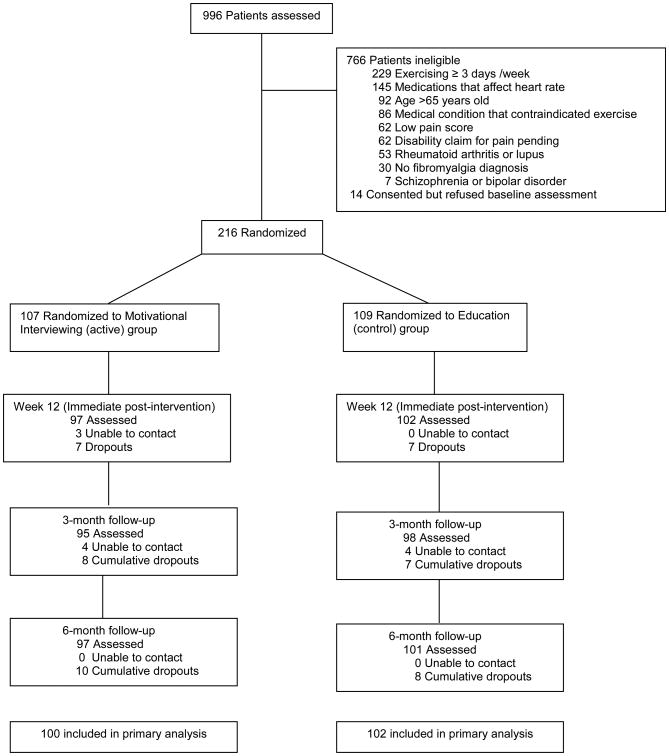
Methods: This was a secondary data analysis of a 36-week randomized controlled trial to assess the efficacy of MI to promote physical activity among participants with FM. Participants were randomized to 1 of 2 treatment arms: 6 phone-based MI sessions (n = 107) or 6 sessions of FM self-management instructions [attention control (AC), n = 109]. The primary outcomes were changes in physical function (Medical Outcomes Study Short Form-36), pain severity (Brief Pain Inventory), global FM symptom severity (Fibromyalgia Impact Questionnaire), and the amount of light to moderate physical activity (LMPA) from baseline to each followup visit. At study entry, subjects were categorized as opioid nonusers versus users. Repeated measures ANOVA was used to assess treatment effects adjusting for potential confounders.
Results: Of the 216 participants, 145 (67%) were nonusers and 71 (33%) were opioid users. Among nonusers, MI was associated with improved physical function, reduced pain severity, and global FM severity, and increased LMPA at 6-month followup. Among opioid users, there were no significant differences in any outcome measures between the MI and AC groups.
Conclusion: Exercise-based MI was associated with sustained clinical benefits 6 months after completion of therapy, but only for those who were not taking opioids.
Keywords: FIBROMYALGIA; MOTIVATIONAL INTERVIEWING; OPIOID RISK; TREATMENT MODERATOR.
Conflict of interest statement
There is no conflicts of interested indicated by the authors.
Figures
Comment in
-
Another Nasty Effect of Opioids: Attenuating the Benefits of Motivational Interviewing in Fibromyalgia?J Rheumatol. 2017 Apr;44(4):407-409. doi: 10.3899/jrheum.170076. J Rheumatol. 2017. PMID: 28604346 No abstract available.
References
-
- Skaer TL. Fibromyalgia: disease synopsis, medication cost effectiveness and economic burden. Pharmacoeconomics. 2014;32:457–66. - PubMed
-
- Bidonde J, Busch AJ, Bath B, Milosavljevic S. Exercise for adults with fibromyalgia: an umbrella systematic review with synthesis of best evidence. Curr Rheumatol Rev. 2014;10:45–79. - PubMed
-
- Segura-Jimenez V, Alvarez-Gallardo IC, Estevez-Lopez F, Soriano-Maldonado A, Delgado-Fernandez M, Ortega FB, et al. Differences in sedentary time and physical activity between female patients with fibromyalgia and healthy controls: the al-Andalus project. Arthritis Rheumatol. 2015;67:3047–57. - PubMed
-
- Dobkin PL, Da Costa D, Abrahamowicz M, Dritsa M, Du Berger R, Fitzcharles MA, et al. Adherence during an individualized home based 12-week exercise program in women with fibromyalgia. J Rheumatol. 2006;33:333–41. - PubMed
Publication types
MeSH terms
Substances
Grants and funding
LinkOut - more resources
Full Text Sources
Other Literature Sources
Medical