The Effect of High-Frequency Repetitive Transcranial Magnetic Stimulation on Occupational Stress among Health Care Workers: A Pilot Study
- PMID: 27909453
- PMCID: PMC5128350
- DOI: 10.4306/pi.2016.13.6.622
The Effect of High-Frequency Repetitive Transcranial Magnetic Stimulation on Occupational Stress among Health Care Workers: A Pilot Study
Abstract
Objective: Repetitive transcranial magnetic stimulation (rTMS) was approved by the Food and Drug Administration to alleviate symptoms of treatment-resistant depression. This study aimed to evaluate the effectiveness of rTMS treatment on alleviating occupational stress by evaluating clinical symptoms and quantitative electroencephalography (QEEG).
Methods: Twenty-four health care workers were randomized to receive 12 sessions of active or sham rTMS delivered to the left dorsolateral prefrontal cortex (DLPFC). Each session consisted of 32 trains of 10 Hz repetitive TMS delivered in 5-second trains at 110% of the estimated prefrontal cortex threshold. Before and after the intervention, the Korean version of the occupational stress inventory (K-OSI), Beck's depression inventory (BDI), and Beck's anxiety inventory (BAI) were administered and EEG was performed using a 21-channel digital EEG system.
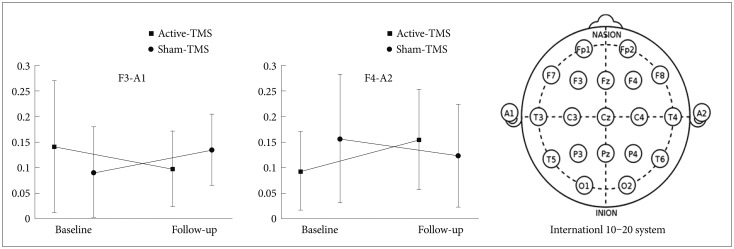
Results: After TMS, the average scores for the affective responses to stressors on the personal strain questionnaire (PSQ) subscale of K-OSI and BDI decreased significantly for the active-TMS group compared to the sham-TMS group. Also, the active-TMS group showed a significantly greater decrease in relative alpha in the F3 electrode and a significantly greater increase in the F4 electrode.
Conclusion: High-frequency rTMS on the left DLPFC had stress-relieving and mood-elevating effects in health care workers, likely by stimulating the left frontal lobe.
Keywords: Health care workers; Occupational stress; Quantitative electroencephalography; Repetitive transcranial magnetic stimulation.
Figures
References
-
- Kim HJ, June K, Shin G, Choo J. Associations between job stress and work-related musculoskeletal symptoms in street sanitation workers. J Korean Acad Community Health Nurs. 2013;24:314–322.
-
- Chang SJ, Koh S, Kang D, Kim S, Kang M, Lee C. Developing an occupational stress scale for Korean employees. Korean J Occup Environ Med. 2005;17:297–317.
-
- Kim Y. The Influence of a general hospital nurse's emotional labor, emotional intelligence on job stress. J Digit Convergence. 2014;12:245–253.
-
- Tomioka K, Morita N, Saeki K, Okamoto N, Kurumatani N. Working hours, occupational stress and depression among physicians. Occup Med (Lond) 2011;61:163–170. - PubMed
LinkOut - more resources
Full Text Sources
Other Literature Sources
Miscellaneous