


Nutritional quality of lunches consumed by Korean workers: Comparison between institutional and commercial lunches
- PMID: 27909558
- PMCID: PMC5126410
- DOI: 10.4162/nrp.2016.10.6.606
Nutritional quality of lunches consumed by Korean workers: Comparison between institutional and commercial lunches
Abstract
Background/objectives: The nutritional quality of lunches is an important factor related to workers' health. This study examined the nutritional quality of Korean workers' lunches with a focus on comparing institutional and commercial lunches.
Subjects/methods: The data from a 1-day, 24-hour dietary recall from the 5th Korea National Health and Nutrition Examination Survey (2010-2012) were analyzed. A total of 2,192 subjects aged 19 to 64 years, who had consumed lunches served by institutional or commercial food service vendors, were included for analysis. The nutritional quality of the lunches of the institutional lunch group (n=626) and the commercial lunch group (n=1,566) was compared in terms of the number of servings, food groups, nutrient intake, Nutrient Adequacy Ratio (NAR), and Mean Adequacy Ratio (MAR).
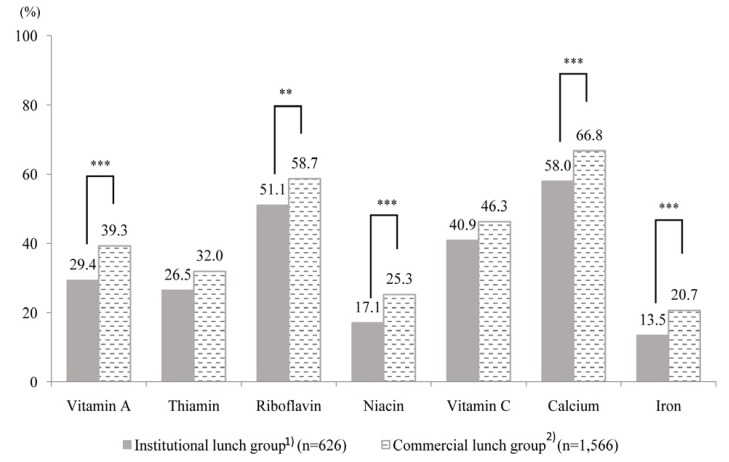
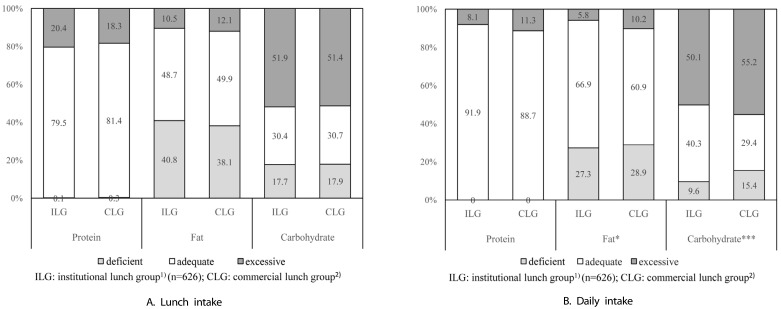
Results: The NAR and MAR were significantly higher in the institutional lunches than in the commercial lunches, but more than half of workers in both groups obtained over 65% of their energy from carbohydrate. The average sodium intake from the lunches exceeded the daily intake goal (2,000 mg) in both groups. More than half of workers in both groups presented less than one-third of their respective recommended daily intake of riboflavin and calcium. With the exception of riboflavin, the nutrient intake from lunches accounted for more than 35% of the daily nutrient intake.
Conclusions: The overall nutritional quality of institutional lunches was higher than that of commercial lunches. However, institutional lunches had room for improvement in terms of nutritional quality.
Keywords: Nutrition surveys; food services; lunch; workers; workplace.
Conflict of interest statement
The authors declare no potential conflicts of interests.
Figures
References
-
- Statistics Korea. Deaths and death rates by cause [Internet] Daejeon: Statistics Korea; 2015. [cited 2016 March 18]. Available from: http://kosis.kr/ups/ups_01List.jsp.
-
- Ministry of Health and Welfare, Korea Centers for Disease Control and Prevention. Korea Health Statistics 2014: Korea National Health and Nutrition Examination Survey (KNHANES VI-2) Sejong: Korea: Centers for Disease Control and Prevention; 2015.
-
- Statistics Korea. Annual report of employment: 2014 [Internet] Daejeon: Statistics Korea; 2015. [cited 2016 March 18]. Available from: http://kosis.kr/ups/ups_01List.jsp.
-
- Kim YS. The necessity and significance of reducing working hours [Internet] Seoul: Lavour and Society Institute; 2016. [cited 2016 April 16]. Available from: http://klsi.org/content/8436.
-
- Jang MR, Hong WS. Nutrition service need assessment for industrial employees. J Korean Diet Assoc. 2000;6:26–32.
LinkOut - more resources
Full Text Sources
Other Literature Sources
