


The ability of low-magnitude mechanical signals to normalize bone turnover in adolescents hospitalized for anorexia nervosa
- PMID: 27909781
- PMCID: PMC9769086
- DOI: 10.1007/s00198-016-3851-9
The ability of low-magnitude mechanical signals to normalize bone turnover in adolescents hospitalized for anorexia nervosa
Abstract
We sought to determine whether low-magnitude mechanical stimulation (LMMS) normalizes bone turnover among adolescents hospitalized for anorexia nervosa (AN). Brief, daily LMMS prevents the decline in bone turnover typically seen during bed rest in AN. LMMS may have application for patients with AN in the inpatient setting to protect bone health.
Introduction: Malnourished adolescents with AN requiring medical hospitalization are at high risk for rapid reduction in skeletal quality. Even short-term bed rest can suppress normal patterns of bone turnover. We sought to determine whether LMMS normalizes bone turnover among adolescents hospitalized for complications of AN.
Methods: In this randomized, double-blind trial, we prospectively enrolled adolescent females (n = 41) with AN, age 16.3 ± 1.9 years (mean ± SD) and BMI 15.6 ± 1.7 kg/m2. Participants were randomized to stand on a platform delivering LMMS (0.3 g at 32-37 Hz) or placebo platform for 10 min/day for 5 days. Serum markers of bone formation [bone-specific alkaline phosphatase (BSAP)], turnover [osteocalcin (OC)], and bone resorption [serum C-telopeptides (CTx)] were measured. From a random coefficients model, we constructed estimates and confidence intervals for all outcomes.
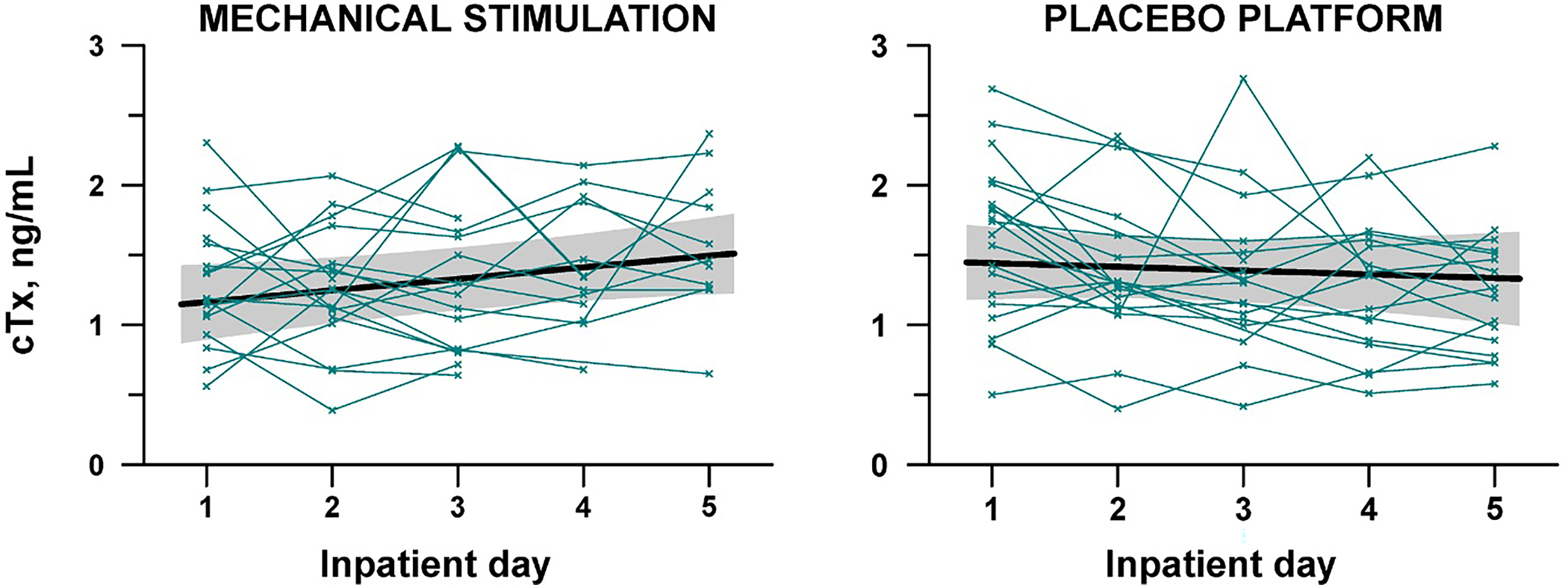
Results: BSAP decreased by 2.8% per day in the placebo arm (p = 0.03) but remained stable in the LMMS group (p = 0.51, pdiff = 0.04). CTx did not change with placebo (p = 0.56) but increased in the LMMS arm (+6.2% per day, p = 0.04; pdiff = 0.01). Serum OC did not change in either group (p > 0.70).
Conclusions: Bed rest during hospitalization for patients with AN is associated with a suppression of bone turnover, which may contribute to diminished bone quality. Brief, daily LMMS prevents a decline in bone turnover during bed rest in AN. Protocols prescribing strict bed rest may not be appropriate for protecting bone health for these patients. LMMS may have application for these patients in the inpatient setting.
Keywords: Anorexia nervosa; Bed rest; Bone formation; Bone resorption; Bone turnover; Mechanical stimulation; Metabolic disorders; Osteoporosis.
Conflict of interest statement
Dr. DiVasta wrote the first draft of the manuscript. No author was given any honorarium, grant, or other form of payment to produce the manuscript. Each author listed on the manuscript has seen and approved the submission of this version of the manuscript and takes full responsibility for the manuscript.
Figures


References
-
- Eastell R Pathogenesis of postmenopausal osteoporosis. In: Favus MJ, ed. Primer on the Metabolic Bone Diseases and Disorders of Mineral Metabolism. Fifth Ed. Washington, D.C.: American Society for Bone and Mineral Research; 2003:314–316.
-
- Forman SF, McKenzie N, Hehn R, et al. Predictors of outcome at 1 year in adolescents with DSM-5 restrictive eating disorders: report of the national eating disorders quality improvement collaborative. J. Adolesc. Health 2014;55(6):750–6. - PubMed
-
- Gordon CM. Effects of Oral Dehydroepiandrosterone on Bone Density in Young Women with Anorexia Nervosa: A Randomized Trial. J. Clin. Endocrinol. Metab. 2002;87(11):4935–4941. - PubMed
-
- Golden NH. Eating disorders in adolescence: what is the role of hormone replacement therapy? Curr. Opin. Obstet. Gynecol. 2007;19(5):434–439. - PubMed
-
- Bachrach LK, Guido D, Katzman D, Litt IF, Marcus R. Decreased bone density in adolescent girls with anorexia nervosa. Pediatrics 1990;86(3):440–447. - PubMed
Publication types
MeSH terms
Substances
Grants and funding
LinkOut - more resources
Full Text Sources
Other Literature Sources
Medical
