Review
. 2017 Apr;22(2-3):289-305.
doi: 10.1007/s00775-016-1420-5. Epub 2016 Dec 1.

High-valent copper in biomimetic and biological oxidations

Affiliations
Review

High-valent copper in biomimetic and biological oxidations

William Keown et al. J Biol Inorg Chem. 2017 Apr.

Abstract

A long-standing debate in the Cu-O2 field has revolved around the relevance of the Cu(III) oxidation state in biological redox processes. The proposal of Cu(III) in biology is generally challenged as no spectroscopic or structural evidence exists currently for its presence. The reaction of synthetic Cu(I) complexes with O2 at low temperature in aprotic solvents provides the opportunity to investigate and define the chemical landscape of Cu-O2 species at a small-molecule level of detail; eight different types are characterized structurally, three of which contain at least one Cu(III) center. Simple imidazole or histamine ligands are competent in these oxygenation reactions to form Cu(III) complexes. The combination of synthetic structural and reactivity data suggests (1) that Cu(I) should be considered as either a one or two electron reductant reacting with O2, (2) that Cu(III) reduction potentials of these formed complexes are modest and well within the limits of a protein matrix and (3) that primary amine and imidazole ligands are surprisingly good at stabilizing Cu(III) centers. These Cu(III) complexes are efficient oxidants for hydroxylating phenolate substrates with reaction hallmarks similar to that performed in biological systems. The remarkable ligation similarity of the synthetic and biological systems makes it difficult to continue to exclude Cu(III) from biological discussions.

Keywords: Biomimetic; Copper(III); Dioxygen activation; Tyrosinase.


Figures
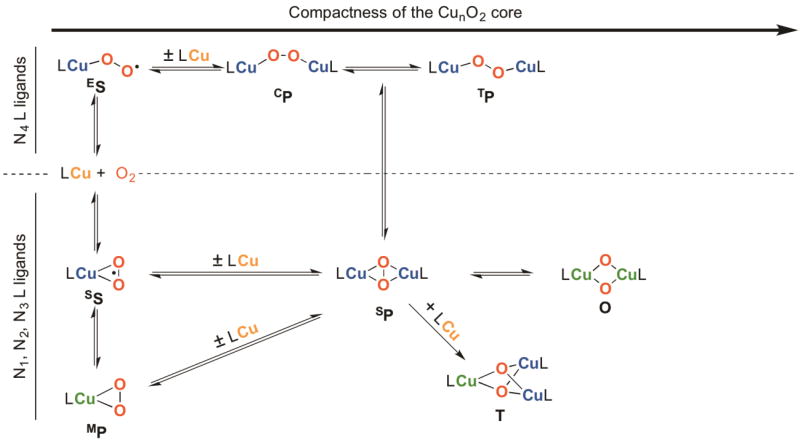
Fig. 1
Fig. 1
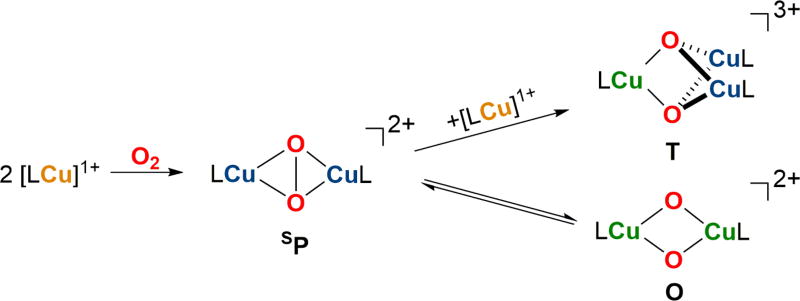
Formation of the eight structurally characterized Cu-O2 species generated in the reaction of Cu(I) and O2 with mono-, bi-, tri-, and tetradentate ligation (modified from Mirica et al.) [18].
Fig. 2
Fig. 2
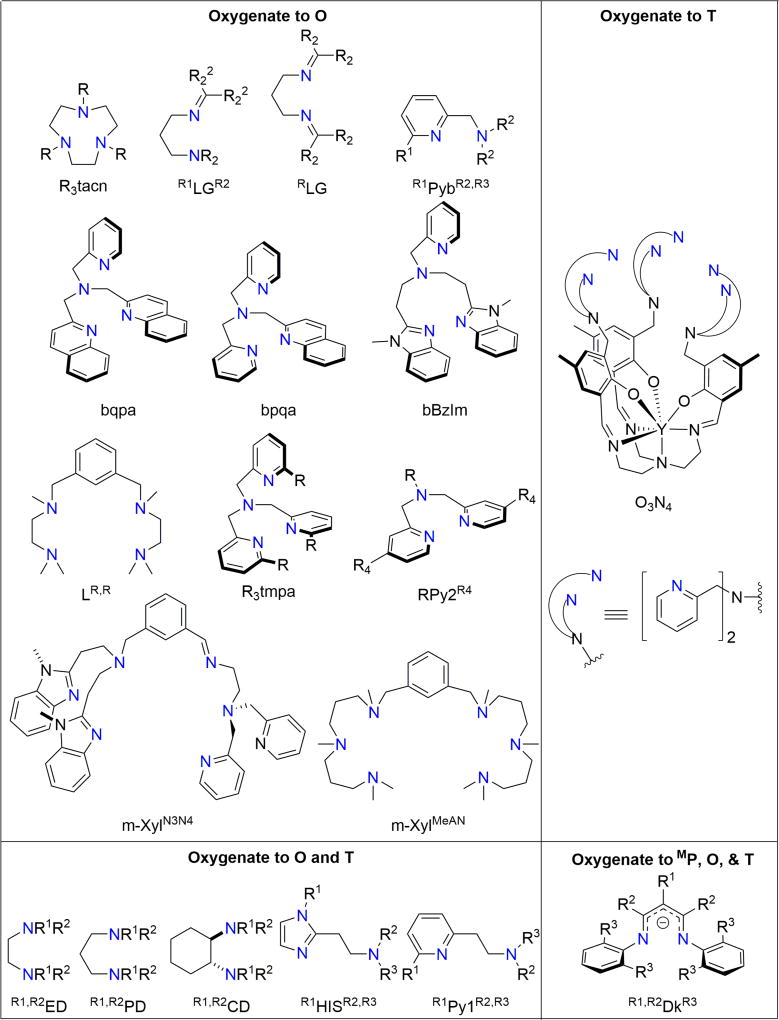
Top left: Ligands that stabilize Cu(I) for reaction with O2 to produce Cu(III)-containing O species exclusively. Top right: Ligands that oxygenate to T species exclusively. Bottom left: Sufficiently compact ligands allow formation of both O and T species, dependent on their substituents and reaction conditions. Bottom right: β-diketiminate ligands that produce all three Cu(III)-containing species (MP, O, and T).
Fig. 3
Fig. 3
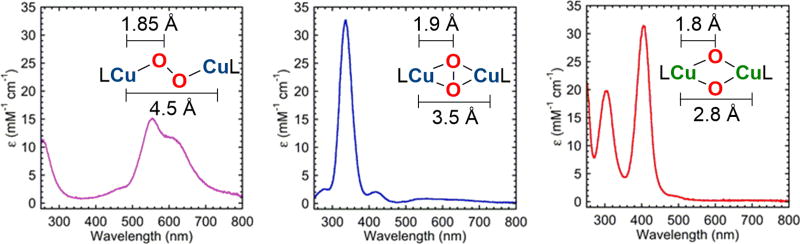
Optical spectra of a bis-Cu(II) TP (left), bis-Cu(II) SP (middle), and a bis-Cu(III) O species (right).
Fig. 4
Fig. 4
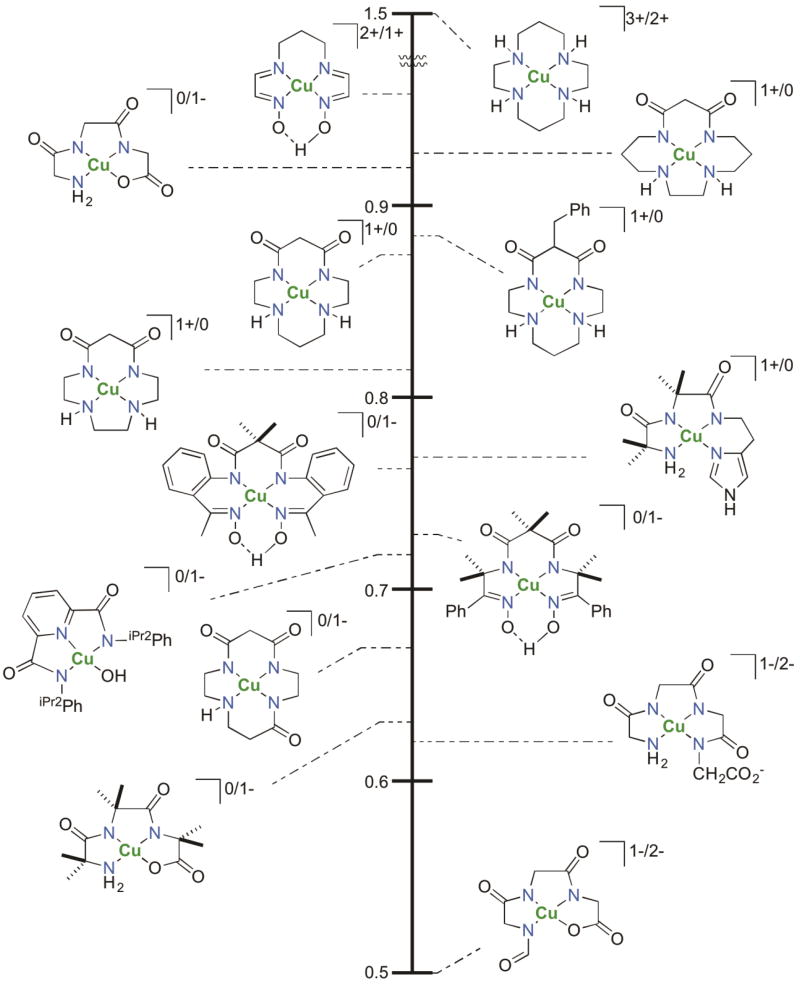
Comparison of Cu(III/II) potentials for Cu(III) complexes with varied donor strength and overall complex charge. Adapted from Hanss et al. [55].
Fig. 5
Fig. 5
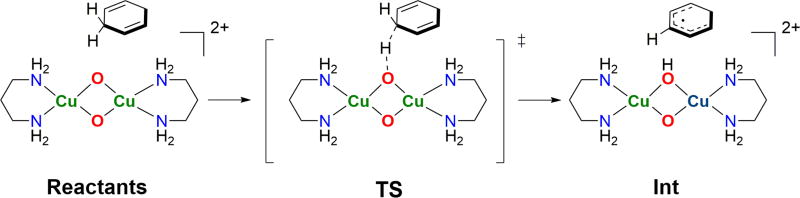
The lowest energy DFT calculated pathway for C-H bond activation from cyclohexanediene (CHD) along the O-O vector of OPD [21].
Fig. 6
Fig. 6
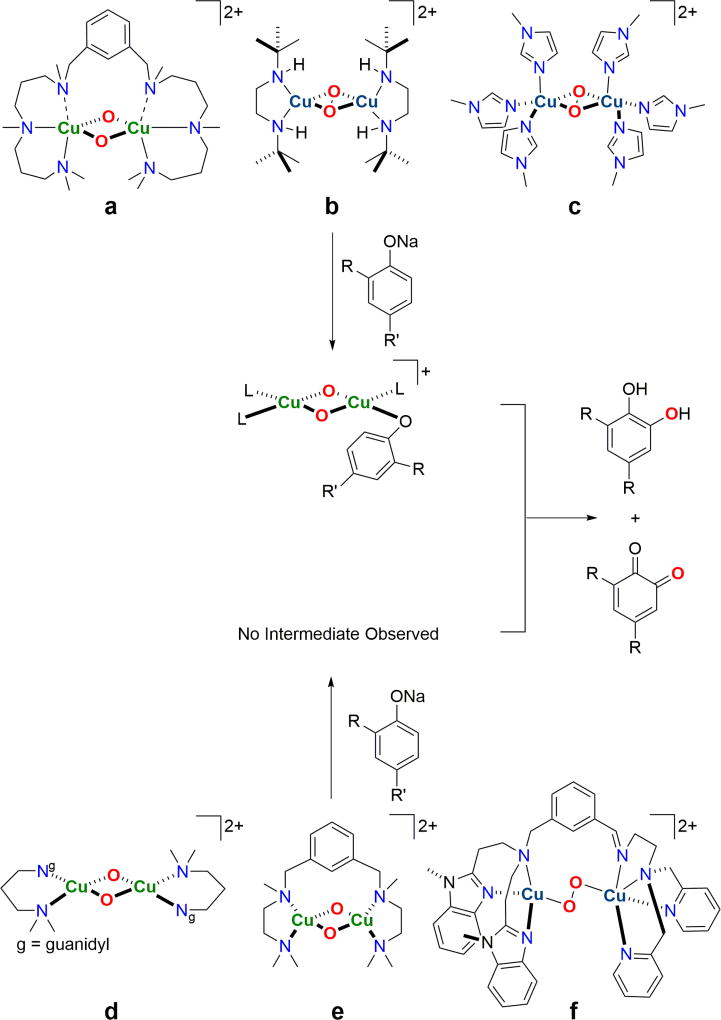
Cu-O2 complexes known to perform ortho-hydroxylation of exogenous phenolates through a O active oxidant. Reactions with complexes a, b, and c proceed through an observed, phenolate-bonded Cu(III) intermediate [18,39,40]. Complexes d, e, and f are proposed to react in a similar fashion, although no Cu(III) intermediates are detected spectroscopically [25,28,38,91].
Fig. 7
Fig. 7
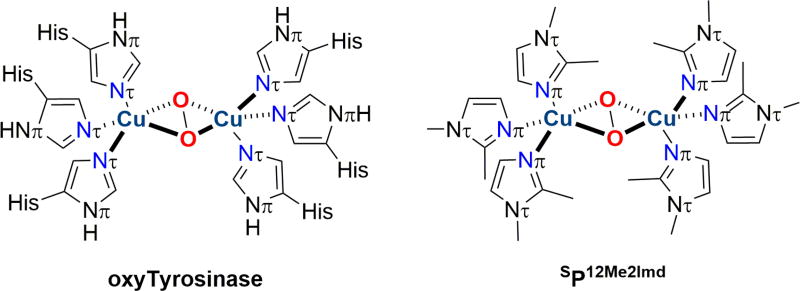
Left: The oxygenated form of Ty and Hc displaying exclusive Nτ imidazole ligation to the Cu centers [88,92]. Right: The SP species formed from oxygenation of Cu(I) and 1,2-dimethylimidazole showing exclusively Nπ imidazole ligation [37].
Fig. 8
Fig. 8
Proposed formation mechanism of the trinuclear cluster given observed formation kinetics [23].
Fig. 9
Fig. 9
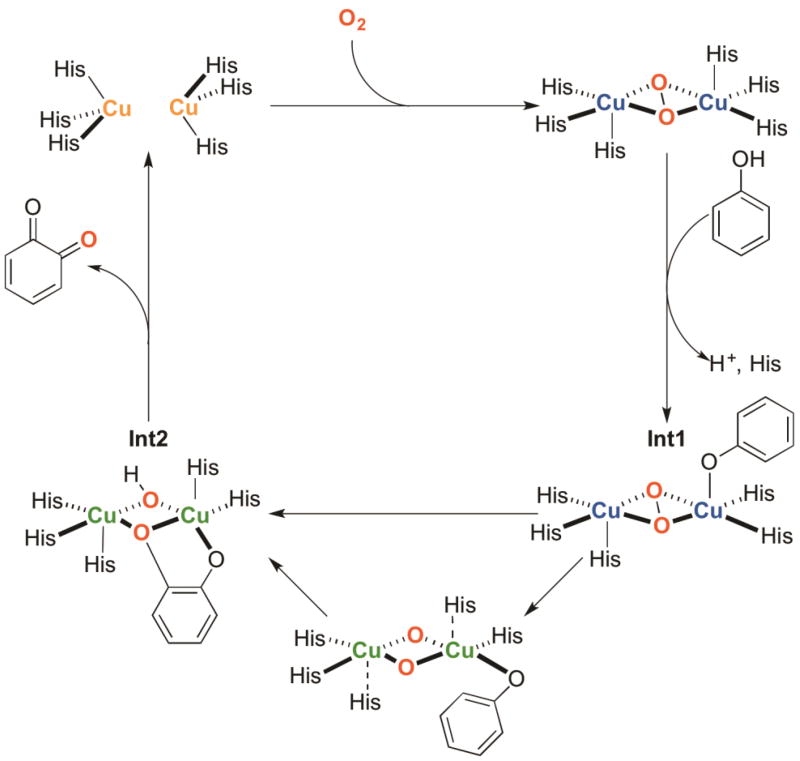
Two potential phenol hydroxylation mechanisms by Ty. Oxygenation to a SP species, followed by phenolate ligation with imidazole dissociation creates Int1. The generally accepted biological mechanism involves a rate limiting concerted C-O bond formation with C-H bond cleavage to Int2. Alternatively, phenolate rearrangement could trigger O-O bond cleavage, followed by a rate limiting C-H insertion to Int2.

References

    1. Mason HS, Fowlks WL, Peterson E. J Am Chem Soc. 1955;77:2914–2915.
    1. Mirica LM, Ottenwaelder X, Stack TDP. Chem Rev. 2004;104:1013–1045. - PubMed
    1. Lewis EA, Tolman WB. Chem Rev. 2004;104:1047–1076. - PubMed
    1. Solomon EI, Heppner DE, Johnston EM, Ginsbach JW, Cirera J, Qayyum M, Kieber-Emmons MT, Kjaergaard CH, Hadt RG, Tian L. Chem Rev. 2014;114:3659–3853. - PMC - PubMed
    1. Hoffmann A, Citek C, Binder S, Goos A, Rübhausen M, Troeppner O, Ivanović-Burmazović I, Wasinger EC, Stack TDP, Herres-Pawlis S. Angew Chem Int Ed. 2013;52:5398–5401. - PMC - PubMed

Publication types

LinkOut - more resources