


The Disinfection Characteristics of Ebola Virus Outbreak Variants
- PMID: 27910909
- PMCID: PMC5133602
- DOI: 10.1038/srep38293
The Disinfection Characteristics of Ebola Virus Outbreak Variants
Abstract
The recent Ebola virus outbreak in West Africa has forced experts to re-evaluate their understanding of how to best disinfect areas contaminated with infectious bodily fluids. Recent research has found that Ebola virus remains viable in blood for 7-10 days making appropriate disinfection crucial to infection control. We sought to determine if the three most important outbreak variants of Zaire ebolavirus (Mayinga, Kikwit and Makona) exhibit separate phenotypes when challenged with a range of sodium hypochlorite (NaOCl) concentrations or 70% ethanol (EtOH) at average West African temperature. The time dependent killing of Ebola virus was evaluated by measuring infectious virus and viral RNA (vRNA), to determine if RNA detection is a viable method for decontamination measurement in areas without high containment laboratory access. Makona was less susceptible to weaker concentrations of NaOCl (0.05 and 0.1%) than Mayinga and Kikwit. At the recommended concentration of NaOCl (≥0.5%) all of the variants were inert after 5 minutes of contact time. Similarly, all variants were inactivated by 70% EtOH after 2.5 minutes, only Makona was detected at 1 minute. In multiple instances, high amounts of vRNA was detected in the absence of infectious virus, suggesting that it does not serve as an accurate measure of remaining infectivity after cleansing.
Figures
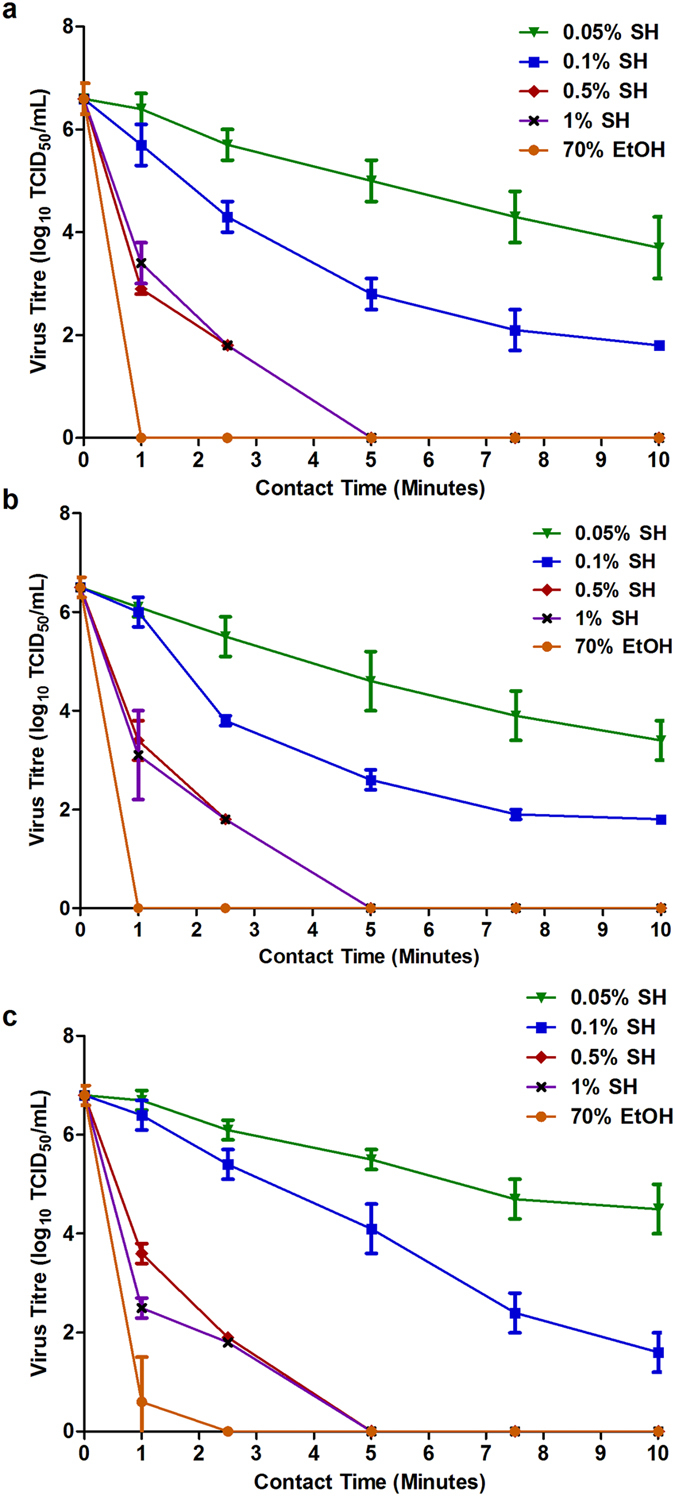
 ), 0.1% (
 ), 0.5% (
 ) and 1% (x) and 70% ethanol (EtOH) (
 ) over time. This amalgamated data is from each disinfectant experiment with virus titres from three independent experiments each with three technical replicates is presented.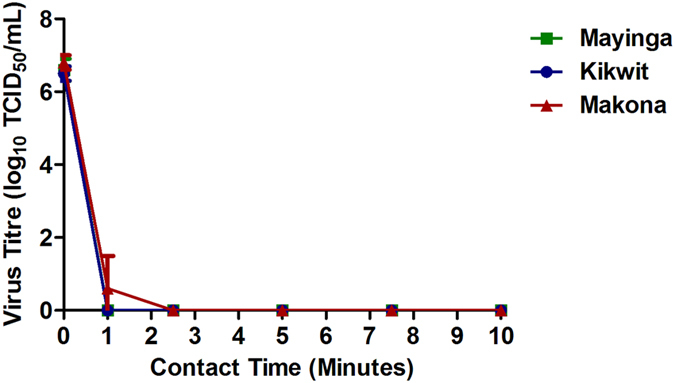
 ), Kikwit (
 ) and Makona (
 ) on stainless steel were determined by recovery of infectious particles from the carriers and subsequent quantification using the TCID50 assay performed in quintuplicate for each dilution. Virus titres from three independent experiments each with three technical replicates are presented. For statistical analysis, Makona was compared to Mayinga (green) or Kikwit (blue) at the respective time point.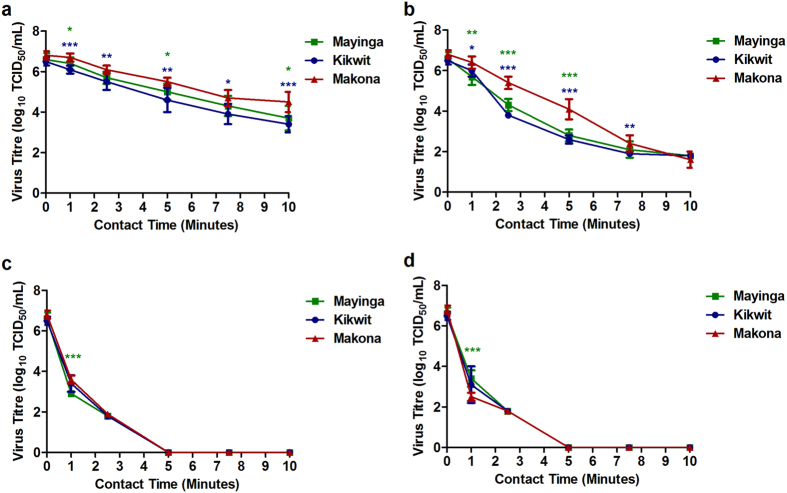
 ) was compared to Mayinga (
 ), Kikwit (
 ) at the respective time point, *p < 0.05, **p < 0.01, ***p < 0.001.
References
-
- (CDC), Centers for Disease Control and Prevention. Outbreaks chronology: Ebola virus disease. 1 (2016). at http://www.cdc.gov/vhf/ebola/outbreaks/history/chronology.html.
-
- (WHO) World Health Organization. Clinical management of patients with viral haemorrhagic fever: a pocket guide for front-line health workers. 1 (2016). at http://www.who.int/csr/resources/publications/clinical-management-patien....
-
- Uyeki T. M. et al.. Ebola Virus Persistence in Semen of Male Survivors. Clin. Infect. Dis. 62, 1552–5 (2016). - PubMed
Publication types
MeSH terms
Substances
Grants and funding
LinkOut - more resources
Full Text Sources
Other Literature Sources
Medical
