


Screening for Mild Cognitive Impairment and Dementia with Automated, Anonymous Online and Telephone Cognitive Self-Tests
- PMID: 27911296
- PMCID: PMC5389042
- DOI: 10.3233/JAD-160566
Screening for Mild Cognitive Impairment and Dementia with Automated, Anonymous Online and Telephone Cognitive Self-Tests
Abstract
Background: Many older people worry about cognitive decline. Early cognitive screening in an anonymous and easily accessible manner may reassure older people who are unnecessarily worried about normal cognitive aging while it may also expedite help seeking in case of suspicious cognitive decline.
Objective: To develop and validate online and telephone-based automated self-tests of cognitive function.
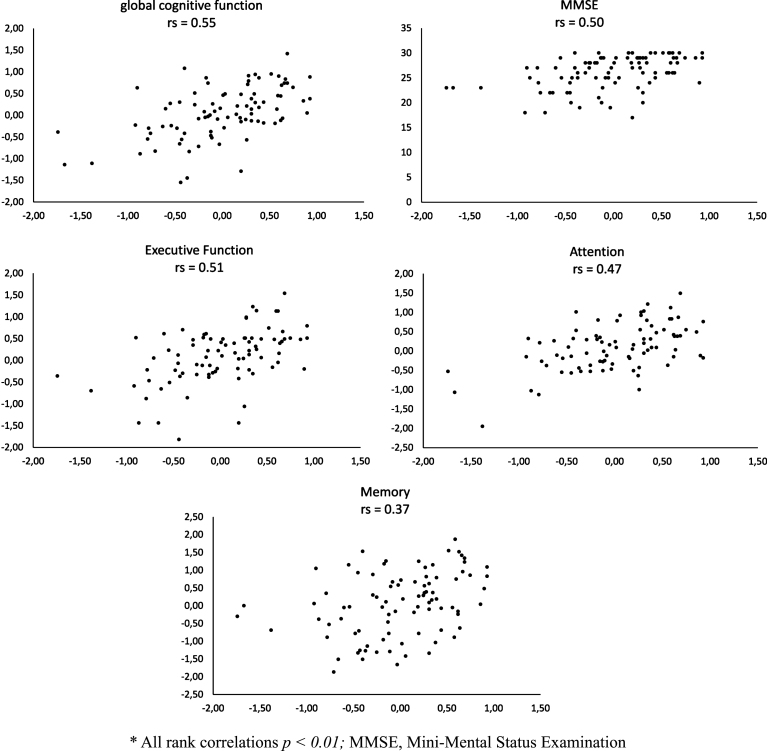
Methods: We examined the feasibility and validity of the self-tests in a prospective study of 117 participants of whom 34 had subjective cognitive decline (SCD), 30 had mild cognitive impairment (MCI), and 53 had dementia. The ability of these self-tests to accurately distinguish MCI and dementia from SCD was examined with ROC curves. Convergent validity was examined by calculating rank correlations between the self-tests and neuropsychological tests.
Results: Both the online and telephone cognitive self-tests were feasible, because the majority of participants (86% and 80%, respectively) were able to complete them. The online self-test had adequate diagnostic accuracy in the screening for MCI and dementia versus SCD with an Area under the Curve (AUC) of 0.86 (95% CI: 0.78-0.93). The AUC of the MMSE was 0.82 (95% CI: 0.74-0.89). By contrast, the telephone self-test had lower diagnostic accuracy (AUC = 0.75, 95% CI: 0.64-0.86). Both self-tests had good convergent validity as demonstrated by moderate to strong rank correlations with neuropsychological tests.
Conclusion: We demonstrated good diagnostic accuracy and convergent validity for the online self-test of cognitive function. It is therefore a promising tool in the screening for MCI and dementia.
Keywords: Alzheimer’s disease; cognitive screening; online and telephone cognitive self-test; sensitivity; specificity.
Figures


References
-
- Alzheimer’s Disease International (2015) World Alzheimer report. http://www.alz.co.uk/research/WorldAlzheimerReport2015.pdf, updated 2015. Accessed December 3, 2015.
-
- National Institute for Health and Clinical Excellence (2006) Dementia: Supporting people with dementia and their carers in health and social care. CG42 Dementia: NICE guideline.
-
- Espinosa A, Alegret M, Valero S, Vinyes-Junqué G, Hernández I, Mauleón A, Rosende-Roca M, Ruiz A, López O, Tárraga L, Boada M (2013) A longitudinal follow-up of 550 mild cognitive impairment patients: Evidence for large conversion to dementia rates and detection of major risk factors involved. J Alzheimers Dis 34, 769–780. - PubMed
-
- Commissaris CJ, Ponds RW, Jolles J (1998) Subjective forgetfulness in a normal Dutch population: Possibilities for health education and other interventions. Patient Educ Couns 34, 25–32. - PubMed
-
- van den Dungen P, van Marwijk HW, van der Horst HE, Moll van Charante EP, Macneil Vroomen J, van de Ven PM, van Hout HPJ (2012) The accuracy of family physicians’ dementia diagnoses at different stages of dementia: A systematic review. Int J Geriatr Psychiatry 27, 342–354. - PubMed
Publication types
MeSH terms
LinkOut - more resources
Full Text Sources
Other Literature Sources
Medical
