


The Lateral Habenula Circuitry: Reward Processing and Cognitive Control
- PMID: 27911751
- PMCID: PMC5125215
- DOI: 10.1523/JNEUROSCI.2350-16.2016
The Lateral Habenula Circuitry: Reward Processing and Cognitive Control
Abstract
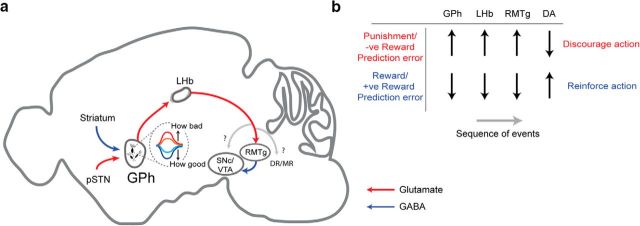
There has been a growing interest in understanding the role of the lateral habenula (LHb) in reward processing, affect regulation, and goal-directed behaviors. The LHb gets major inputs from the habenula-projecting globus pallidus and the mPFC, sending its efferents to the dopaminergic VTA and SNc, serotonergic dorsal raphe nuclei, and the GABAergic rostromedial tegmental nucleus. Recent studies have made advances in our understanding of the LHb circuit organization, yet the precise mechanisms of its involvement in complex behaviors are largely unknown. To begin to address this unresolved question, we present here emerging cross-species perspectives with a goal to provide a more refined understanding of the role of the LHb circuits in reward and cognition. We begin by highlighting recent findings from rodent experiments using optogenetics, electrophysiology, molecular, pharmacology, and tracing techniques that reveal diverse neural phenotypes in the LHb circuits that may underlie previously undescribed behavioral functions. We then discuss results from electrophysiological studies in macaques that suggest that the LHb cooperates with the anterior cingulate cortex to monitor action outcomes and signal behavioral adjustment. Finally, we provide an integrated summary of cross-species findings and discuss how further research on the connectivity, neural signaling, and physiology of the LHb circuits can deepen our understanding of the role of the LHb in normal and maladaptive behaviors associated with mental illnesses and drug abuse.
Keywords: anterior cingulate cortex; cognition; globus pallidus; lateral habenula; punishment; reward; rostromedial tegmental nucleus.
Copyright © 2016 the authors 0270-6474/16/3611482-07$15.00/0.
Figures
References
-
- Baker PM, Raynor SA, Francis NT, Mizumori SJ. Lateral habenula integration of proactive and retroactive information mediates behavioral flexibility. Neuroscience. 2016 doi: 10.1016/j.neuroscience.2016.02.010. doi: 10.1016/j.neuroscience.2016.02.010. Advance online publication. Retrieved Feb. 10, 2016. - DOI - PubMed
-
- Balcita-Pedicino JJ, Omelchenko N, Bell R, Sesack SR. The inhibitory influence of the lateral habenula on midbrain dopamine cells: ultrastructural evidence for indirect mediation via the rostromedial mesopontine tegmental nucleus. J Comp Neurol. 2011;519:1143–1164. doi: 10.1002/cne.22561. - DOI - PMC - PubMed
Publication types
MeSH terms
Grants and funding
LinkOut - more resources
Full Text Sources
Other Literature Sources
