


Frontosubthalamic Circuits for Control of Action and Cognition
- PMID: 27911752
- PMCID: PMC5125216
- DOI: 10.1523/JNEUROSCI.2348-16.2016
Frontosubthalamic Circuits for Control of Action and Cognition
Abstract
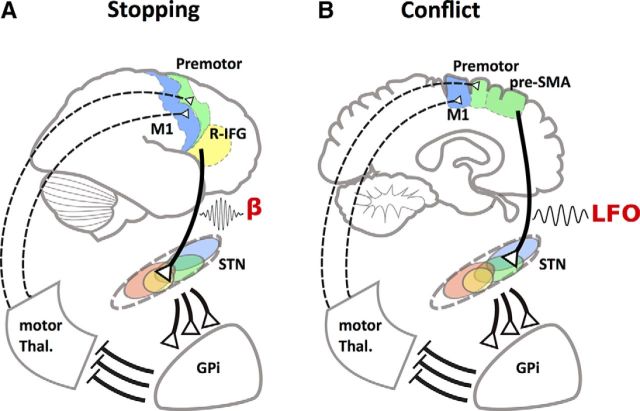
The subthalamic nucleus (STN) of the basal ganglia appears to have a potent role in action and cognition. Anatomical and imaging studies show that different frontal cortical areas directly project to the STN via so-called hyperdirect pathways. This review reports some of the latest findings about such circuits, including simultaneous recordings from cortex and the STN in humans, single-unit recordings in humans, high-resolution fMRI, and neurocomputational modeling. We argue that a major function of the STN is to broadly pause behavior and cognition when stop signals, conflict signals, or surprise signals occur, and that the fronto-STN circuits for doing this, at least for stopping and conflict, are dissociable anatomically and in terms of their spectral reactivity. We also highlight recent evidence for synchronization of oscillations between prefrontal cortex and the STN, which may provide a preferential "window in time" for single neuron communication via long-range connections.
Keywords: basal ganglia; conflict; oscillations; response inhibition; stopping; surprise.
Copyright © 2016 the authors 0270-6474/16/3611489-07$15.00/0.
Figures
References
-
- Alegre M, Lopez-Azcarate J, Obeso I, Wilkinson L, Rodriguez-Oroz MC, Valencia M, Garcia-Garcia D, Guridi J, Artieda J, Jahanshahi M, Obeso JA. The subthalamic nucleus is involved in successful inhibition in the stop-signal task: a local field potential study in Parkinson's disease. Exp Neurol. 2012;239:1–12. - PubMed
Publication types
MeSH terms
Grants and funding
LinkOut - more resources
Full Text Sources
Other Literature Sources
