Review
. 2016 Dec 2;2016(1):226-231.
doi: 10.1182/asheducation-2016.1.226.

Cold agglutinin disease

Affiliations
Review

Cold agglutinin disease

Sigbjørn Berentsen. Hematology Am Soc Hematol Educ Program. .

Abstract

Primary chronic cold agglutinin disease (CAD) is a well-defined clinicopathologic entity in which a specific, clonal lymphoproliferative B-cell bone marrow disorder results in autoimmune hemolytic anemia. The immune hemolysis is entirely complement-dependent, predominantly mediated by activation of the classical pathway and phagocytosis of erythrocytes opsonized with complement protein C3b. Typical clinical features in CAD have diagnostic and therapeutic implications. Pharmacologic treatment should be offered to patients with symptom-producing anemia or disabling circulatory symptoms. CAD should not be treated with corticosteroids. Based on an individualized approach, rituximab monotherapy or rituximab-fludarabine in combination is recommended as first-line therapy. Rituximab-bendamustine is still an investigational therapy. Although complement-modulating agents are still to be considered experimental in CAD, therapy with the anti-C1s monoclonal antibody TNT009 seems promising.


Conflict of interest statement

Conflict-of-interest disclosure: The author has received research funding from Mundipharma and Roche, has consulted for True North Therapeutics and Alexion, and has received honoraria from Alexion.

Figures
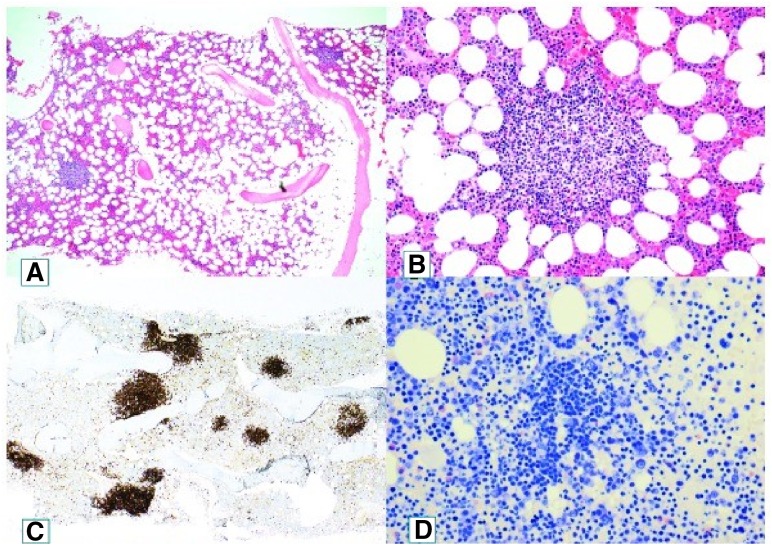
Figure 1.
Figure 1.
Cold agglutinin–associated lymphoproliferative bone marrow disease. Bone marrow trephine biopsy showing intraparenchymatous nodular lymphoid lesions (A-B, hematoxylin and eosin staining, original magnification ×40 and ×200, respectively). Immunoperoxidase staining for CD20 highlights intraparenchymatous nodular B-cell infiltration (C, original magnification ×200). Mast cells are not discerned around the nodular lymphoid lesions (D, Giemsa staining, original magnification ×200). Reprinted from Randen et al with permission.
Figure 2.
Figure 2.
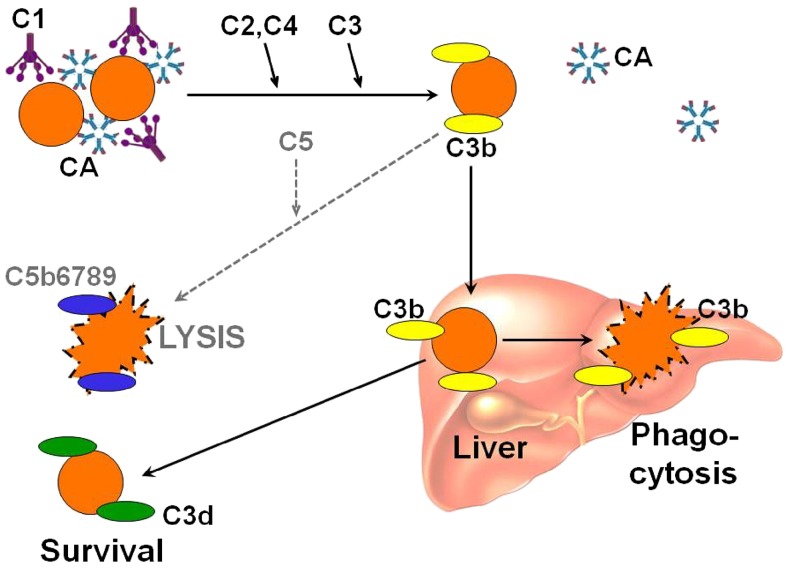
Complement-mediated hemolysis in cold agglutinin disease. Antigen-bound CA on the cell surface binds C1q and initiates the classical complement pathway. C1 esterase activates C2 and C4, generating C3 convertase, which results in the cleavage of C3 to C3a and C3b. Upon warming to 37°C, CA detaches from the cell, allowing agglutinated erythrocytes to separate, whereas C3b remains bound. A proportion of the C3b-coated cells is sequestered by macrophages of the reticuloendothelial system, mainly in the liver. On the surface of the surviving RBCs, C3b is cleaved, leaving high numbers of C3d molecules on the cell surface. In some situations, complement activation may proceed beyond the C3b step with cleavage of C5, resulting in activation of the terminal pathway and intravascular hemolysis. C, complement protein. Reprinted from Berentsen and Sundic with permission.
Figure 3.
Figure 3.
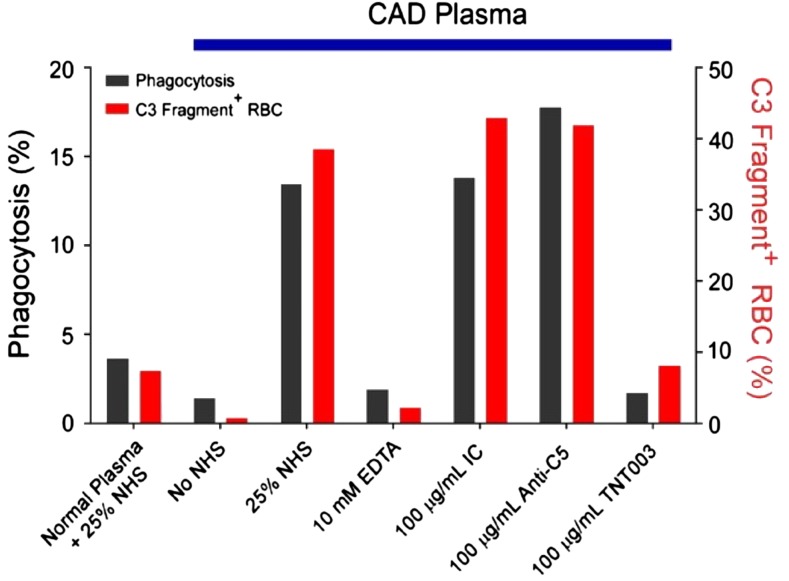
TNT003 prevents complement C3 deposition and phagocytosis of RBCs exposed to CAD patient plasma in the presence of normal human serum. Representative assay using a single patient sample. IC, internal control; NHS, normal human serum. Columns below blue bar represent measurements after addition of cold agglutinin (patient plasma). Reprinted from Shi et al.

References

    1. Sokol RJ, Hewitt S, Stamps BK. Autoimmune haemolysis: an 18-year study of 865 cases referred to a regional transfusion centre. Br Med J (Clin Res Ed). 1981;282(6281):2023-2027. - PMC - PubMed
    1. Berentsen S, Randen U, Tjønnfjord GE. Cold agglutinin-mediated autoimmune hemolytic anemia. Hematol Oncol Clin North Am. 2015;29(3):455-471. - PubMed
    1. Berentsen S, Tjønnfjord GE. Diagnosis and treatment of cold agglutinin mediated autoimmune hemolytic anemia. Blood Rev. 2012;26(3):107-115. - PubMed
    1. Randen U, Trøen G, Tierens A, et al. Primary cold agglutinin-associated lymphoproliferative disease: a B-cell lymphoma of the bone marrow distinct from lymphoplasmacytic lymphoma. Haematologica. 2014;99(3):497-504. - PMC - PubMed
    1. Landsteiner K. Über Beziehungen zwischen dem Blutserum und den Körperzellen. Munch Med Wochenschr. 1903;50:1812-1814.

MeSH terms