


Cigarette Smoking and Mortality in Adults Aged 70 Years and Older: Results From the NIH-AARP Cohort
- PMID: 27914770
- PMCID: PMC5318256
- DOI: 10.1016/j.amepre.2016.09.036
Cigarette Smoking and Mortality in Adults Aged 70 Years and Older: Results From the NIH-AARP Cohort
Abstract
Introduction: Tobacco use remains a leading modifiable cause of cancer incidence and premature mortality in the U.S. and globally. Despite increasing life expectancy worldwide, less is known about the effects of cigarette smoking on older populations. This study sought to determine the effects of smoking on mortality in older age.
Methods: Associations of mortality with self-reported age at smoking cessation, age at smoking initiation, and amount smoked after age 70 years were examined in 160,113 participants of the NIH-AARP Diet and Health Study aged >70 years. Participants completed a questionnaire detailing their smoking use in 2004-2005, and were followed for mortality through December 31, 2011. Analyses were conducted between 2014 and 2016.
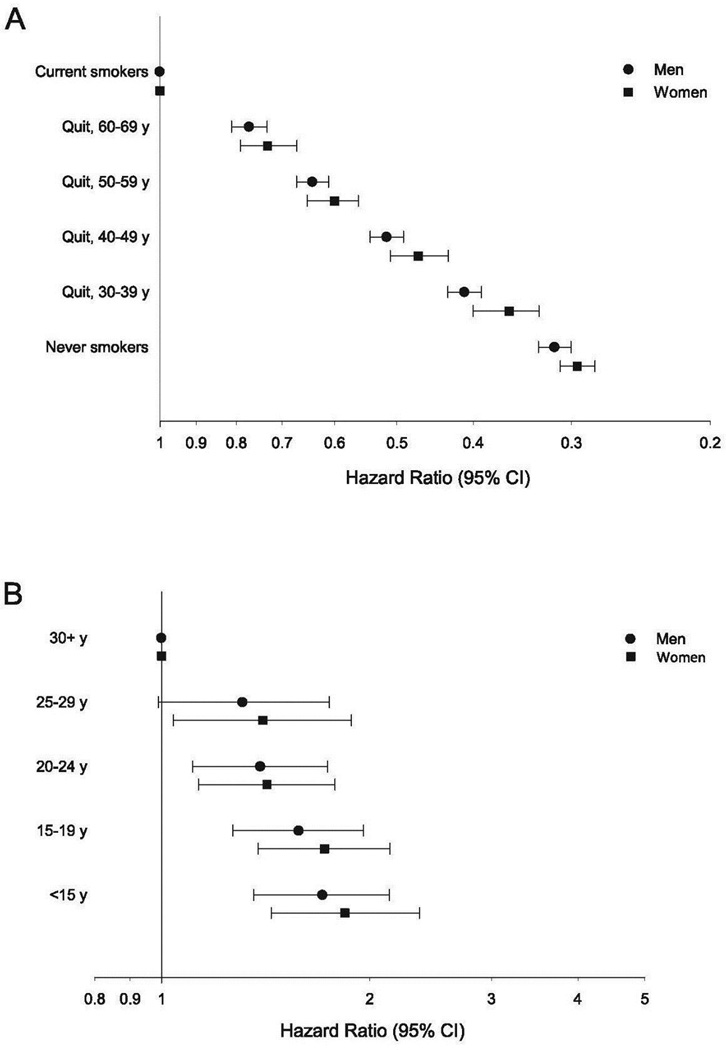
Results: Relative to never smokers, current smokers were more likely to die during follow-up (hazard ratio, 3.18; 95% CI=3.04, 3.31). Furthermore, former smokers had lower risks than current smokers (hazard ratios for quitting between ages 30-39, 40-49, 50-59, and 60-69 years were 0.41 [95% CI=0.39, 0.43], 0.51 [95% CI=0.49, 0.54], 0.64 [95% CI=0.61, 0.67], and 0.77 [95% CI=0.73, 0.81], respectively). Among current smokers, mortality was inversely associated with age at initiation, but directly associated with the number of cigarettes smoked per day at age >70 years.
Conclusions: As among younger people, lifetime cigarette smoking history is a key determinant of mortality after age 70 years.
Published by Elsevier Inc.
Figures
References
-
- Holford TR, Meza R, Warner KE, et al. Tobacco control and the reduction in smoking-related premature deaths in the United States, 19642013;2012. JAMA. 2014;311(2):164–171. http://dx.doi.org/10.1001/jama.2013.285112. - DOI - PMC - PubMed
-
- American Cancer Society. Cancer Facts and Figures 2014. Atlanta, GA: American Cancer Society; 2014.
-
- The Health Consequences of Smoking-50 Years of Progress: A Report of the Surgeon General. Atlanta, GA: DHHS, CDC, National Center for Chronic Disease Prevention and Health Promotion, Office on Smoking and Health; 2014.
-
- Carter BD, Abnet CC, Feskanich D, et al. Smoking and mortality--beyond established causes. N Engl J Med. 2015;372(7):631–640. http://dx.doi.org/10.1056/NEJMsa1407211. - DOI - PubMed
-
- WHO. Geneva, Switzerland: WHO Press; 2012. WHO global report: mortality attributable to tobacco.
MeSH terms
Grants and funding
LinkOut - more resources
Full Text Sources
Other Literature Sources
Medical
