


The role of extracellular biophysical cues in modulating the Hippo-YAP pathway
- PMID: 27916025
- PMCID: PMC5342869
- DOI: 10.5483/bmbrep.2017.50.2.199
The role of extracellular biophysical cues in modulating the Hippo-YAP pathway
Abstract
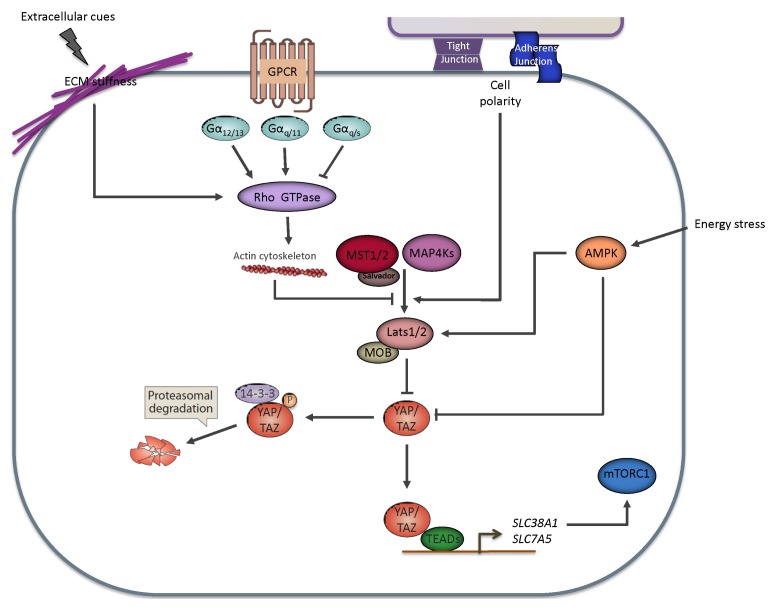
The Hippo signaling pathway plays an essential role in adult-tissue homeostasis and organ-size control. In Drosophila and vertebrates, it consists of a highly conserved kinase cascade, which involves MST and Lats that negatively regulate the activity of the downstream transcription coactivators, YAP and TAZ. By interacting with TEADs and other transcription factors, they mediate both proliferative and antiapoptotic gene expression and thus regulate tissue repair and regeneration. Dysregulation or mutation of the Hippo pathway is linked to tumorigenesis and cancer development. Recent studies have uncovered multiple upstream inputs, including cell density, mechanical stress, G-protein-coupled receptor (GPCR) signaling, and nutrients, that modulate Hippo pathway activity. This review focuses on the role of the Hippo pathway as effector of these biophysical cues and its potential implications in tissue homeostasis and cancer. [BMB Reports 2017; 50(2): 71-78].
Conflict of interest statement
The authors have no conflicting financial interests.
Figures
References
Publication types
MeSH terms
Substances
LinkOut - more resources
Full Text Sources
Other Literature Sources
