


Perceived Discrimination Associated With Asthma and Related Outcomes in Minority Youth: The GALA II and SAGE II Studies
- PMID: 27916618
- PMCID: PMC5472516
- DOI: 10.1016/j.chest.2016.11.027
Perceived Discrimination Associated With Asthma and Related Outcomes in Minority Youth: The GALA II and SAGE II Studies
Abstract
Background: Asthma disproportionately affects minority populations and is associated with psychosocial stress such as racial/ethnic discrimination. We aimed to examine the association of perceived discrimination with asthma and poor asthma control in African American and Latino youth.
Methods: We included African American (n = 954), Mexican American (n = 1,086), other Latino (n = 522), and Puerto Rican Islander (n = 1,025) youth aged 8 to 21 years from the Genes-Environments and Admixture in Latino Americans study and the Study of African Americans, Asthma, Genes, and Environments. Asthma was defined by physician diagnosis, and asthma control was defined based on the National Heart, Lung, and Blood Institute guidelines. Perceived racial/ethnic discrimination was assessed by the Experiences of Discrimination questionnaire, with a focus on school, medical, and public settings. We examined the associations of perceived discrimination with each outcome and whether socioeconomic status (SES) and global African ancestry modified these associations.
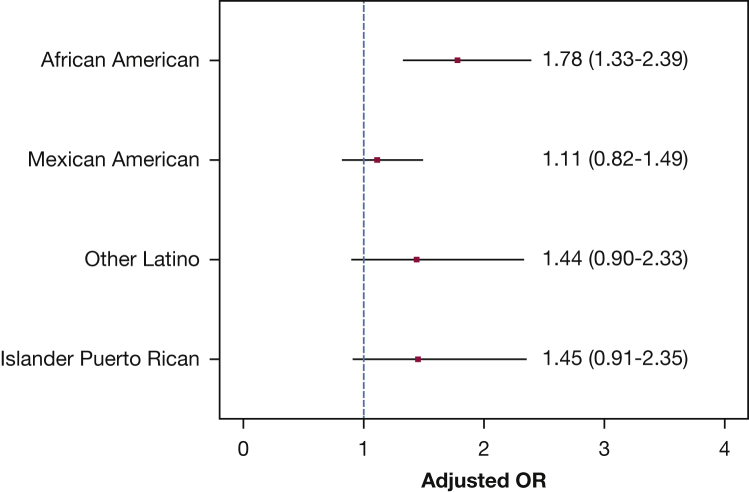
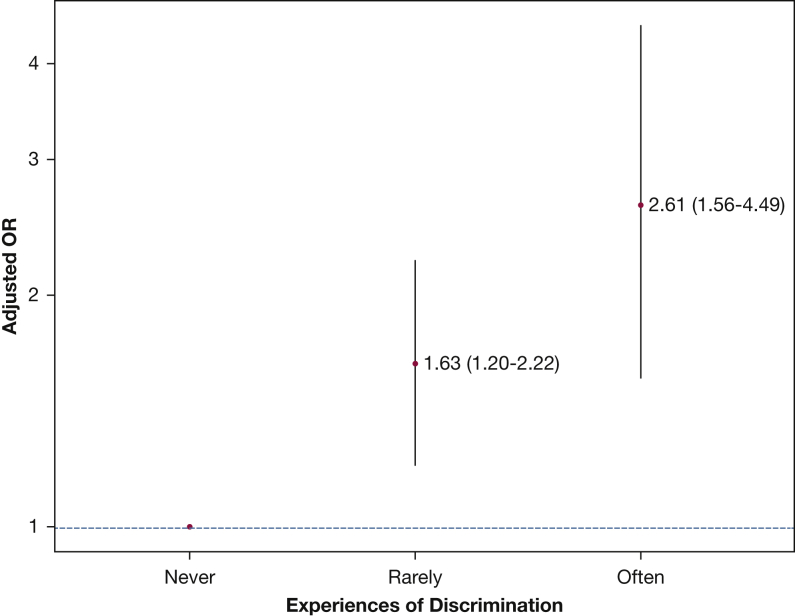
Results: African American children reporting any discrimination had a 78% greater odds of experiencing asthma (OR, 1.78; 95% CI, 1.33-2.39) than did those not reporting discrimination. Similarly, African American children faced increased odds of poor asthma control with any experience of discrimination (OR, 1.97; 95% CI, 1.42-2.76) over their counterparts not reporting discrimination. These associations were not observed among Latino children. We observed heterogeneity of the association between reports of discrimination and asthma according to SES, with reports of discrimination increasing the odds of having asthma among low-SES Mexican American youth (interaction P = .01) and among high-SES other Latino youth (interaction P = .04).
Conclusions: Perceived discrimination is associated with increased odds of asthma and poorer control among African American youth. SES exacerbates the effect of perceived discrimination on having asthma among Mexican American and other Latino youth.
Keywords: children; health status disparity; psychosocial stress; race; socioeconomic status.
Copyright © 2016 American College of Chest Physicians. Published by Elsevier Inc. All rights reserved.
Figures
References
-
- Pittman C.T. Getting mad but ending up sad: the mental health consequences for African American using anger to cope with racism. J Black Stud. 2011;42(7):1106–1124. - PubMed
-
- Carter R.T. Racism and psychological and emotional injury: recognizing and assessing race-based traumatic stress. Couns Psychol. 2007;35(1):13–105.
-
- Brondolo E., Thompson S., Brady N. The relationship of racism to appraisals and coping in a community sample. Ethn Dis. 2005;15:S5–S14. S5-S19. - PubMed
MeSH terms
Grants and funding
- R01 ES015794/ES/NIEHS NIH HHS/United States
- R01 HL155024/HL/NHLBI NIH HHS/United States
- K12 HL119997/HL/NHLBI NIH HHS/United States
- T32 GM007546/GM/NIGMS NIH HHS/United States
- R01 HL104608/HL/NHLBI NIH HHS/United States
- P60 MD006902/MD/NIMHD NIH HHS/United States
- K23 HL125551/HL/NHLBI NIH HHS/United States
- R21 ES024844/ES/NIEHS NIH HHS/United States
- R01 MD010443/MD/NIMHD NIH HHS/United States
- M01 RR000188/RR/NCRR NIH HHS/United States
- R01 HL078885/HL/NHLBI NIH HHS/United States
- R25 MD006832/MD/NIMHD NIH HHS/United States
- U19 AI077439/AI/NIAID NIH HHS/United States
- M01 RR000083/RR/NCRR NIH HHS/United States
- R01 HL088133/HL/NHLBI NIH HHS/United States
LinkOut - more resources
Full Text Sources
Other Literature Sources
Medical
Molecular Biology Databases
