


Introduction of complementary foods in Sweden and impact of maternal education on feeding practices
- PMID: 27917749
- PMCID: PMC10261380
- DOI: 10.1017/S1368980016003104
Introduction of complementary foods in Sweden and impact of maternal education on feeding practices
Abstract
Objective: To describe the introduction of complementary foods in a population-based cohort in relation to recommendations and explore the possible impact of maternal education on infant feeding practices.
Design: Prospective data from the All Babies in Southeast Sweden (ABIS) cohort study were used. The ABIS study invited all infants born in south-east Sweden during October 1997-October 1999 (n 21 700) to participate. A questionnaire was completed for 16 022 infants. During the infants' first year parents continuously filed in a diary covering introduction of foods.
Setting: Sweden.
Subjects: Infants (n 9727) with completed food diaries.
Results: Potatoes, vegetables, fruits/berries and porridge were the foods first introduced, with a median introduction between 19 and 22 weeks, followed by introduction of meat, cow's milk, follow-on formula and sour milk/yoghurt between 24 and 27 weeks. Early introduction of any food, before 16 weeks, occurred for 27 % of the infants and was more common in infants of mothers with low education. Overall, potatoes (14·7 %), vegetables (11·1 %), fruits/berries (8·5 %), porridge (7·4 %) and follow-on formula (2·7 %) were the foods most frequently introduced early. The majority of infants (≥70 %) were introduced to potatoes, vegetables, fruits/berries and porridge during concurrent breast-feeding, but introduction during concurrent breast-feeding was less common in infants of mothers with low education.
Conclusions: Most infants were introduced to complementary foods timely in relation to recommendations. Low maternal education was associated with earlier introduction of complementary foods and less introduction during concurrent breast-feeding. Still, the results indicated exposure to fewer foods at 12 months in infants of mothers with low education.
Keywords: Breast-feeding; Complementary food; Education; Food diary; Infant feeding.
Figures

 , breast-feeding;
  , infant formula;
  , potatoes/vegetables/fruits/berries;
  , porridge;
  , meat;
  , milk/sour milk/yoghurt;
  , follow-on formula;
  , bread;
  , rice/pasta;
 , fish;
  , cheese;
 , sugar-containing foods;
  , eggs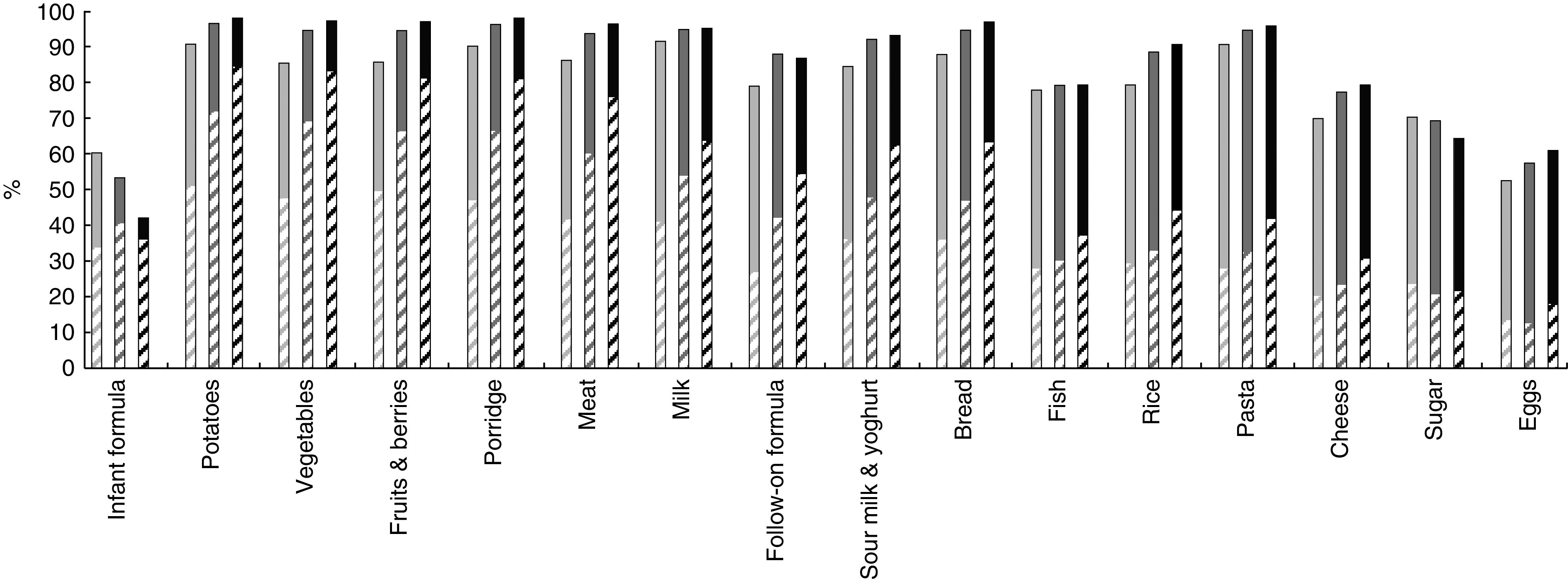
 , low education;
  , intermediate education;
  , high education. Hatching shows percentage introduced to complementary foods during breast-feeding (at least 30 d overlap)
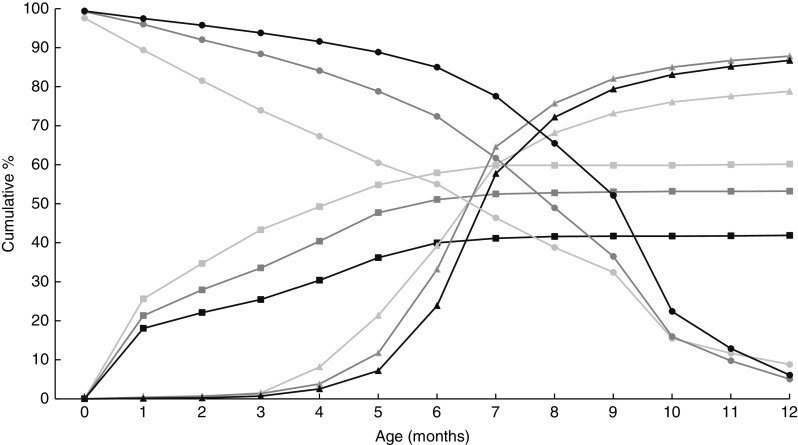 , infant formula, low education; , follow-on formula, low education; , breast-feeding, low education; , infant formula, intermediate education;
, follow-on formula, intermediate education; , breast-feeding, intermediate education; , infant formula, high education; , follow-on formula, high education; , breast-feeding, high education. Differences in proportions breast-fed, introduced to infant formula and follow-on formula across categories of maternal education at age 4 and 6 months, respectively, were tested and were significant at both ages for all variables (P<0·001)
, infant formula, low education; , follow-on formula, low education; , breast-feeding, low education; , infant formula, intermediate education;
, follow-on formula, intermediate education; , breast-feeding, intermediate education; , infant formula, high education; , follow-on formula, high education; , breast-feeding, high education. Differences in proportions breast-fed, introduced to infant formula and follow-on formula across categories of maternal education at age 4 and 6 months, respectively, were tested and were significant at both ages for all variables (P<0·001) , fish, low education; , eggs, low education; , milk/sour milk/yoghurt, low education; , fish, intermediate education; , eggs, intermediate education; , milk/sour milk/yoghurt, intermediate education; , fish, high education; , eggs, high education; , mil/sour milk/yoghurt, high education. Differences in proportions introduced to milk, eggs and fish across categories of maternal education at age 4 and 6 months, respectively, were tested and were significant at both ages for milk products and fish (P<0·001) but not for eggs (P>0·001)
References
-
- World Health Organization (2001) 54th World Health Assembly: Global Strategy for Infant and Young Child Feeding. Geneva: WHO.
-
- World Health Organization & UNICEF (2003) Global Strategy on Infant and Young Child Feeding. Geneva: WHO & UNICEF.
-
- Domellöf M, Braegger C, Campoy C et al. (2014) Iron requirements of infants and toddlers. J Pediatr Gastroenterol Nutr 58, 119–129. - PubMed
-
- World Health Organization (2003) Guiding Principles For Complementary Feeding of the Breastfed Child. Geneva: WHO.
MeSH terms
LinkOut - more resources
Full Text Sources
Other Literature Sources
Medical
