


Review
doi: 10.3390/ijms17122028.
Exosomes as miRNA Carriers: Formation-Function-Future
Affiliations
- PMID: 27918449
- PMCID: PMC5187828
- DOI: 10.3390/ijms17122028
Item in Clipboard
Review
Exosomes as miRNA Carriers: Formation-Function-Future
Int J Mol Sci.
.
Abstract
Exosomes, which are one of the smallest extracellular vesicles released from cells, have been shown to carry different nucleic acids, including microRNAs (miRNAs). miRNAs significantly regulate cell growth and metabolism by posttranscriptional inhibition of gene expression. The rapidly changing understanding of exosomes' formation and function in delivering miRNAs from cell to cell has prompted us to review current knowledge in exosomal miRNA secretion mechanisms as well as possible therapeutic applications for personalized medicine.
Keywords: cell metabolism; exosome; extracellular vesicle; miRNA.
Conflict of interest statement
The authors declare no conflict of interest.
Figures
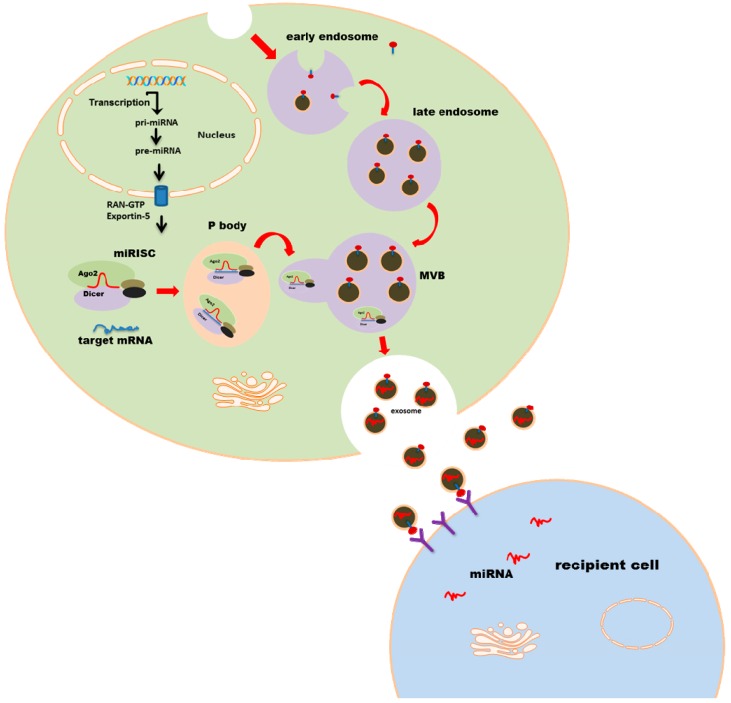
Mechanism of exosomal miRNA secretion. Pri-miRNA is initially transcribed from the genome, processed by Drosha to pre-miRNA, and is then transported into cytoplasm via Exportin-5 where mature miRNA is formed. Mature miRNA is integrated into the miRISC complex and therefore targets mRNA. The P-body fuses with late endosomes and releases miRNA-containing exosomes. Exosomes are further taken up by the receptor-ligand interaction, regulating a series of gene expressions in recipient cells.
References
-
- Bastos-Amador P., Perez-Cabezas B., Izquierdo-Useros N., Puertas M.C., Martinez-Picado J., Pujol-Borrell R., Naranjo-Gomez M., Borras F.E. Capture of cell-derived microvesicles (exosomes and apoptotic bodies) by human plasmacytoid dendritic cells. J. Leukoc. Biol. 2012;91:751–758. doi: 10.1189/jlb.0111054. - DOI - PubMed
-
- Conde-Vancells J., Rodriguez-Suarez E., Embade N., Gil D., Matthiesen R., Valle M., Elortza F., Lu S.C., Mato J.M., Falcon-Perez J.M. Characterization and comprehensive proteome profiling of exosomes secreted by hepatocytes. J. Proteome Res. 2008;7:5157–5166. doi: 10.1021/pr8004887. - DOI - PMC - PubMed
Publication types
MeSH terms
Substances
LinkOut - more resources
Full Text Sources
Other Literature Sources
