


Radiation and circulatory disease
- PMID: 27919337
- PMCID: PMC5315567
- DOI: 10.1016/j.mrrev.2016.07.008
Radiation and circulatory disease
Abstract
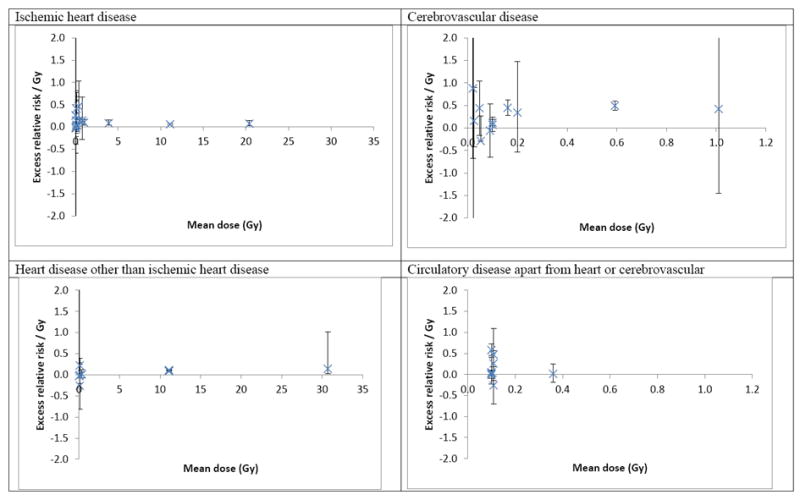
Exposure to therapeutic doses of ionizing radiation is associated with damage to the heart and coronary arteries. However, only recently have studies with high-quality individual dosimetry data allowed this risk to be quantified while also adjusting for concomitant chemotherapy, and medical and lifestyle risk factors. At lower levels of exposure the evidence is less clear. In this article I review radiation-associated risks of circulatory disease in groups treated with radiotherapy for malignant and non-malignant disease, and in occupationally- or environmentally-exposed groups receiving rather lower levels of radiation dose, also for medical diagnostic purposes. Results of a meta-analysis suggest that excess relative risks per unit dose for various types of heart disease do not exhibit statistically significant (p>0.2) heterogeneity between studies. Although there are no marked discrepancies between risks derived from the high-dose therapeutic and medical diagnostic studies and from the moderate/low dose occupational and environmental studies, at least for ischemic heart disease and stroke there are indications of larger risks per unit dose for lower dose rate and fractionated exposures. Risks for stroke and other types of circulatory disease are significantly more variable (p<0.0001), possibly resulting from confounding and effect-modification by well known (but unobserved) risk factors. Adjustment for any of mean dose, dose fractionation or age at exposure results in the residual heterogeneity for cerebrovascular disease becoming non-significant. The review provides strong evidence in support of a causal association between both low and high dose radiation exposure and most types of circulatory disease.
Keywords: Circulatory disease; Heart disease; Radiation; Review; Stroke.
Published by Elsevier B.V.
Conflict of interest statement
The author (MPL) has no conflicts of interest.
Figures
References
-
- World Health Organization (WHO) World Health Organization Statistical Information System (WHOSIS) 2015 (updated 17 November 2015)( http://www.who.int/gho/en/)
-
- Centers for Disease Control and Prevention (CDC) Underlying Cause of Death 1999-2014 on CDC WONDER Online Database. CDC WONDER; 2016.
-
- McMillan TJ, Bennett MR, Bridges BA, Darby SC, Hendry J, Jones B, Kanthou C, Little MP, Taylor A, Tzoulaki I, Bouffler SD, Zhang W, Walker H, Keep P. Report of the independent Advisory Group on Ionising Radiation. Health Protection Agency; Holborn Gate, 330 High Holborn, London: 2010. Circulatory disease risk; pp. 1–116.
-
- Kreuzer M, Auvinen A, Cardis E, Hall J, Jourdain JR, Laurier D, Little MP, Peters A, Raj K, Russell NS, Tapio S, Zhang W, Gomolka M. Low-dose ionising radiation and cardiovascular diseases--Strategies for molecular epidemiological studies in Europe. Mutat Res Rev Mutat Res. 2015;764:90–100. - PubMed
-
- Wilson PWF, D’Agostino RB, Levy D, Belanger AM, Silbershatz H, Kannel WB. Prediction of coronary heart disease using risk factor categories. Circulation. 1998;97:1837–1847. - PubMed
Publication types
MeSH terms
Grants and funding
LinkOut - more resources
Full Text Sources
Other Literature Sources
