. 2017 Jul;27(7):2765-2775.
doi: 10.1007/s00330-016-4673-z. Epub 2016 Dec 5.

European society of urogenital radiology (ESUR) guidelines: MR imaging of pelvic endometriosis

Affiliations

European society of urogenital radiology (ESUR) guidelines: MR imaging of pelvic endometriosis

M Bazot et al. Eur Radiol. 2017 Jul.

Abstract

Endometriosis is a common gynaecological condition of unknown aetiology that primarily affects women of reproductive age. The accepted first-line imaging modality is pelvic ultrasound. However, magnetic resonance imaging (MRI) is increasingly performed as an additional investigation in complex cases and for surgical planning. There is currently no international consensus regarding patient preparation, MRI protocols or reporting criteria. Our aim was to develop clinical guidelines for MRI evaluation of pelvic endometriosis based on literature evidence and consensus expert opinion. This work was performed by a group of radiologists from the European Society of Urogenital Radiology (ESUR), experts in gynaecological imaging and a gynaecologist expert in methodology. The group discussed indications for MRI, technical requirements, patient preparation, MRI protocols and criteria for the diagnosis of pelvic endometriosis on MRI. The expert panel proposed a final recommendation for each criterion using Oxford Centre for Evidence Based Medicine (OCEBM) 2011 levels of evidence.

Key points: • This report provides guidelines for MRI in endometriosis. • Minimal and optimal MRI acquisition protocols are provided. • Recommendations are proposed for patient preparation, best MRI sequences and reporting criteria.

Keywords: Endometriosis; Evidence-based Medicine/standards; Guidelines; Magnetic resonance imaging (MRI); Protocols.


Figures
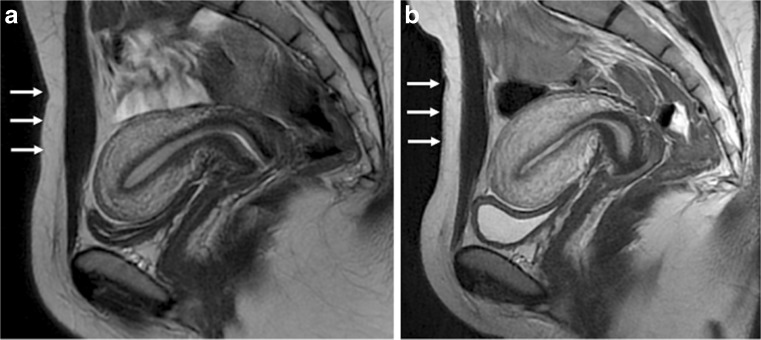
Fig. 1
Fig. 1
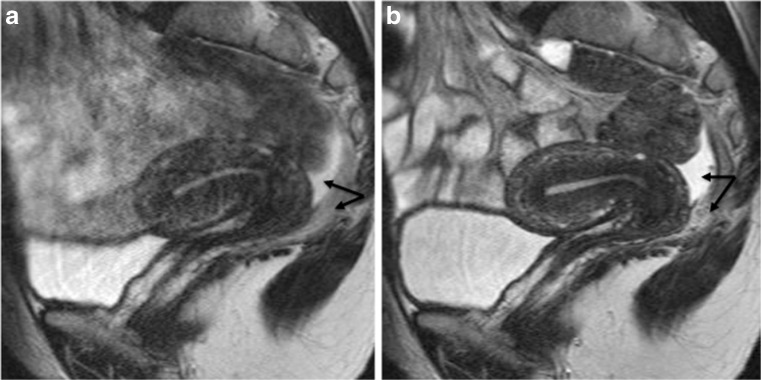
Sagittal 2D T2-weighted MR images in the same patient performed at (a) 1.5 Tesla and (b) 3.0 Tesla provide similar good imaging quality for the evaluation of pelvic anatomy, especially uterine zonal anatomy. Note the quality of abdominal strapping on both 1.5 and 3.0 T examinations (arrows)
Fig. 2
Fig. 2
Sagittal 2D T2-weighted MR images performed at 1.5 Tesla showing the benefits of anti-peristaltic agents on image quality. Imaging performed in the same patient before (a) and after (b) administration of glucagon demonstrating a dramatic improvement in image quality. Note the presence of pelvic fluid in the pouch of Douglas underlining a clear demarcation between peritoneal and posterior subperitoneal compartments (double arrow) (reprinted with permission - Bazot M. Ed. Lavoisier-Paris 2016)
Fig. 3
Fig. 3
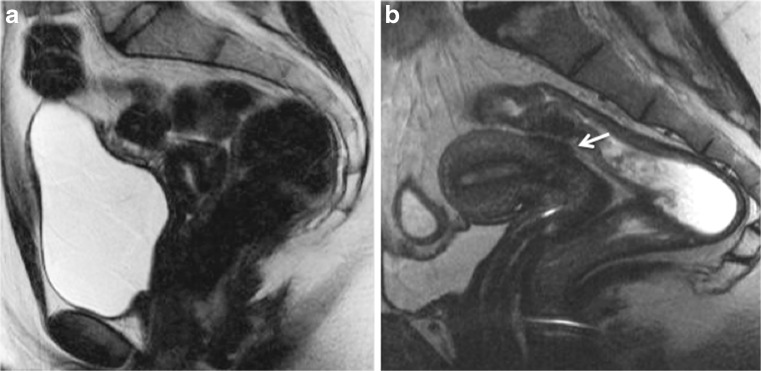
Sagittal 2D T2-weighted MR images performed at 1.5 Tesla showing the benefits of patient preparation on image quality. (a) Imaging performed with a full urinary bladder and without bowel preparation is sub-optimal for interpretation and disease may be overlooked. (b) MR imaging performed in a different patient following bowel preparation with Normacol and 2 h after emptying her urinary bladder. Note the superior image quality in (b) and the large endometriotic lesion on the anterior rectosigmoid colon (arrows)
Fig. 4
Fig. 4
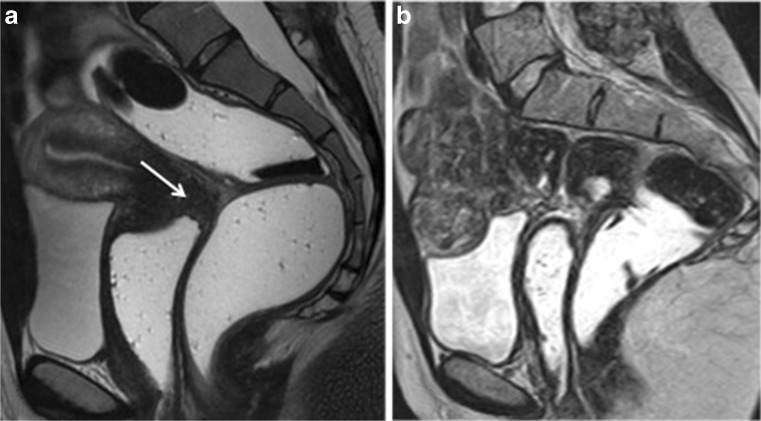
Sagittal 2D T2-weighted MR images performed in two different patients at 1.5 Tesla following vaginal and rectal opacification with sonographic gel and with (a) or without (b) bowel preparation. Vaginal distension demonstrates thickening of the posterior vaginal fornix (white arrow) without involvement of the pouch of Douglas or rectum posteriorly that is clearly analysable (a). Vaginal and rectal opacification without bowel preparation cannot permit an accurate analysis of potential deep posterior endometriosis, especially potential rectal endometriosis (b)
Fig. 5
Fig. 5
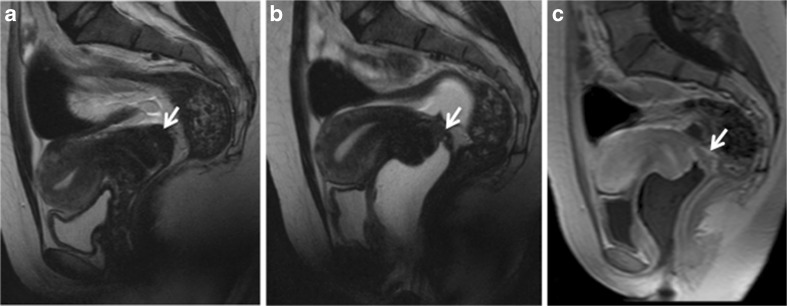
Sagittal 2D MR images performed at 1.5 Tesla demonstrating the use of sonographic gel to opacify and distend the vagina. (a) Sagittal 2D T2-weighted image demonstrating an endometriotic plaque involving the posterior vaginal fornix (white arrow). Following distension of the vagina with sonographic gel, the plaque is better delineated on both T2-weighted (b) and fat-suppressed T1-weighted (c) sequences (white arrows) (reprinted with permission - Bazot M. Ed. Lavoisier-Paris)
Fig. 6
Fig. 6
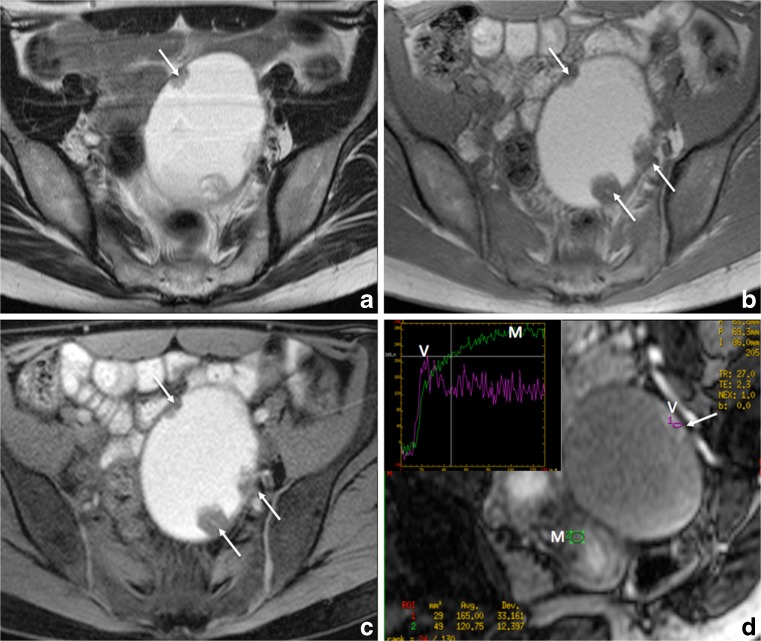
Axial 2D MR images performed at 1.5 Tesla demonstrating the use of gadolinium in the diagnosis of indeterminate adnexal mass related to endometrial cyst complicated with clear cell carcinoma. (a) Axial 2D T2-weighted image demonstrates a large unilocular cyst containing papillary projections and/or solid portion (arrows). Axial without (b) and with (c) fat-suppressed T1-weighted sequences display high signal content related to endometriotic fluid. Axial oblique dynamic contrast enhanced MR images (d) display location of region of interest (ROI) within external myometrium (M) and vegetation (V) and the initial increase in the signal intensity of solid tissue (arrow) that is steeper than that of myometrium (M), corresponding to a curve type 3 (V) highly suggestive of carcinoma confirmed at histopathological examination

References

    1. Clement MD. Endometriosis, lesions of the secondary müllerian system, and pelvic mesothelial proliferations. In: Kurman RJ, editor. Blaustein's pathology of the female genital tract. 5. New York: Springer-Verlag; 2002. pp. 516–559.
    1. Dunselman GA, Vermeulen N, Becker C, et al. ESHRE guideline: management of women with endometriosis. Hum Reprod. 2014;29(3):400–412. doi: 10.1093/humrep/det457. - DOI - PubMed
    1. Fedele L, Bianchi S, Raffaelli R, Portuese A. Pre-operative assessment of bladder endometriosis. Hum Reprod. 1997;12(11):2519–2522. doi: 10.1093/humrep/12.11.2519. - DOI - PubMed
    1. Chapron C, Dumontier I, Dousset B, et al. Results and role of rectal endoscopic ultrasonography for patients with deep pelvic endometriosis. Hum Reprod. 1998;13(8):2266–2270. doi: 10.1093/humrep/13.8.2266. - DOI - PubMed
    1. Bazot M, Detchev R, Cortez A, Amouyal P, Uzan S, Darai E. Transvaginal sonography and rectal endoscopic sonography for the assessment of pelvic endometriosis: a preliminary comparison. Hum Reprod. 2003;18(8):1686–1692. doi: 10.1093/humrep/deg314. - DOI - PubMed

LinkOut - more resources