Randomized Controlled Trial
. 2017 Mar;112(3):447-457.
doi: 10.1038/ajg.2016.500. Epub 2016 Dec 6.

Percutaneous Gastrostomy Device for the Treatment of Class II and Class III Obesity: Results of a Randomized Controlled Trial

Affiliations
Randomized Controlled Trial

Percutaneous Gastrostomy Device for the Treatment of Class II and Class III Obesity: Results of a Randomized Controlled Trial

Christopher C Thompson et al. Am J Gastroenterol. 2017 Mar.

Abstract

Objectives: The AspireAssist System (AspireAssist) is an endoscopic weight loss device that is comprised of an endoscopically placed percutaneous gastrostomy tube and an external device to facilitate drainage of about 30% of the calories consumed in a meal, in conjunction with lifestyle (diet and exercise) counseling.

Methods: In this 52-week clinical trial, 207 participants with a body-mass index (BMI) of 35.0-55.0 kg/m2 were randomly assigned in a 2:1 ratio to treatment with AspireAssist plus Lifestyle Counseling (n=137; mean BMI was 42.2±5.1 kg/m2) or Lifestyle Counseling alone (n=70; mean BMI was 40.9±3.9 kg/m2). The co-primary end points were mean percent excess weight loss and the proportion of participants who achieved at least a 25% excess weight loss.

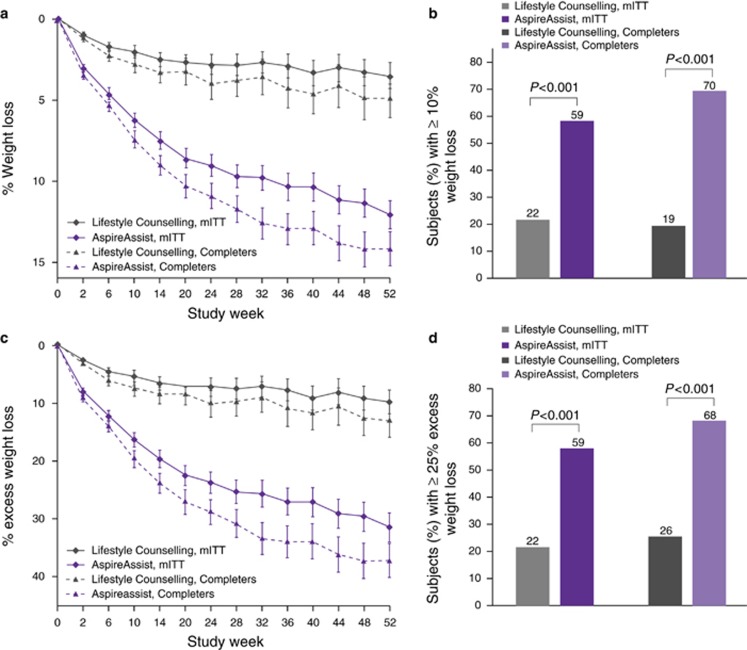
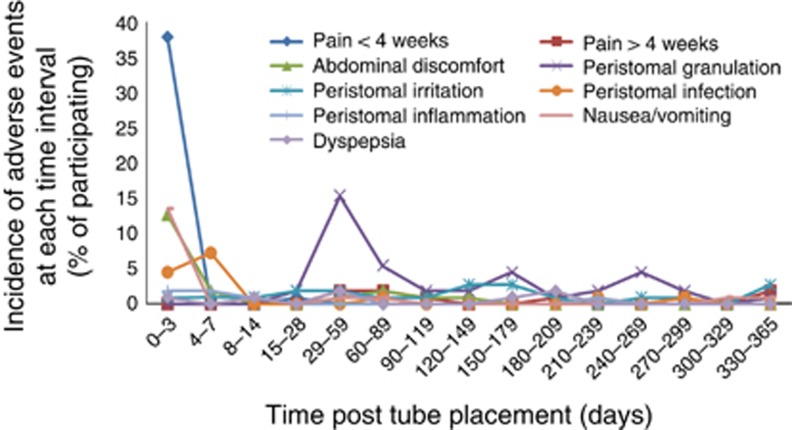
Results: At 52 weeks, participants in the AspireAssist group, on a modified intent-to-treat basis, had lost a mean (±s.d.) of 31.5±26.7% of their excess body weight (12.1±9.6% total body weight), whereas those in the Lifestyle Counseling group had lost a mean of 9.8±15.5% of their excess body weight (3.5±6.0% total body weight) (P<0.001). A total of 58.6% of participants in the AspireAssist group and 15.3% of participants in the Lifestyle Counseling group lost at least 25% of their excess body weight (P<0.001). The most frequently reported adverse events were abdominal pain and discomfort in the perioperative period and peristomal granulation tissue and peristomal irritation in the postoperative period. Serious adverse events were reported in 3.6% of participants in the AspireAssist group.

Conclusions: The AspireAssist System was associated with greater weight loss than Lifestyle Counseling alone.


Conflict of interest statement

Guarantor of the article: Christopher C. Thompson, MD, MSc, FASGE, FACG.

Specific author contributions: All authors were involved in the preparation of the manuscript, agreed to submit it for publication, and assumed responsibility for the accuracy and completeness of the data and the data analyses. The sponsor, Aspire Bariatrics (King of Prussia, PA, USA), performed the statistical analyses and provided editorial assistance in preparing this manuscript. Study supervision, analysis and interpretation of data, drafting of the manuscript, and critical revision of the manuscript for important intellectual content: Christopher C. Thompson; study supervision and critical revision of the manuscript for important intellectual content: Louis J. Aronne; subject supervision: Barham K. Abu Dayyeh, Adam C. Stein, Michel Kahaleh, Marvin Ryou, Christopher Huang, Daniel D. Tran, Joseph P. Glaser, John A. Martin, Francis A. Farraye, Samuel B. Ho, and Nitin Kumar; study supervision: Robert Kushner, Shelby Sullivan, Alan B. Schorr, Anastassia Amaro, Caroline M. Apovian, Terrence Fullum, Amir Zarrinpar, Michael D. Jensen, Steven Edmundowicz, J. Matthew Bohning, Gregory Ginsberg, and David L. Jaffe; acquisition of data: Donna Harakal, Meredith Young, Catherine E. Thomas, Alpana P. Shukla, Michele B. Ryan, and Miki Haas; study concept and design, analysis and interpretation of data, assistance in preparing the manuscript: Heidi Goldsmith and Jennifer McCrea.

Financial support: This trial was sponsored in full by Aspire Bariatrics, Inc., King of Prussia, PA, USA. C.C.T., L.J.A., R.K., S.S., A.B.S., A.A., C.M.A., T.F., A.Z., M.D.J., S.E., J.M.B., G.G., and D.L.J. received institutional research support from Aspire Bariatrics for this clinical trial.

Potential competing interests: Heidi Goldsmith and Jennifer McCrea are employees of Aspire Bariatrics. The remaining authors declare no potential competing interests.

Figures

Figure 1
Figure 1
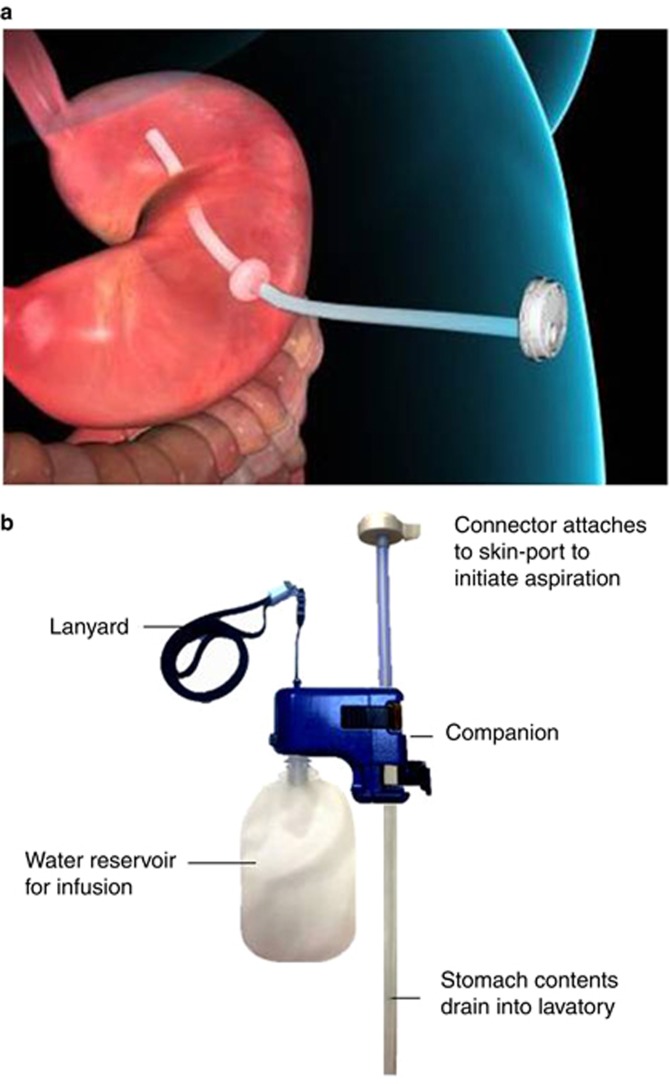
(a,b) AspireAssist A-Tube with Skin-Port (a) and External Device (b). Individual components of the AspireAssist device are labeled. After most of the ingested meal has been converted into a chyme by the stomach (about 20 min after meal ingestion), the Connector is attached to the Skin-Port, which opens the closed Skin-Port valve. Gastric contents then spontaneously flow out of the stomach through the drain tube into a toilet bowl. Remaining food particles are flushed out of the stomach and through the A-tube by flipping the lever on the Companion to allow water to be infused into the stomach from the reservoir and then reversing the flow to allow gastric contents to drain out of the stomach.
Figure 2
Figure 2
Effect of AspireAssist on excess weight loss and percentage weight loss. Mean percentage body weight loss (a) at each study visit is shown, according to study group, for the modified intention-to-treat population (with multiple imputation for missing values) and for those who completed the entire study. The proportion of participants who lost 10% or more of their total body weight at 52 weeks (b) is shown for the modified intention-to-treat population and for those who completed 52 weeks. I bars (a,c) indicate s.e. Mean percent excess weight loss (c) at each study visit is shown, according to study group, for the modified intention-to-treat population (with multiple imputation for missing values) and for those who completed the entire study. The proportion of participants who lost 25% or more of their excess weight at 52 weeks (d) is shown for the modified intention-to-treat population and for those who completed 52 weeks.
Figure 3
Figure 3
Occurrence of adverse events in the AspireAssist group. Time course of the adverse advents that occurred at a prevalence rate 5% or more during the 52-week study in the AspireAssist group.

Comment in

References

    1. Klein S, Wadden T, Sugerman HJ. American Gastroenterological Association Technical Review: clinical issues in obesity. Gastroenterology 2002;123:882–932. - PubMed
    1. Li W, Baraboi ED, Cluny NL et al. Malabsorption plays a major role in the effects of the biliopancreatic diversion with duodenal switch on energy metabolism in rats. Surg Obes Relat Dis 2015;11:356–66. - PubMed
    1. Xia Y, Kelton CM, Guo JJ et al. Treatment of obesity: pharmacotherapy trends in the United States from 1999 to 2010. Obesity 2015;23:1721–8. - PubMed
    1. Buchwald H, Oien D. Metabolic/bariatric surgery worldwide 2011. Obes Surg 2013;23:427–36. - PubMed
    1. Langeveld M, DeVries JH. The long-term effect of energy restricted diets for treating obesity. Obesity 2015;23:1529–38. - PubMed

Publication types