. 2016 Dec 6:6:38330.
doi: 10.1038/srep38330.

DETC-based bacterial cellulose bio-curatives for topical treatment of cutaneous leishmaniasis

Affiliations

DETC-based bacterial cellulose bio-curatives for topical treatment of cutaneous leishmaniasis

Fabiana S Celes et al. Sci Rep. .

Abstract

The treatment of leishmaniasis still relies on drugs with potentially serious adverse effects. Herein, we tested a topical formulation of bacterial cellulose (BC) membranes containing Diethyldithiocarbamate (DETC), a superoxide dismutase 1 inhibitor. Leishmania-infected macrophages exposed to BC-DETC resulted in parasite killing, without pronounced toxic effects to host cells. This outcome was associated with lower SOD1 activity and higher production of superoxide and cytokine mediators. Topical application of BC-DETC significantly decreased lesion size, parasite load and the inflammatory response at the infection site, as well as the production of both IFN-γ and TNF. Combination of topical BC-DETC plus intraperitoneal Sbv also significantly reduced disease development and parasite load. The leishmanicidal effect of BC-DETC was extended to human macrophages infected with L. braziliensis, highlighting the feasibility of BC-DETC as a topical formulation for chemotherapy of cutaneous leishmaniasis caused by L. braziliensis.


Figures
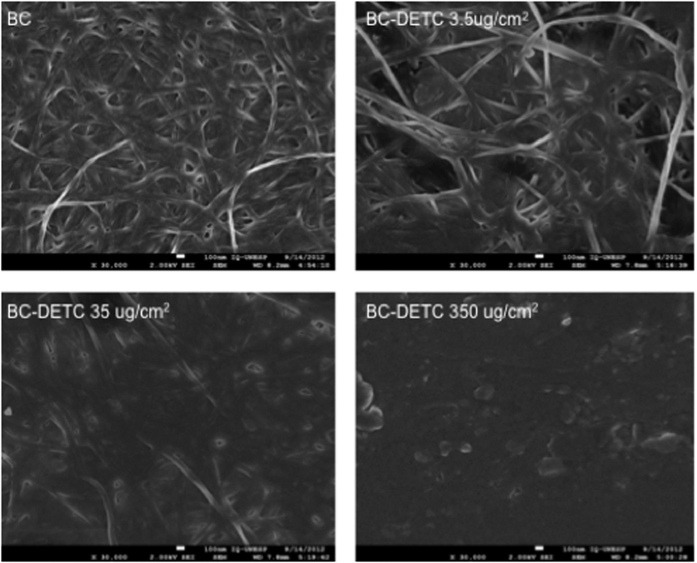
Figure 1
Figure 1. Scanning electron micrographs of bacterial cellulose membrane (BC) and BC membranes containing DETC.
All images were obtained on 30,000X magnification.
Figure 2
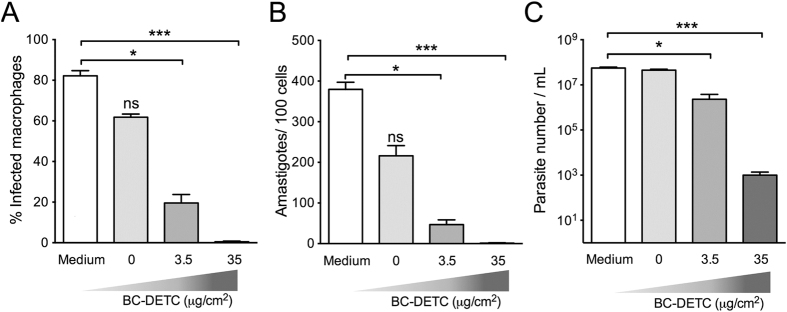
Figure 2. Dose-dependent effect of BC-DETC on L. braziliensis-infected macrophages.
Macrophages were infected and exposed to empty BC or to BC-DETC (3.5 or 35 μg/cm2). Cells were assessed for (A) the percentage of infected macrophages and (B) the number of amastigotes per 100 macrophages. (C) The number of viable parasites was evaluated by culture in Schneider medium, free of BC-DETC. Data are from a representative experiment performed in quintuplicate. *p < 0.05, ***p < 0.001.
Figure 3
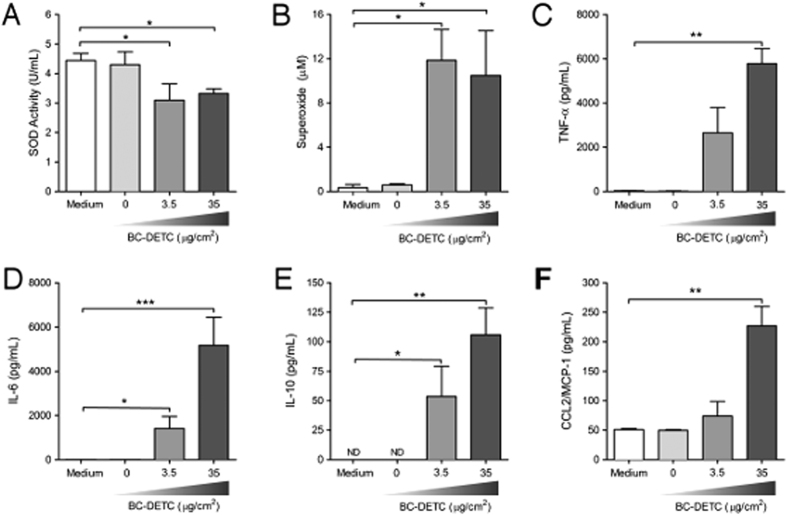
Figure 3. BC-DETC treatment reduces SOD activity and modulates cytokine release in L. braziliensis-infected macrophages.
Macrophages were infected and exposed to empty BC or to BC-DETC (3.5 or 35 μg/cm2). (A) SOD activity, (B) superoxide, (C) TNF, (D) IL-6, (E) CCL2/MCP-1 and (F) IL-10 levels were evaluated after 48 hours. Data are from a representative experiment performed in quintuplicate. *p < 0.05, **p < 0.01, ***p < 0.001.
Figure 4
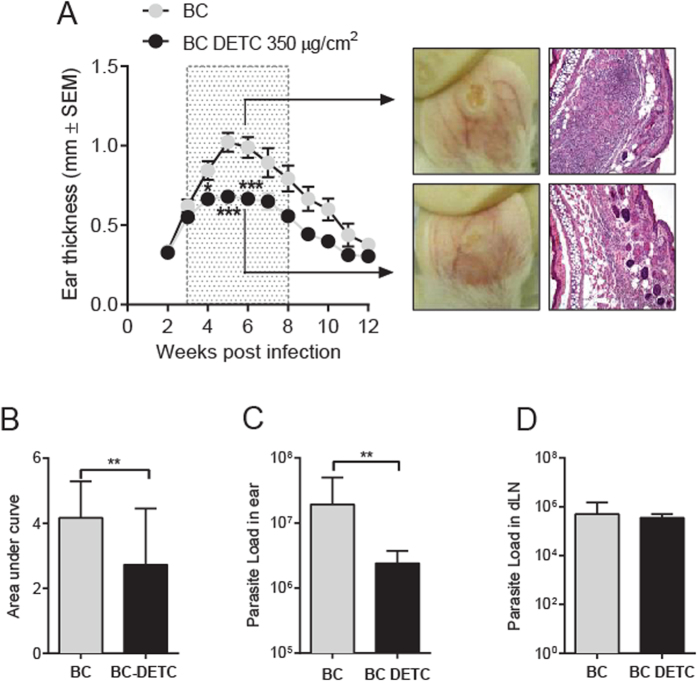
Figure 4. Topical treatment with BC-DETC controls CL development.
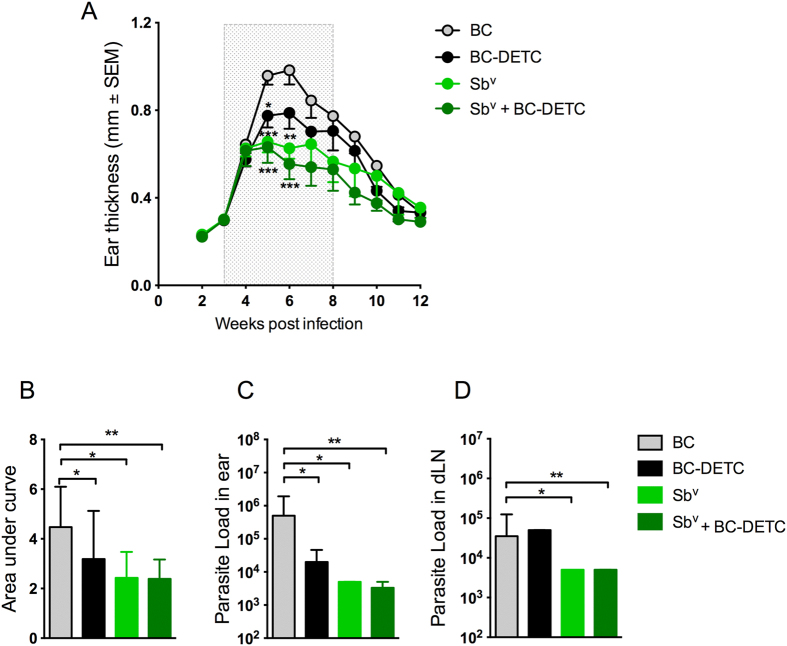
Mice were infected with L. braziliensis and three weeks later BC-DETC (at 350 μg/cm2) was applied for three weeks (boxed area). Controls received empty BC. (A) Lesion development was measured weekly. Ear sections, obtained six weeks after infection, were analyzed by optical microscopy under 20X magnification. (B) Disease burden [shown as Area Under the Curves (AUC) depicted in (A)] in mice treated with BC-DETC or empty BC. Parasite load was determined at the infection site (C) and at the dLN (D), at six weeks, by limiting dilution analysis. Data are pooled from three independent experiments, each performed with four to six mice per group. **p < 0.01.
Figure 5
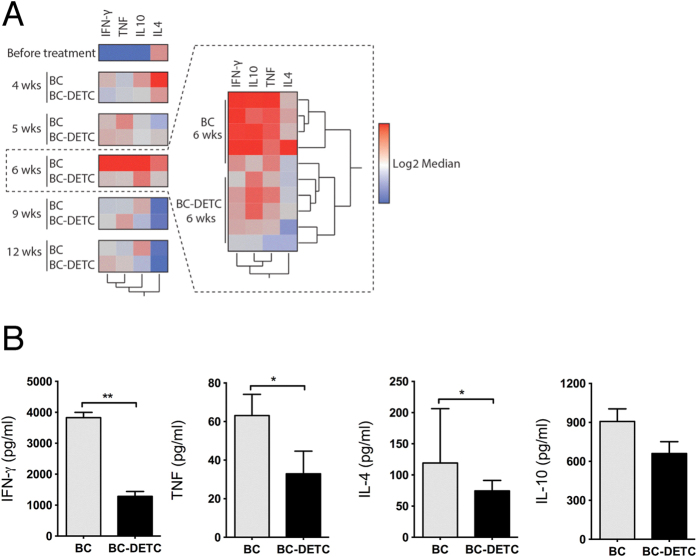
Figure 5. BC-DETC treatment modulates the cellular recall response.
Mice were infected and three weeks later BC-DETC (at 350 μg/cm2) was applied for three weeks. Controls received empty BC. Draining lymph nodes were re-stimulated in vitro and cytokines were quantified by ELISA. (A) Heat map depicting cytokine production, colored to indicate levels. Insert shows data for individual mice at six weeks. (B) Cytokine levels detected in culture supernatants, at six weeks. Data are from a representative experiment performed with six mice per group. *p < 0.05.
Figure 6
Figure 6. Efficacy of topical BC-DETC and intraperitoenal Sbv combined therapy in L. braziliensis infection.
Mice were infected and three weeks later were treated with topical BC-DETC (at 350 μg/cm2), intraperitoneal Sbv (100 mg/kg/day) or both. Controls received empty BC. (A) The course of lesion size development was measured weekly. (B) Disease burden [shown as Area Under the Curves (AUC) depicted in (A)] for each group. Parasite load was determined at the infection site (C) and at the dLN (D), 6 weeks after infection, by limiting dilution analysis. Data are from a representative experiment performed with twelve mice per group. *p < 0.05; **p < 0.01; ***p < 0.001.
Figure 7
Figure 7. BC-DETC leishmanicidal effect on human macrophages infected with L. braziliensis.
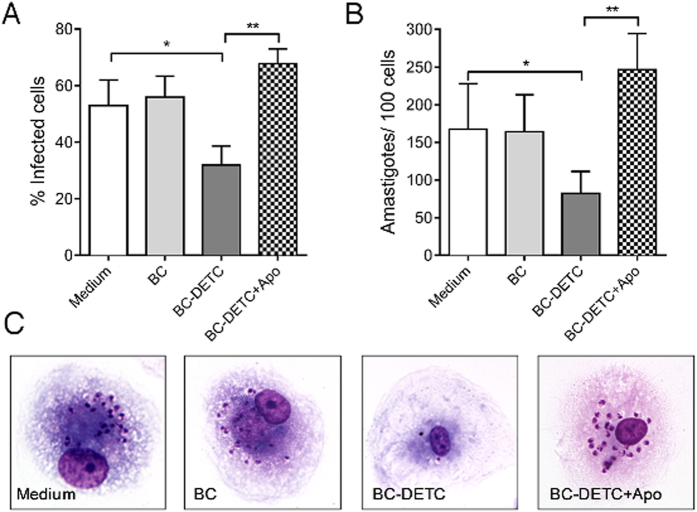
Macrophages were infected and were exposed to BC-DETC (IC50) (284.9 μg DETC/cm2) in the presence or absence of apocynin (APO) (20 μM). Cells were assessed for (A) the percentage of infected macrophages (A and B) for the number of amastigotes per 100 macrophages. (C) Representative photomicrographs of cultures shown in (A and B). Data are presented individually. *p < 0.05, **p < 0.01.

References

    1. den Boer M., Argaw D., Jannin J. & Alvar J. Leishmaniasis impact and treatment access. Clin Microbiol Infect 17, 1471–1477 (2011). - PubMed
    1. Bittencourt A. et al.. Post-kala-azar dermal leishmaniasis associated with AIDS. Braz J Infect Dis. 7, 229–233 (2003). - PubMed
    1. Alvar J. et al.. Leishmaniasis worldwide and global estimates of its incidence. PLoS One 7, e35671 (2012). - PMC - PubMed
    1. Croft S. L. & Coombs G. H. Leishmaniasis–current chemotherapy and recent advances in the search for novel drugs. Trends Parasitol 19, 502–508 (2003). - PubMed
    1. Llanos-Cuentas A. et al.. Clinical and parasite species risk factors for pentavalent antimonial treatment failure in cutaneous leishmaniasis in Peru. Clin Infect Dis 46 (2008). - PubMed

Publication types

MeSH terms

LinkOut - more resources