


Interventional Effects for Mediation Analysis with Multiple Mediators
- PMID: 27922534
- PMCID: PMC5289540
- DOI: 10.1097/EDE.0000000000000596
Interventional Effects for Mediation Analysis with Multiple Mediators
Abstract
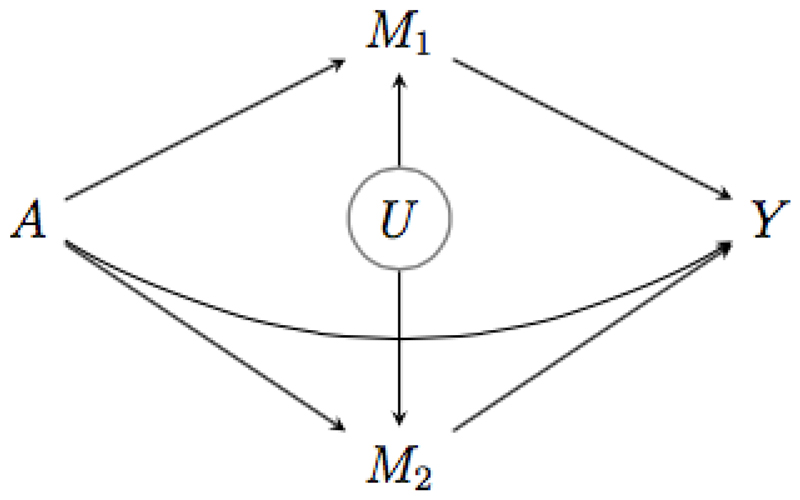
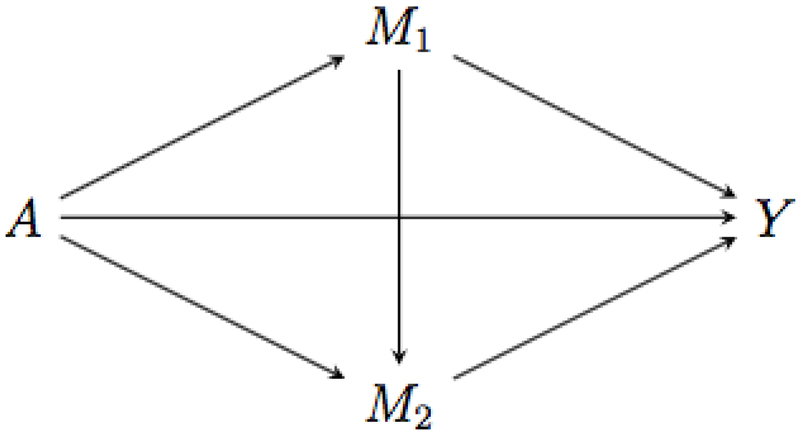
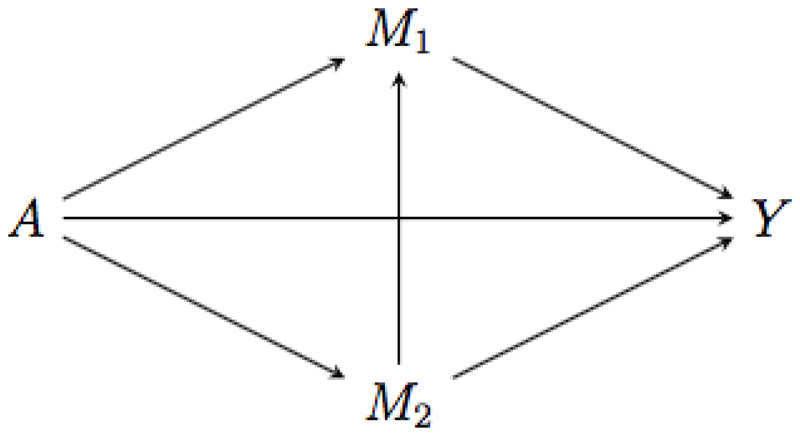
The mediation formula for the identification of natural (in)direct effects has facilitated mediation analyses that better respect the nature of the data, with greater consideration of the need for confounding control. The default assumptions on which it relies are strong, however. In particular, they are known to be violated when confounders of the mediator-outcome association are affected by the exposure. This complicates extensions of counterfactual-based mediation analysis to settings that involve repeatedly measured mediators, or multiple correlated mediators. VanderWeele, Vansteelandt, and Robins introduced so-called interventional (in)direct effects. These can be identified under much weaker conditions than natural (in)direct effects, but have the drawback of not adding up to the total effect. In this article, we adapt their proposal to achieve an exact decomposition of the total effect, and extend it to the multiple mediator setting. Interestingly, the proposed effects capture the path-specific effects of an exposure on an outcome that are mediated by distinct mediators, even when-as often-the structural dependence between the multiple mediators is unknown, for instance, when the direction of the causal effects between the mediators is unknown, or there may be unmeasured common causes of the mediators.
Conflict of interest statement
The authors report no conflicts of interest.
Figures
References
-
- Avin C, Shpitser I, Pearl J. Identifiability of path-specific effects. Proceedings of the International Joint Conferences on Artificial Intelligence; 2005. pp. 357–363.
-
- Didelez V, Dawid A, Geneletti S. Direct and indirect effects of sequential treatments. Proceedings of the 22nd Annual Conference on Uncertainty in Artificial Intelligence; 2006. pp. 138–146.
-
- Imai K, Yamamoto T. Identification and sensitivity analysis for multiple causal mechanisms: Revisiting evidence from framing experiments. Political Analysis. 2013;21:141–171. doi: 10.1093/pan/mps040. - DOI
Publication types
MeSH terms
Grants and funding
LinkOut - more resources
Full Text Sources
Other Literature Sources
Medical
