Review
. 2016 Dec 7;20(1):391.
doi: 10.1186/s13054-016-1573-1.

Immunomodulation after ischemic stroke: potential mechanisms and implications for therapy

Affiliations
Review

Immunomodulation after ischemic stroke: potential mechanisms and implications for therapy

Cynthia Santos Samary et al. Crit Care. .

Erratum in

Abstract

Brain injuries are often associated with intensive care admissions, and carry high morbidity and mortality rates. Ischemic stroke is one of the most frequent causes of injury to the central nervous system. It is now increasingly clear that human stroke causes multi-organ systemic disease. Brain inflammation may lead to opposing local and systemic effects. Suppression of systemic immunity by the nervous system could protect the brain from additional inflammatory damage; however, it may increase the susceptibility to infection. Pneumonia and urinary tract infection are the most common complications occurring in patients after stroke. The mechanisms involved in lung-brain interactions are still unknown, but some studies have suggested that inhibition of the cholinergic anti-inflammatory pathway and release of glucocorticoids, catecholamines, and damage-associated molecular patterns (DAMPs) are among the pathophysiological mechanisms involved in communication from the ischemic brain to the lungs after stroke. This review describes the modifications in local and systemic immunity that occur after stroke, outlines mechanisms of stroke-induced immunosuppression and their role in pneumonia, and highlights potential therapeutic targets to reduce post-stroke complications. Despite significant advances towards a better understanding of the pathophysiology of ischemic stroke-induced immunosuppression and stroke-associated pneumonia (SAP) in recent years, many unanswered questions remain. The true incidence and outcomes of SAP, especially in intensive care unit settings, have yet to be determined, as has the full extent of stroke-induced immunosuppression and its clinical implications.

Keywords: Damage-associated molecular patterns; Immunosuppression; Inflammation; Ischemic stroke; Stroke-associated pneumonia.


Figures
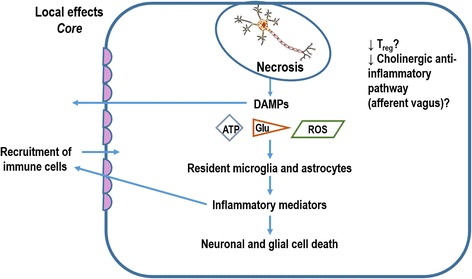
Fig. 1
Fig. 1
In the ischemic core, energy failure induces local excitotoxicity and peri-infarct depolarization, which lead to cell death, mainly by necrosis. The necrotic cells release several endogenous damage-associated molecular patterns (DAMPs): glutamate (Glu), reactive oxygen species (ROS), and adenosine triphosphate (ATP), which activate resident microglial cells and astrocytes to trigger downstream inflammatory signaling cascades. These mediators trigger the recruitment of peripheral immune cells in an attempt to initiate clearance of cell debris and healing in the brain. This process will induce further neuronal and glial cell death
Fig. 2
Fig. 2
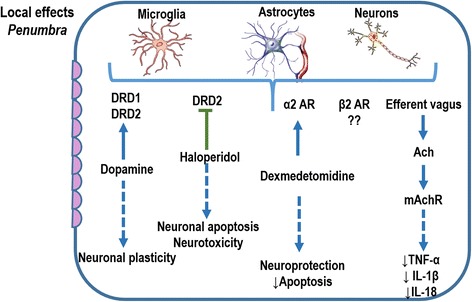
In the ischemic penumbra, excitotoxicity and peri-infarct depolarization lead to cell death by necrosis or apoptosis. Microglia, astrocytes, and neurons express receptors which can be activated or inhibited by some therapies, thus resulting in neuroprotection in this area of penumbra. Solid blue lines represent stimulation of the receptors. Dashed blue lines represent the effects resulting from stimulation. Solid green lines represent inhibition of the receptor. Dopamine receptor D1 (DRD1), dopamine receptor D2 (DRD2), α2 adrenergic receptor (ARα2), β2 adrenergic receptor (ARβ2), acetylcholine (Ach), muscarinic acetylcholine receptor (mAchR), tumor necrosis factor (TNF)-α, interleukin (IL)-1β, and IL-18
Fig. 3
Fig. 3
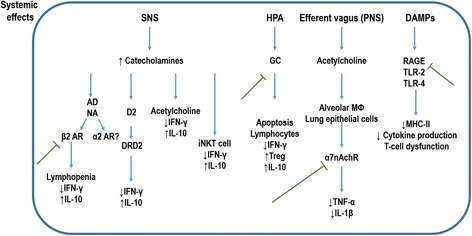
Ischemic stroke induces systemic immunosuppression mediated by several factors. These are: (1) overactivation of the sympathetic nervous system (SNS) results in secretion of catecholamines, which act on β-adrenergic receptors (ARβ2), dopaminergic receptors (dopamine receptor D2, DRD2), acetylcholine, and hepatic invariant natural killer T-cell (iNKT) stimulation; (2) activation of the hypothalamic-pituitary-adrenal (HPA) axis results in excessive glucocorticoid (GC) secretion, which acts on T cells to reduce interferon (IFN)-γ production, inducing apoptotic cell death and promoting interleukin (IL)-10 secretion through regulatory T cells (T reg); (3) parasympathetic nervous system (PNS) stimulation activates the cholinergic anti-inflammatory pathway, driven by the efferent vagus nerve at nAChRα7 receptors expressed in alveolar macrophages () and lung epithelial cells, reducing tumor necrosis factor (TNF)-α and interleukin (IL)-1β; and (4) damage-associated molecular patterns (DAMPs) are released by cells undergoing non-apoptotic death or by immune system cells, characterized by reduced major histocompatibility complex (MHC)-II expression, decreased cytokine production upon stimulation, and T cell dysfunction. This contributes to the overall immunosuppressive state after stroke, which is the main explanation for post-stroke susceptibility to infection. Blue arrows represent the systemic effects of stroke. Green lines represent possible therapeutic targets to prevent systemic immunosuppression and stroke-associated pneumonia. AD adrenalin, NR noradrenaline, RAGE receptor for advanced glycation end-products, TLR toll-like receptor

References

    1. Seshadri S, Beiser A, Kelly-Hayes M, et al. The lifetime risk of stroke: estimates from the Framingham Study. Stroke. 2006;37(2):345–50. doi: 10.1161/01.STR.0000199613.38911.b2. - DOI - PubMed
    1. Strong K, Mathers C, Bonita R. Preventing stroke: saving lives around the world. Lancet Neurol. 2007;6(2):182–7. doi: 10.1016/S1474-4422(07)70031-5. - DOI - PubMed
    1. Warlow CP. Epidemiology of stroke. Lancet. 1998;352(Suppl 3):SIII1–4. doi: 10.1016/S0140-6736(98)90086-1. - DOI - PubMed
    1. Chamorro A, Urra X, Planas AM. Infection after acute ischemic stroke: a manifestation of brain-induced immunodepression. Stroke. 2007;38(3):1097–103. doi: 10.1161/01.STR.0000258346.68966.9d. - DOI - PubMed
    1. Westendorp WF, Nederkoorn PJ, Vermeij JD, et al. Post-stroke infection: a systematic review and meta-analysis. BMC Neurol. 2011;11:110. doi: 10.1186/1471-2377-11-110. - DOI - PMC - PubMed

Substances