


Attentional Bias Modification With Serious Game Elements: Evaluating the Shots Game
- PMID: 27923780
- PMCID: PMC5174726
- DOI: 10.2196/games.6464
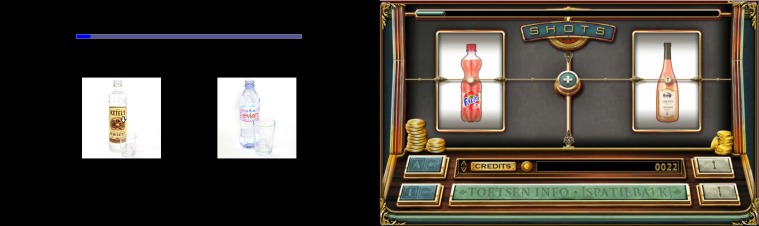
Attentional Bias Modification With Serious Game Elements: Evaluating the Shots Game
Abstract
Background: Young adults often experiment with heavy use of alcohol, which poses severe health risks and increases the chance of developing addiction problems. In clinical patients, cognitive retraining of automatic appetitive processes, such as selective attention toward alcohol (known as "cognitive bias modification of attention," or CBM-A), has been shown to be a promising add-on to treatment, helping to prevent relapse.
Objective: To prevent escalation of regular use into problematic use in youth, motivation appears to play a pivotal role. As CBM-A is often viewed as long and boring, this paper presents this training with the addition of serious game elements as a novel approach aimed at enhancing motivation to train.
Methods: A total of 96 heavy drinking undergraduate students carried out a regular CBM-A training, a gamified version (called "Shots"), or a placebo training version over 4 training sessions. Measures of motivation to change their behavior, motivation to train, drinking behavior, and attentional bias for alcohol were included before and after training.
Results: Alcohol attentional bias was reduced after training only in the regular training condition. Self-reported drinking behavior was not affected, but motivation to train decreased in all conditions, suggesting that the motivational features of the Shots game were not enough to fully counteract the tiresome nature of the training. Moreover, some of the motivational aspects decreased slightly more in the game condition, which may indicate potential detrimental effects of disappointing gamification.
Conclusions: Gamification is not without its risks. When the motivational value of a training task with serious game elements is less than expected by the adolescent, effects detrimental to their motivation may occur. We therefore advise caution when using gamification, as well as underscore the importance of careful scientific evaluation.
Keywords: adolescents; attentional bias; cognitive bias modification (CBM); cognitive training; motivation; serious games.
©Wouter J Boendermaker, Soraya Sanchez Maceiras, Marilisa Boffo, Reinout W Wiers. Originally published in JMIR Serious Games (http://games.jmir.org), 06.12.2016.
Conflict of interest statement
Conflicts of Interest: None declared.
Figures
References
-
- Singleton RA. Collegiate alcohol consumption and academic performance. J Stud Alcohol Drugs. 2007 Jul;68(4):548–55. - PubMed
-
- Kuntsche E, Rossow I, Simons-Morton B, Ter Bogt T, Kokkevi A, Godeau E. Not early drinking but early drunkenness is a risk factor for problem behaviors among adolescents from 38 European and North American countries. Alcohol Clin Exp Res. 2013 Feb;37(2):308–14. doi: 10.1111/j.1530-0277.2012.01895.x. http://europepmc.org/abstract/MED/23240610 - DOI - PMC - PubMed
-
- Deutsch R, Strack F. Reflective and impulsive determinants of addictive behaviors. In: Wiers RW, Stacy AW, editors. Handbook of Implicit Cognition and Addiction. Thousand Oaks, CA: Sage; 2006. pp. 45–57.
-
- Wiers RW, Bartholow BD, van den Wildenberg E, Thush C, Engels RC, Sher KJ, Grenard J, Ames SL, Stacy AW. Automatic and controlled processes and the development of addictive behaviors in adolescents: a review and a model. Pharmacol Biochem Behav. 2007 Feb;86(2):263–83. doi: 10.1016/j.pbb.2006.09.021. - DOI - PubMed
-
- Gladwin TE, Figner B, Crone EA, Wiers RW. Addiction, adolescence, and the integration of control and motivation. Dev Cogn Neurosci. 2011 Oct;1(4):364–76. doi: 10.1016/j.dcn.2011.06.008. http://linkinghub.elsevier.com/retrieve/pii/S1878-9293(11)00065-X - DOI - PMC - PubMed
LinkOut - more resources
Full Text Sources
Other Literature Sources
Research Materials
