. 2017 Apr;188(1):138-147.
doi: 10.1111/cei.12909. Epub 2017 Jan 18.

Lectin complement pathway proteins in healthy individuals

Affiliations

Lectin complement pathway proteins in healthy individuals

A Troldborg et al. Clin Exp Immunol. 2017 Apr.

Abstract

Since the discovery of the lectin pathway of complement activation, numerous clinical cohorts have been examined for one or more proteins, with the intention of uncovering the functions of the proteins or with the aim of discovering new biomarkers or diagnostic tools. To unveil the abnormal, it is pivotal to know the normal. Our aim was to describe the concentrations of the 11 known proteins of the lectin pathway in serum and plasma and to uncover possible gender differences, age and diurnal variations, which must be taken into account for investigation in different cohorts. We examined the concentrations of all lectin pathway proteins mannan-binding lectin (MBL), H-ficolin, L-ficolin, M-ficolin, collectin-K1, collectin-L1, MBL-associated serine protease 2 (MASP-2), MASP-3, MBL-associated protein of 44 kDa (MAp44) and MAp19 in 300 Danish blood donors in serum and ethylenediamine tetraacetic acid (EDTA) plasma in established assays, and we further developed a new assay to measure MASP-1 in the same samples. We found significant differences in concentrations between serum and plasma for all proteins except for MBL and MASP-3. H-ficolin, M-ficolin and MAp19 displayed convincing diurnal variation. H-ficolin, in particular, halved from morning to the middle of the night. There were gender differences for most proteins, whereas age did not seem to influence concentration. The present study underlines the necessity of considering which material to use, correct matching and a trial design that takes the nature of the protein into account in order for the outcome of cohort studies to have significant relevance.

Keywords: complement system; diurnal variation; innate immunity; lectin pathway.


Figures

Figure 1
Figure 1
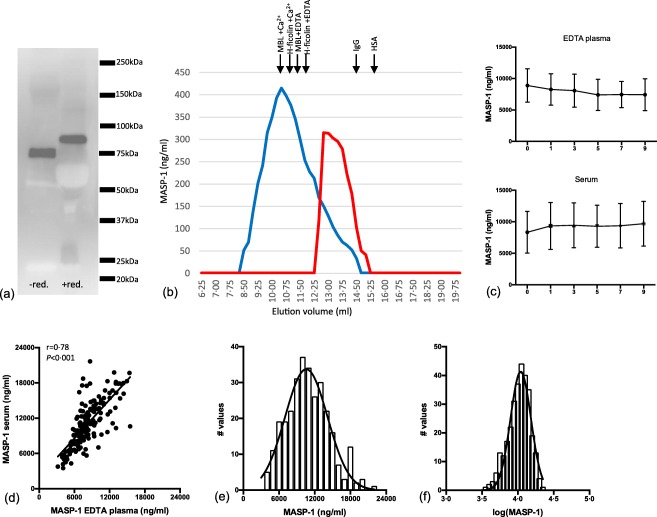
Characterization of the anti‐mannan‐binding lectin (MBL)‐associated serine protease 1 (MASP‐1) monoclonal antibody (mAb) and estimation of MASP‐1 in donor samples. (a) Western blot of 1 μl plasma under non‐reducing and reducing conditions developed with antibody against MASP‐1 (5A6B7). (b) Serum fractionated by gel‐permeation chromatography (GPC) in buffer with calcium (blue) or in buffer with high NaCl and ethylenediamine tetraacetic acid (EDTA) (red). Fractions were tested for MASP‐1 in the developed MASP‐1 assay. In the buffer with calcium, the main MASP‐1 signal is seen in volumes corresponding to where MBL and H‐ficolin elutes (given by arrows above the graph), whereas EDTA/high NaCl dissociates the MASPs from the pattern recognition molecules (PRMs) and the main signal is now seen in fractions eluting slightly earlier than immunoglobulin (Ig)G (150 kDa). (c) Serum and EDTA samples (n = 10) exposed to nine freeze/thaw cycles and measured for MASP‐1. Each time‐point represents the average of 10 different samples with a 95% confidence interval. (d) Correlation between measurements of MASP‐1 in serum and EDTA plasma. (e) Distribution of MASP‐1 concentrations in serum of 300 blood donors. (f) Distribution of MASP‐1 concentrations after log‐transformation. [Colour figure can be viewed at wileyonlinelibrary.com]
Figure 2
Figure 2
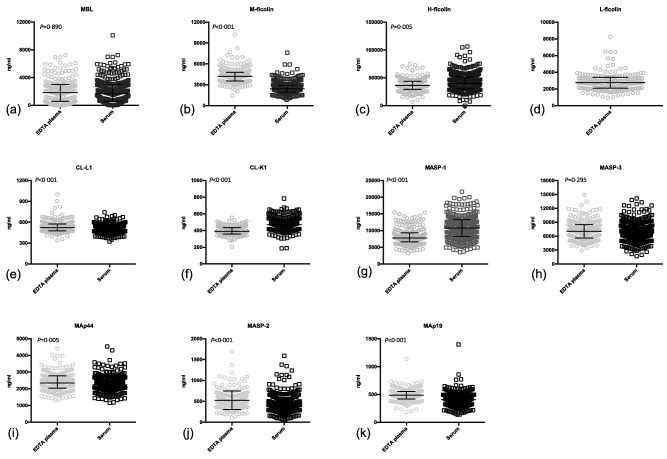
Concentration in plasma and serum of lectin pathway proteins. Bars indicate median and interquartile range. The actual values are listed in Table 1.
Figure 3
Figure 3
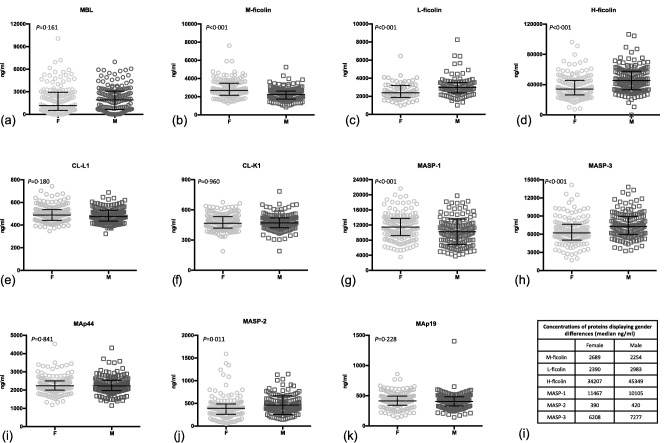
The concentrations of the lectin pathway proteins in serum [ethylenediamine tetraacetic acid (EDTA) plasma for L‐ficolin] from male (M) and female (F) blood donors (a–k). The same differences were observed for proteins in serum and EDTA plasma. Bars indicate median and interquartile range. Table indicates specific levels for proteins where a significant gender difference was observed (l).
Figure 4
Figure 4
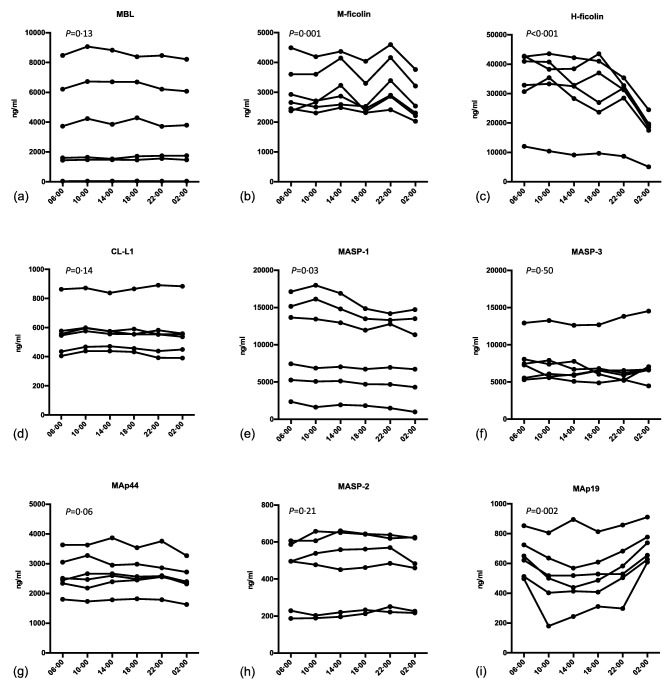
Diurnal variation of lectin pathway proteins in ethylenediamine tetraacetic acid (EDTA) plasma from six healthy individuals. Samples were taken at the time‐points given on the x‐axis. P‐values denote if there is an overall significant variation in concentration during 24 h.
Figure 5
Figure 5
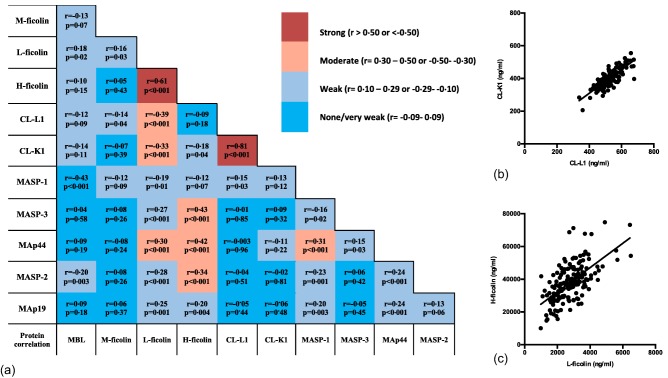
Plots and analysis of correlation between concentrations of lectin pathway (LP) proteins. Pairwise correlation between the concentrations of the proteins of the lectin pathway are given in (a). Grey tones indicate strong, moderate, weak and very weak correlations, as indicated on the bar next to (a). Spearman's rho and a P‐value are given for each correlation. Data points corresponding to the median values of the estimated concentrations are shown for the two strongest correlations observed, collectin liver‐1 (CL‐L1) versus CL‐K1 (b) and H‐ficolin versus L‐ficolin (c). [Colour figure can be viewed at wileyonlinelibrary.com]

References

    1. Bajic G, Degn SE, Thiel S, Andersen GR. Complement activation, regulation, and molecular basis for complement‐related diseases. EMBO J 2015; 34:2735–57. - PMC - PubMed
    1. Merle NS, Church SE, Fremeaux‐Bacchi V, Roumenina LT. Complement system part I – molecular mechanisms of activation and regulation. Front Immunol 2015; 6:262. - PMC - PubMed
    1. Kjaer TR, Thiel S, Andersen GR. Toward a structure‐based comprehension of the lectin pathway of complement. Mol Immunol 2013; 56:222–31. - PubMed
    1. Henriksen ML, Brandt J, Andrieu J‐P et al Heteromeric complexes of native collectin kidney 1 and collectin liver 1 are found in the circulation with MASPs and activate the complement system. J Immunol 2013; 191:6117–27. - PubMed
    1. Degn SE, Thiel S. Humoral pattern recognition and the complement system. Scand J Immunol 2013; 78:181–93. - PubMed

Publication types

Substances