Family Cluster Analysis of Severe Fever with Thrombocytopenia Syndrome Virus Infection in Korea
- PMID: 27928083
- PMCID: PMC5154449
- DOI: 10.4269/ajtmh.16-0527
Family Cluster Analysis of Severe Fever with Thrombocytopenia Syndrome Virus Infection in Korea
Abstract
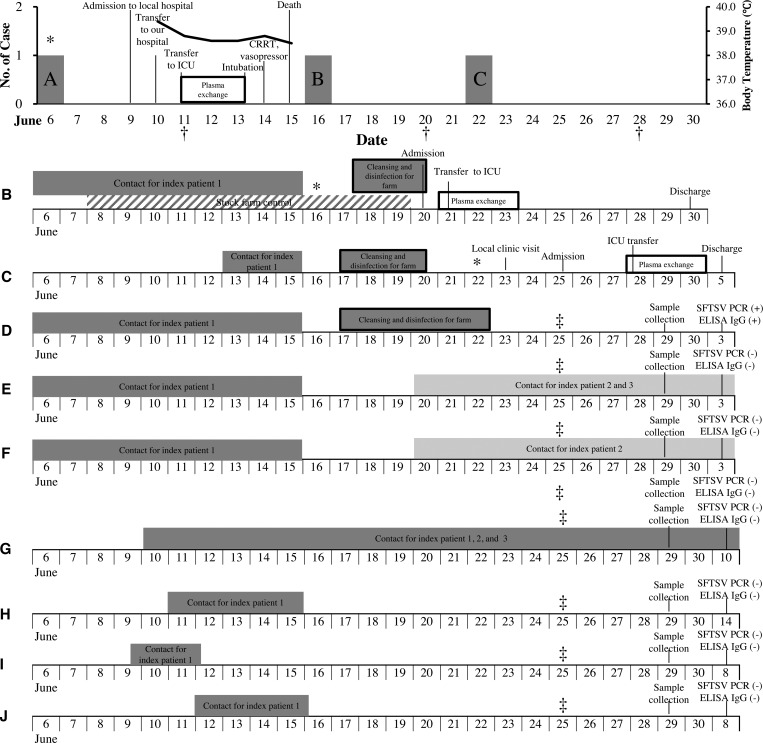
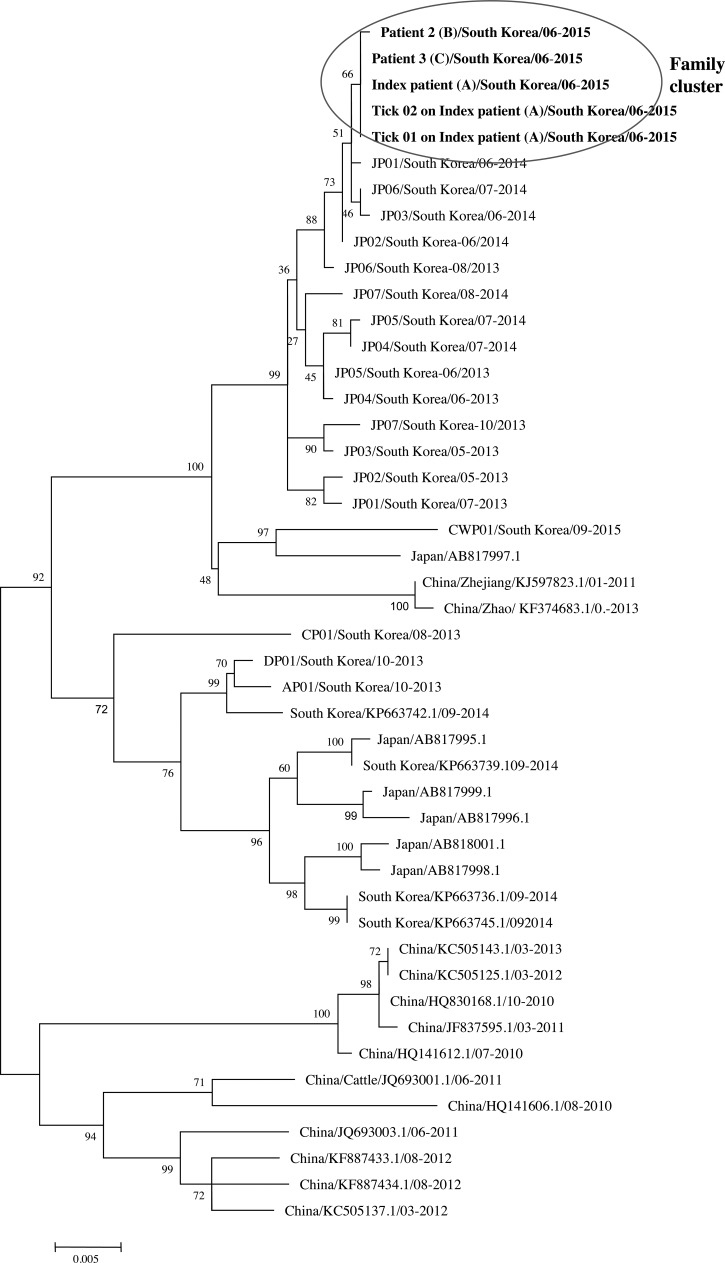
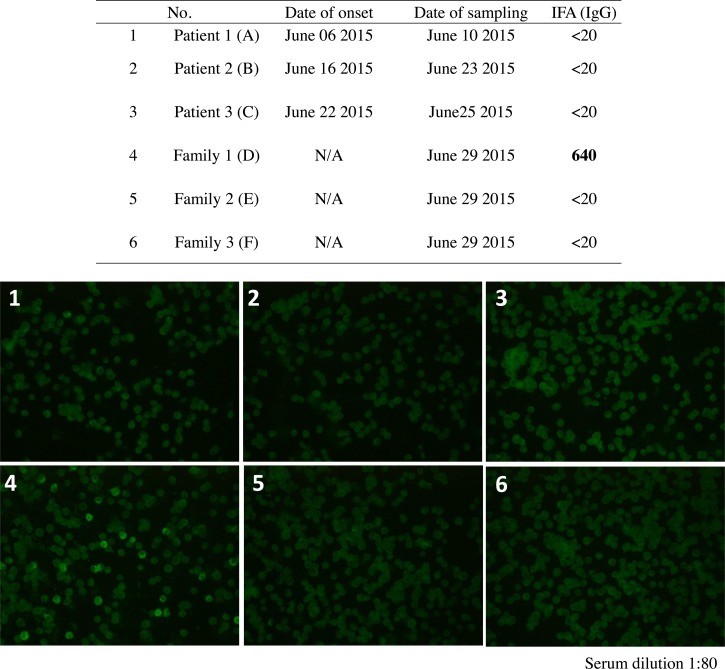
Severe fever with thrombocytopenia syndrome (SFTS) is tick-borne viral disease that was first suspected in China in 2009. The causative virus (SFTSV) was isolated in 2009 and reported in 2011, and SFTSV expanded its geographic distribution in 2012-2013, from China to South Korea and Japan. Most SFTSV infections occur through Haemaphysalis longicornis However, SFTSV infection can also occur between family members, and nosocomial transmission of SFTSV is also possible through close contact with a patient. In this study, we first analyzed clinical, epidemiological, and laboratory data for SFTS patients and family members of an index patient in Korea. The S segment of SFTSV was amplified from the sera of three patients, and the S segment of SFTSV and IgG specific to SFTSV were detected in the serum from one family member; although this individual had no history of exposure to H. longicornis, she frequently had close contact with the index patient. In Korea, SFTSV infection among family members does not have to be reported, and we suggest that person-to-person transmission of SFTSV among family members is possible in Korea.
© The American Society of Tropical Medicine and Hygiene.
Figures
References
-
- Yu XJ, Liang MF, Zhang SY, Liu Y, Li JD, Sun YL, Zhang L, Zhang QF, Popov VL, Li C, Qu J, Li Q, Zhang YP, Hai R, Wu W, Wang Q, Zhan FX, Wang XJ, Kan B, Wang SW, Wan KL, Jing HQ, Lu JX, Yin WW, Zhou H, Guan XH, Liu JF, Bi ZQ, Liu GH, Ren J, Wang H, Zhao Z, Song JD, He JR, Wan T, Zhang JS, Fu XP, Sun LN, Dong XP, Feng ZJ, Yang WZ, Hong T, Zhang Y, Walker DH, Wang Y, Li DX. Fever with thrombocytopenia associated with a novel bunyavirus in China. N Engl J Med. 2011;364:1523–1532. - PMC - PubMed
-
- Lee KH, Medlock JM, Heo ST. Severe fever with thrombocytopenia syndrome virus, Crimean-Congo haemorrhagic fever virus, and migratory birds. J Bacteriol Virol. 2013;43:235–243.
-
- Takahashi T, Maeda K, Suzuki T, Ishido A, Shigeoka T, Tominaga T, Kamei T, Honda M, Ninomiya D, Sakai T, Senba T, Kaneyuki S, Sakaguchi S, Satoh A, Hosokawa T, Kawabe Y, Kurihara S, Izumikawa K, Kohno S, Azuma T, Suemori K, Yasukawa M, Mizutani T, Omatsu T, Katayama Y, Miyahara M, Ijuin M, Doi K, Okuda M, Umeki K, Saito T, Fukushima K, Nakajima K, Yoshikawa T, Tani H, Fukushi S, Fukuma A, Ogata M, Shimojima M, Nakajima N, Nagata N, Katano H, Fukumoto H, Sato Y, Hasegawa H, Yamagishi T, Oishi K, Kurane I, Morikawa S, Saijo M. The first identification and retrospective study of severe fever with thrombocytopenia syndrome in Japan. J Infect Dis. 2014;209:816–827. - PMC - PubMed
-
- The Korea Centers for Disease Control and Prevention Prevention of Severe Fever with Thrombocytopenia Syndrome. http://is.cdc.go.kr/nstat/index.jsp Available at. Accessed August 1, 2015.
Publication types
MeSH terms
Substances
LinkOut - more resources
Full Text Sources
Other Literature Sources