


The diverse roles of the TNF axis in cancer progression and metastasis
- PMID: 27928197
- PMCID: PMC5138060
The diverse roles of the TNF axis in cancer progression and metastasis
Abstract
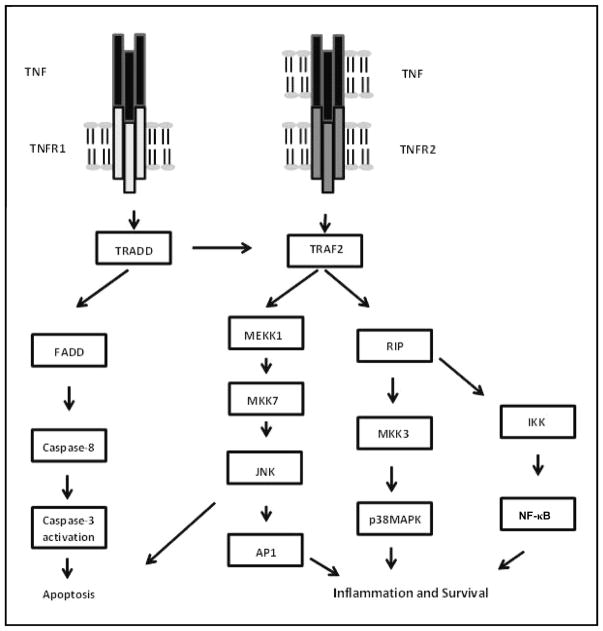
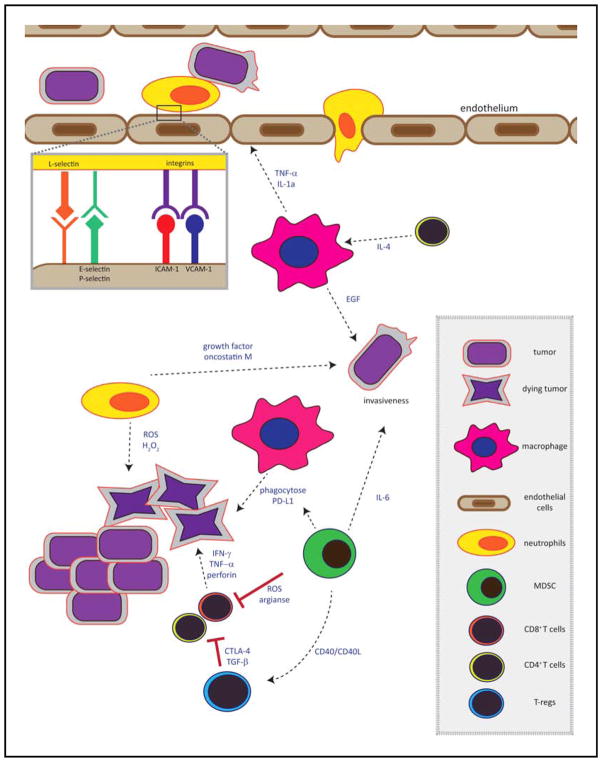
Metastasis is a multi-step process that ultimately depends on the ability of disseminating cancer cells to establish favorable communications with their microenvironment. The tumor microenvironment consists of multiple and continuously changing cellular and molecular components. One of the factors regulating the tumor microenvironment is TNF-α, a pleiotropic cytokine that plays key roles in apoptosis, angiogenesis, inflammation and immunity. TNF-α can have both pro- and anti-tumoral effects and these are transmitted via two major receptors, the 55 kDa TNFR1 and the 75 kDa TNFR2 that have distinct, as well as overlapping functions. TNFR1 is ubiquitously expressed while the expression of TNFR2 is more restricted, mainly to immune cells. While TNFR1 can transmit pro-apoptotic or pro-survival signals through a complex network of downstream mediators, the role of TNFR2 is less well understood. One of its main functions is to act as a survival factor and moderate the pro-apoptotic effects of TNFR1, particularly in immune cells. In this review, we summarize the evidence for the involvement of the TNF system in the progression of the metastatic process from its contribution to the early steps of tumor cell invasion to its role in the colonization of distant sites, particularly the liver. We show how the TNF receptors each contribute to these processes by regulating and shaping the tumor microenvironment. Current evidence and concepts on the potential use of TNF targeting agents for cancer prevention and therapy are discussed.
Keywords: TNF-α; TNFR; immune cells; liver; metastasis.
Conflict of interest statement
STATEMENT The authors have no conflict of interest to declare.
Figures
References
-
- Nguyen DX, Massague J. Nat Rev Genet. 2007;8:341–352. - PubMed
-
- Chambers AF, Groom AC, MacDonald IC. Nat Rev Cancer. 2002;2:563–572. - PubMed
-
- Weiss L, Harlos JP, Torhorst J, Gunthard B, Hartveit F, Svendsen E, Huang WL, Grundmann E, Eder M, Zwicknagl M, Cochrane HR, Stock D, Wright C, Horne CHW. J Cancer Res Clin Oncol. 1988;114:605–612. - PubMed
-
- Weiss L. Clin Exp Metastasis. 1992;10:191–199. - PubMed
-
- Fuxe J, Karlsson MC. Semin Cancer Biol. 2012;22:455–461. - PubMed
Grants and funding
LinkOut - more resources
Full Text Sources