Differences in the Prevalence of Human Papillomavirus (HPV) in Head and Neck Squamous Cell Cancers by Sex, Race, Anatomic Tumor Site, and HPV Detection Method
- PMID: 27930766
- PMCID: PMC7286346
- DOI: 10.1001/jamaoncol.2016.3067
Differences in the Prevalence of Human Papillomavirus (HPV) in Head and Neck Squamous Cell Cancers by Sex, Race, Anatomic Tumor Site, and HPV Detection Method
Abstract
Importance: Human papillomavirus (HPV) causes an increasing proportion of oropharyngeal squamous cell carcinomas (OPSCCs), particularly in white men. The prevalence of HPV among other demographic groups and other anatomic sites of HNSCC is unclear.
Objective: To explore the role of HPV tumor status among women and nonwhites with OPSCC and patients with nonoropharyngeal head and neck squamous cell carcinoma (non-OP HNSCC).
Design, setting, and participants: Retrospective cohort study at 2 tertiary academic centers including cases diagnosed 1995 through 2012, oversampled for minorities and females. A stratified random sample of 863 patients with newly diagnosed SCC of the oral cavity, oropharynx, larynx, or nasopharynx was used.
Main outcomes and measures: Outcomes were HPV status as measured by p16 immunohistochemical analysis, HPV16 DNA in situ hybridization (ISH), and high-risk HPV E6/E7 mRNA ISH.
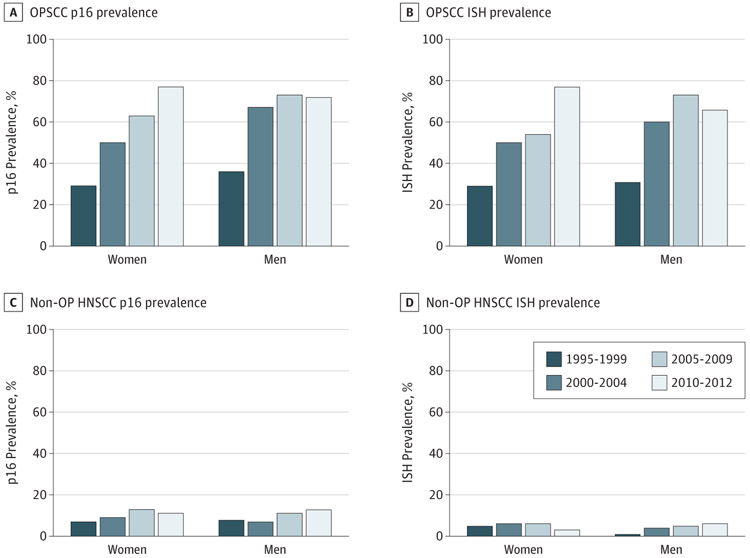
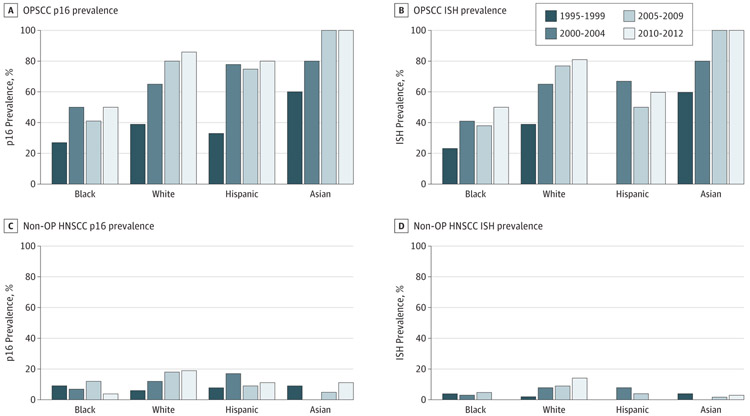
Results: Of 863 patients, 551 (63.9%) were male and median age was 58 years (interquartile range, 51-68 years). Among 240 OPSCCs, 144 (60%) were p16 positive (p16+), 115 (48%) were HPV16 DNA ISH positive (ISH16+), and 134 (56%) were positive for any oncogenic HPV type (ISH+). From 1995 to 2012, the proportion of p16+ OPSCC increased significantly among women (from 29% to 77%; P = .005 for trend) and men (36% to 72%; P < .001 for trend), as well as among whites (39% to 86%; P < .001 for trend) and nonwhites (32% to 62%; P = .02 for trend). Similar results were observed for ISH+ OPSCC (P ≤ .01 for all). Among 623 non-OP HNSCCs, a higher proportion were p16+ compared with ISH positive (62 [10%] vs 30 [5%]; P = .001). A high proportion (26 of 62 [42%]) of these p16+ non-OP HNSCCs were found in sites adjacent to the oropharynx. The proportion of p16+ and ISH+ non-OP HNSCCs were similar by sex. Over time, the proportion of non-OP HNSCCs that were p16+ (or ISH+) increased among whites (P = .04 for trend) but not among nonwhites (each P > .51 for trend). Among OPSCCs, p16 had high sensitivity (100%), specificity (91%), and positive (93%) and negative predictive value (100%) for ISH positivity. In non-OP HNSCCs, p16 had lower sensitivity (83%) and positive predictive value (40%) but high specificity (94%) and negative predictive value (99%) for ISH positivity.
Conclusions and relevance: During 1995 through 2012, the proportion of OPSCCs caused by HPV has increased significantly. This increase was not restricted to white men but was a consistent trend for women and men, as well as for white and nonwhite racial groups. Few non-OP HNSCCs were HPV related. P16 positivity was a good surrogate for ISH+ tumor status among OPSCC, but not a good surrogate for non-OP HNSCC.
Conflict of interest statement
Figures
References
-
- Frisch M, Hjalgrim H, Jaeger AB, Biggar RJ. Changing patterns of tonsillar squamous cell carcinoma in the United States. Cancer Causes Control. 2000;11(6):489–495. - PubMed
-
- Shiboski CH, Schmidt BL, Jordan RCK. Tongue and tonsil carcinoma: increasing trends in the US population ages 20-44 years. Cancer. 2005;103(9):1843–1849. - PubMed
-
- Chaturvedi AK, Engels EA, Anderson WF, Gillison ML. Incidence trends for human papillomavirus-related and -unrelated oral squamous cell carcinomas in the United States. J Clin Oncol. 2008;26(4):612–619. - PubMed
Grants and funding
LinkOut - more resources
Full Text Sources
Other Literature Sources
Research Materials
Miscellaneous