Review
. 2017 Apr 1;23(4):235-247.
doi: 10.1093/molehr/gaw071.

Microfluidic analysis of oocyte and embryo biomechanical properties to improve outcomes in assisted reproductive technologies

Affiliations
Review

Microfluidic analysis of oocyte and embryo biomechanical properties to improve outcomes in assisted reproductive technologies

Livia Z Yanez et al. Mol Hum Reprod. .

Abstract

Measurement of oocyte and embryo biomechanical properties has recently emerged as an exciting new approach to obtain a quantitative, objective estimate of developmental potential. However, many traditional methods for probing cell mechanical properties are time consuming, labor intensive and require expensive equipment. Microfluidic technology is currently making its way into many aspects of assisted reproductive technologies (ART), and is particularly well suited to measure embryo biomechanics due to the potential for robust, automated single-cell analysis at a low cost. This review will highlight microfluidic approaches to measure oocyte and embryo mechanics along with their ability to predict developmental potential and find practical application in the clinic. Although these new devices must be extensively validated before they can be integrated into the existing clinical workflow, they could eventually be used to constantly monitor oocyte and embryo developmental progress and enable more optimal decision making in ART.

Keywords: biomechanics; embryo development; embryology; fertilization; microfluidics; oocyte maturation.


Figures

Figure 1
Figure 1
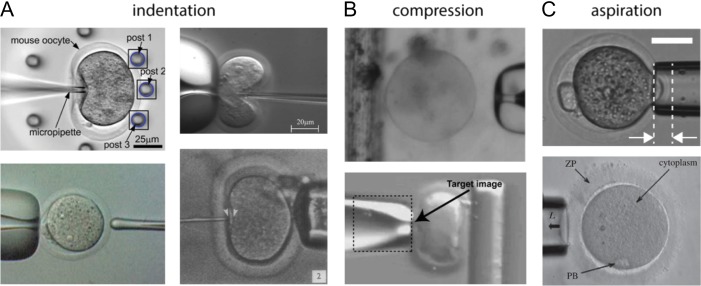
Examples of microfluidic devices used to probe oocyte and embryo mechanical properties. The approaches to measure mechanics can be separated into three main categories. (A) Approaches involving indentation. The top left image is from Liu et al. (2012) and shows an oocyte being pushed against a group of flexible posts. The top right image is from Sun et al. (2003) and shows an oocyte deformed by a force-sensing microneedle. The bottom right image is from Green (1987) and shows an oocyte compressed by a quartz-fiber ‘poker’. The bottom left image is from Murayama et al. (2004) and shows the oocyte being probed by a MTS from the left side. (B) Approaches involving compression. The top image is from Abadie et al. (2014) and shows an oocyte about to be compressed between a micropipette and the edge of a floating platform. The bottom image is from Wacogne et al. (2008) and shows an oocyte being compressed between a micropipette and a flexible post (side view). The ‘target image’ text refers to the algorithm used to track the pipette displacement. (C) Approaches involving aspiration. The top image is from Yanez et al. (2016) and shows an embryo partially aspirated into a micropipette. The region between the arrows is the aspiration depth into the micropipette. The bottom image is from Khalilian et al. (2010b) and shows a portion of the ZP being aspirated into a micropipette.
Figure 2
Figure 2
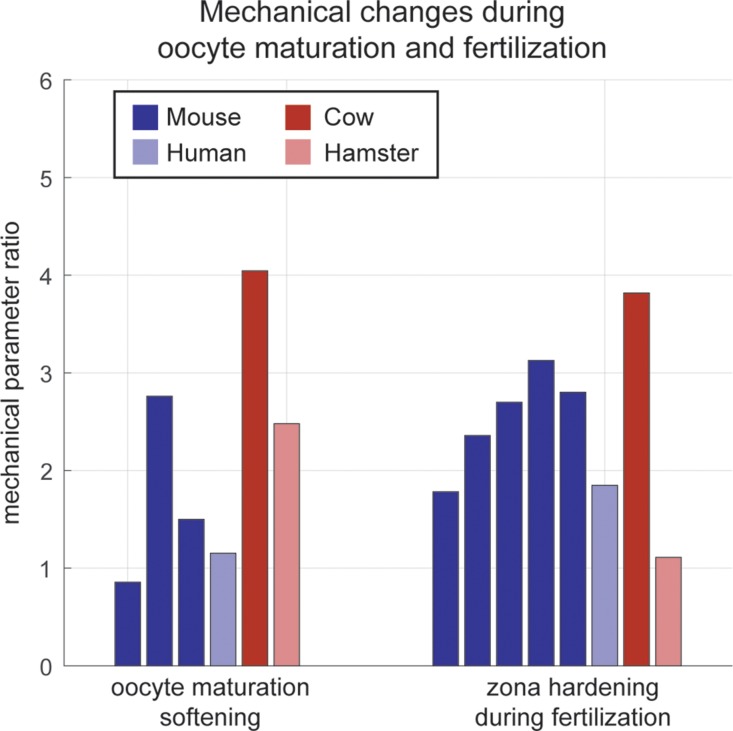
Comparison of measured values of oocyte and embryo mechanical properties using different measurement devices and in different species. Y-axis represents ratio of measured mechanical parameters (for example, Young's modulus or stiffness) between immature and mature oocytes, or between mature oocytes and fertilized embryos. Data are from the following studies: (Drobnis et al., 1988; Murayama et al., 2006; Papi et al., 2010; Abadie et al., 2014; Yanez et al., 2016) for oocyte softening and (Drobnis et al., 1988; Sun et al., 2003; Murayama et al., 2006; Papi et al., 2010; Khalilian et al., 2010b; Yanez et al., 2016) for zona hardening, from left to right. Some studies measured mechanics for multiple species. Results show a fairly consistent degree of zona softening during oocyte maturation and zona hardening during fertilization.
Figure 3
Figure 3
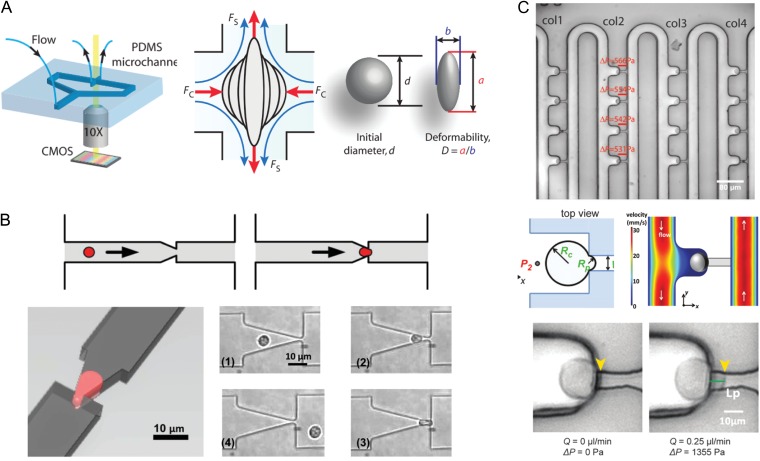
Devices for automated and high-throughput microfluidic mechanical characterization, which could be adapted to measure embryos and oocytes. (A) Hydrodynamic cell stretcher to measure deformability parameter (Tse et al., 2013). The left side of the image shows the microfluidic chip, which contains a channel that contains cells to be tested and a perpendicular channel to stretch them under continuous flow. The middle part of the image shows a schematic of a single cell being stretched, where it is subjected to a compressive (FC) and a shear (FS) force. The right part of the image shows how a ‘deformability’ parameter is calculated. (B) Micropipette aspiration translated to a microfluidic chip (Guo et al., 2012). The top panels show a schematic of a single cell being deformed to simulate micropipette aspiration, and the left panel shows the aspiration process from another angle. The panels numbered (1) through (4) show micrographs of a single neutrophil as it is deformed through a funnel constriction. (C) Device that can autonomously perform micropipette aspiration on many cells simultaneously (Lee and Liu, 2015). The top panel shows loading of single cells into columns with individual trapping structures. The middle left panel shows a schematic of a single cell undergoing aspiration, where RC is the radius of the cell and RP is the radius of the aspiration micropipette. The middle right panel shows a numerical simulation of the flow velocity around the cell. The bottom panels show a demonstration of micropipette aspiration using the device.

References

    1. Abadie J, Roux C, Piat E, Filiatre C, Amiot C. Experimental measurement of human oocyte mechanical properties on a micro and nanoforce sensing platform based on magnetic springs. Sens Actuators B Chem 2014;190:429–438.
    1. Ajduk A, Ilozue T, Windsor S, Yu Y, Seres KB, Bomphrey RJ, Tom BD, Swann K, Thomas A, Graham C et al. . Rhythmic actomyosin-driven contractions induced by sperm entry predict mammalian embryo viability. Nat Commun 2011;2:417. - PMC - PubMed
    1. Bae CY, Kim MS, Park JK. Mechanical stimulation of bovine embryos in a microfluidic culture platform. Biochip J 2011;5:106–113.
    1. Balakier H, Tarkowski AK. Diploid parthenogenetic mouse embryos produced by heat-shock and cytochalasin B. J Embryol Exp Morphol 1976;35:25–39. - PubMed
    1. Banrezes B, Sainte-Beuve T, Canon E, Schultz RM, Cancela J, Ozil JP. Adult body weight is programmed by a redox-regulated and energy-dependent process during the pronuclear stage in mouse. PLoS One 2011;6:1–11. - PMC - PubMed

Publication types

MeSH terms