Review
. 2016 Nov 11;2(11):787-799.
doi: 10.1021/acsinfecdis.6b00104. Epub 2016 Aug 5.

Integration of Global Analyses of Host Molecular Responses with Clinical Data To Evaluate Pathogenesis and Advance Therapies for Emerging and Re-emerging Viral Infections

Affiliations
Review

Integration of Global Analyses of Host Molecular Responses with Clinical Data To Evaluate Pathogenesis and Advance Therapies for Emerging and Re-emerging Viral Infections

Shane D Falcinelli et al. ACS Infect Dis. .

Abstract

Outbreaks associated with emerging and re-emerging viral pathogens continue to increase in frequency and are associated with an increasing burden to global health. In light of this, there is a need to integrate basic and clinical research for investigating the connections between molecular and clinical pathogenesis and for therapeutic development strategies. Here, we will discuss this approach with a focus on the emerging viral pathogens Middle East respiratory syndrome coronavirus (MERS-CoV), Ebola virus (EBOV), and monkeypox virus (MPXV) from the context of clinical presentation, immunological and molecular features of the diseases, and OMICS-based analyses of pathogenesis. Furthermore, we will highlight the role of global investigations of host kinases, the kinome, for investigating emerging and re-emerging viral pathogens from the context of characterizing cellular responses and identifying novel therapeutic targets. Lastly, we will address how increased integration of clinical and basic research will assist treatment and prevention efforts for emerging pathogens.

Keywords: cell signaling; emerging pathogens; high-consequence pathogens; kinases; kinomics; virology.


Conflict of interest statement

The authors declare no competing financial interest.

Figures
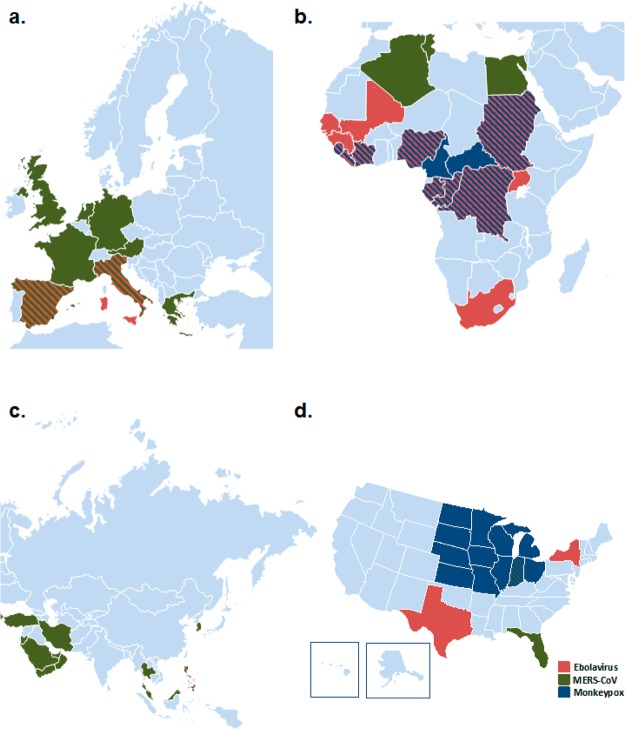
Figure 1
Figure 1
Global outbreaks of Ebola virus, MERS-CoV, and monkeypox: (a) Europe; (b) Africa; (c) Asia; (d) United States. Data include all transmission-related infections that have been documented. Laboratory accident-related infections and medical evacuations are not included.
Figure 2
Figure 2
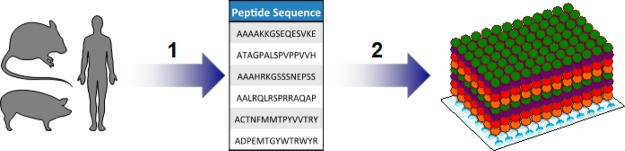
Generation of kinome peptide array targets and kinome peptide arrays: (1) species-specific proteomic or genomic information from a diverse range of species can be used to identify kinase recognition motifs that are composed of a central phosphorylation target and the surrounding amino acids (normally +4 and −4 amino acids from the central phosphorylated residue); (2) peptides that comprise the kinase recognition motifs identified in (1) are synthesized and covalently linked to a glass surface. Peptide targets are spotted in replicates of three to nine spots on each array to account for intra-array variability. Individual amino acids of the peptides are represented by orange, red, purple, and green spheres.
Figure 3
Figure 3
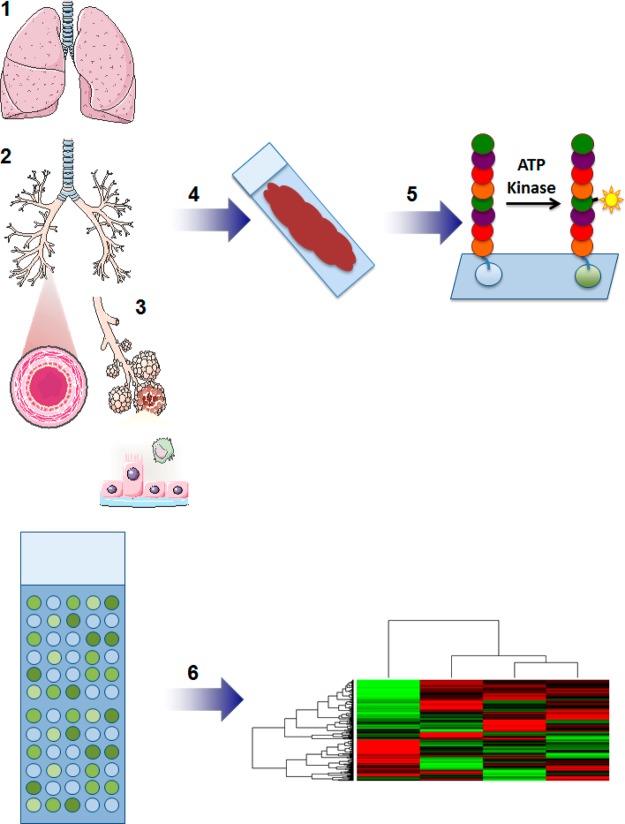
Kinome analysis of biological samples. Biological samples for kinome analysis can encompass (1) complex biological tissues (lung), (2) focused tissue sections (bronchioles), or (3) individual cell types associated with a particular tissue (alveolar epithelial cells or alveolar macrophages). (4) Biological samples are processed to generate cell lysates that are activated with ATP and applied to the kinome peptide array. (5) Following the application of the cell lysate, activated kinases in the cell lysate will recognize their respective kinase recognition motifs and phosphorylate the central phosphorylated residue of the peptide. (6) Kinome peptide arrays are subsequently stained with a phospho-specific fluorescent stain and imaged followed by comparative bioinformatics analyses. Tissue and cell images were derived and/or modified from Servier Medical Arts under a Creative Commons Attribution 3.0 Unported License.

References

    1. Jones K. E.; Patel N. G.; Levy M. A.; Storeygard A.; Balk D.; Gittleman J. L.; Daszak P. (2008) Global trends in emerging infectious diseases. Nature 451, 990–993. 10.1038/nature06536. - DOI - PMC - PubMed
    1. Arias C. A.; Murray B. E. (2015) A new antibiotic and the evolution of resistance. N. Engl. J. Med. 372, 1168–1170. 10.1056/NEJMcibr1500292. - DOI - PMC - PubMed
    1. Hunter T. (2000) Signaling – 2000 and beyond. Cell 100, 113–127. 10.1016/S0092-8674(00)81688-8. - DOI - PubMed
    1. Hunter T. (1995) Protein kinases and phosphatases: the yin and yang of protein phosphorylation and signaling. Cell 80, 225–236. 10.1016/0092-8674(95)90405-0. - DOI - PubMed
    1. Manning G.; Whyte D. B.; Martinez R.; Hunter T.; Sudarsanam S. (2002) The protein kinase complement of the human genome. Science 298, 1912–1934. 10.1126/science.1075762. - DOI - PubMed

Publication types

Substances