


Experimental evidence for chemical mate guarding in a moth
- PMID: 27934963
- PMCID: PMC5146913
- DOI: 10.1038/srep38567
Experimental evidence for chemical mate guarding in a moth
Abstract
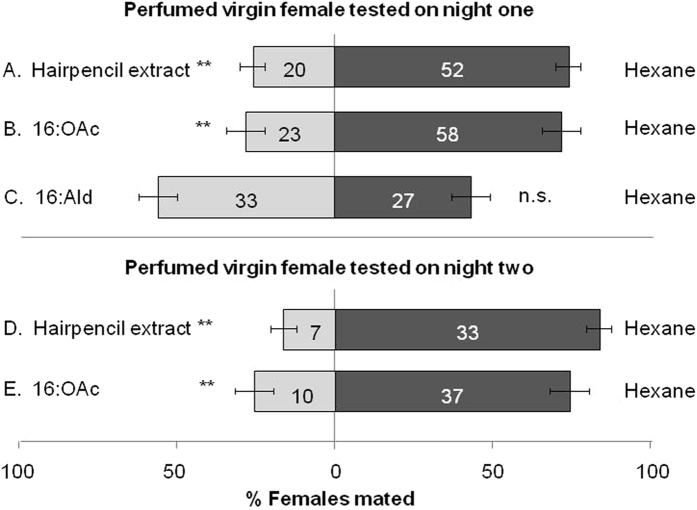
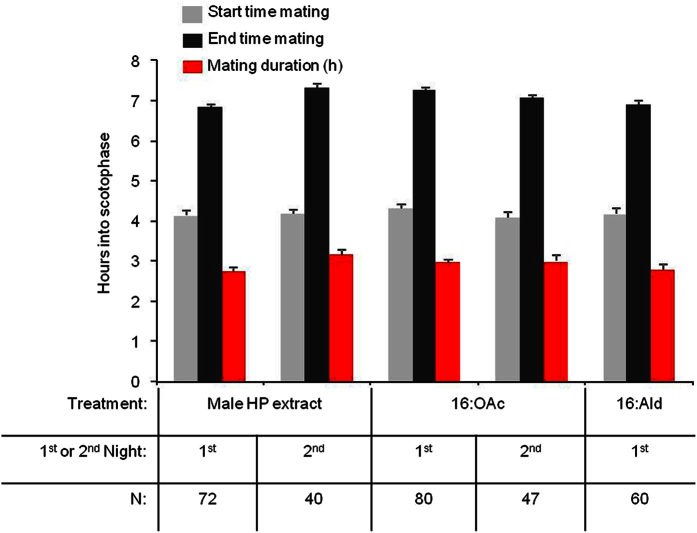
In polyandrous species, males seek to maximize their reproductive output by monopolizing their mate. Often the male transfers substances to the female that suppress her sexual receptivity or antagonize the behavior of competing males; both are usually transferred in seminal fluids and represent forms of chemical mate guarding. In moths, more long-range female sex pheromones have been identified than in any other animal group, and males often display with close-range sex pheromones, yet odor-based post-copulatory mate guarding has not been described in moths so far. We tested the hypothesis that the male sex pheromone in the noctuid moth Heliothis virescens perfumes the female and functions as an anti-aphrodisiac. Indeed, virgin females perfumed with male pheromone extract, or with its main component, mated significantly less than control virgin females, and this effect persisted for two successive nights. This chemical mate guarding strategy was disadvantageous for H. virescens females, because the reproductive output of twice-mated females was significantly higher than that of once-mated females. Since the female and male sex pheromones are biosynthetically related in this and other moth species, chemical mate guarding may also impose selection pressure on the long-range female sex pheromone channel and consequently affect the evolution of sexual communication.
Conflict of interest statement
The authors declare no competing financial interests.
Figures

References
-
- Andersson M. Sexual selection. (Princeton University Press, 1994).
-
- Schiestl F. P. & Ayasse M. Post-mating odor in females of the solitary bee, Andrena nigroaenea (Apoidea, Andrenidae), inhibits male mating behavior. Behav. Ecol. Sociobiol. 48, 303–307 (2000).
-
- Chapman T. & Davies S. J. Functions and analysis of the seminal fluid proteins of male Drosophila melanogaster fruit flies. Peptides 25, 1477–1490 (2004). - PubMed
-
- Wedell N. Female receptivity in butterflies and moths. J. Exp. Biol. 208, 3433–3440 (2005). - PubMed
-
- Gilbert L. E. Postmating female odor in Heliconius butterflies - male-contributed anti-aphrodisiac. Science 193, 419–420 (1976). - PubMed
Publication types
MeSH terms
Substances
LinkOut - more resources
Full Text Sources
Other Literature Sources
