Review
. 2017 Mar;150(3):265-275.
doi: 10.1111/imm.12697. Epub 2017 Jan 3.

Functional and phenotypic heterogeneity of group 3 innate lymphoid cells

Affiliations
Review

Functional and phenotypic heterogeneity of group 3 innate lymphoid cells

Felipe Melo-Gonzalez et al. Immunology. 2017 Mar.

Abstract

Group 3 innate lymphoid cells (ILC3), defined by expression of the transcription factor retinoid-related orphan receptor γt, play key roles in the regulation of inflammation and immunity in the gastrointestinal tract and associated lymphoid tissues. ILC3 consist largely of two major subsets, NCR+ ILC3 and LTi-like ILC3, but also demonstrate significant plasticity and heterogeneity. Recent advances have begun to dissect the relationship between ILC3 subsets and to define distinct functional states within the intestinal tissue microenvironment. In this review we discuss the ever-expanding roles of ILC3 in the context of intestinal homeostasis, infection and inflammation - with a focus on comparing and contrasting the relative contributions of ILC3 subsets.

Keywords: group 3 innate lymphoid cells; innate lymphoid cell; lymphoid tissue-inducer cells; mucosal immunology.


Figures

Figure 1
Figure 1
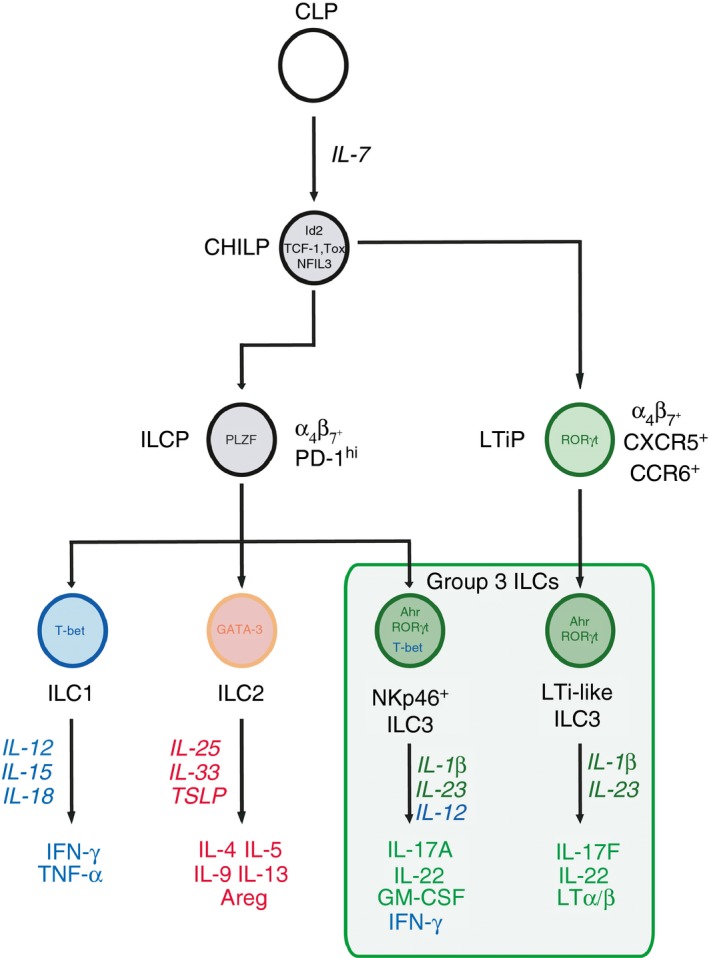
Ontogeny of group 3 innate lymphoid cells (ILC3). All ILC subsets are derived from a common lymphoid progenitor (CLP), Initial commitment towards an ILC fate is associated with up‐regulation of the transcription factor inhibitor of DNA‐binding protein (ID2) and is dependent upon interleukin‐7 (IL‐7). This progenitor population gives rise to all IL‐7receptor (IL‐7R) expressing ILC family members and has been termed the common ‘helper’ ILC progenitor (CHILP). Recent evidence suggests that bifurcation of progenitors occurs downstream of the CHILP. Acquisition of promyelocytic leukaemia zinc finger (PLZF) expression and expression of programmed cell death protein‐1 (PD‐1) mark further commitment to the ILC lineage (ILCP). However, while ILCP give rise to ILC1, ILC2 and NKp46+ ILC3s, these cells fail to generate lymphoid tissue‐inducer (LTi)‐like ILC3 progeny. In contrast, a distinct LTi‐precursor (LTiP) lacking PLZF‐expression is defined as CXCR5+ α 4 β 7 + and CCR6+ and gives rise to fetal LTi and adult LTi‐like ILC3. The bifurcation of group 3 ILC subsets during development may imprint differential transcriptional programmes that underlie the function of mature ILC3 subsets in the periphery.
Figure 2
Figure 2
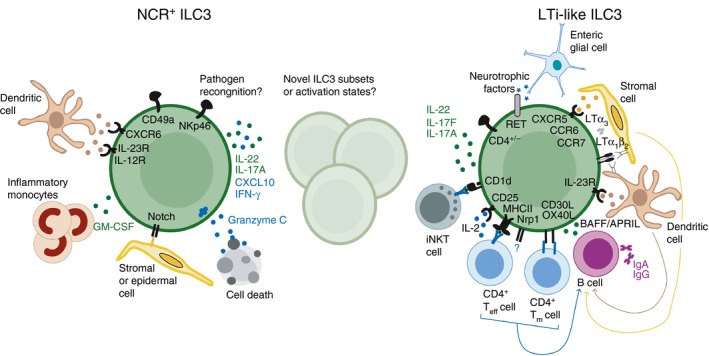
Group 3 innate lymphoid cell (ILC3) subset‐defining phenotypes and functions. Fully mature ILC3 subsets in peripheral tissues are broadly categorized into two major subsets; NKp46+ ILC3 (left panel) and lymphoid tissue‐inducer (LTi) ‐like ILC3 (right panel). Although both subsets express retinoid‐related orphan receptor γt (ROR γt) and share some core functions, emerging evidence suggests subset‐restricted functions. Phenotypic surface markers that typically used to define ILC3 subsets (bold) include natural killer (NK) ‐cell‐associated receptors, such as NKp46 and CD49a, for natural‐cytotoxicity‐receptor‐positive (NCR +) ILC3s, whereas LTi‐like ILC3s are primarily characterized by their expression of CCR6 and variable expression of CD4. Differential localization of NKp46+ ILC3 and LTi‐like ILC3 to the lamina propria and lymphoid tissues, respectively, is determined by differential chemokine receptor profiles. The difference in ILC3 subset localization is indicative of functional specialization. LTi‐like ILC3 express multiple molecules that endow this subset with the ability to indirectly and directly modulate innate‐like and adaptive immune responses in lymphoid tissues. In contrast, NCR + ILC3 appear to largely lack the ability to modulate adaptive immune responses but exhibit unique interactions with populations of myeloid and stromal cells in the tissue that drive the relatively pro‐inflammatory phenotype of this subset. Finally, although the majority of mature ILC3s exhibit NCR + or LTi‐like phenotypes recent transcriptomic studies indicate that multiple intermediate activation states may exist, which are likely determined by transition through metabolic states and differing environmental niches.
Figure 3
Figure 3
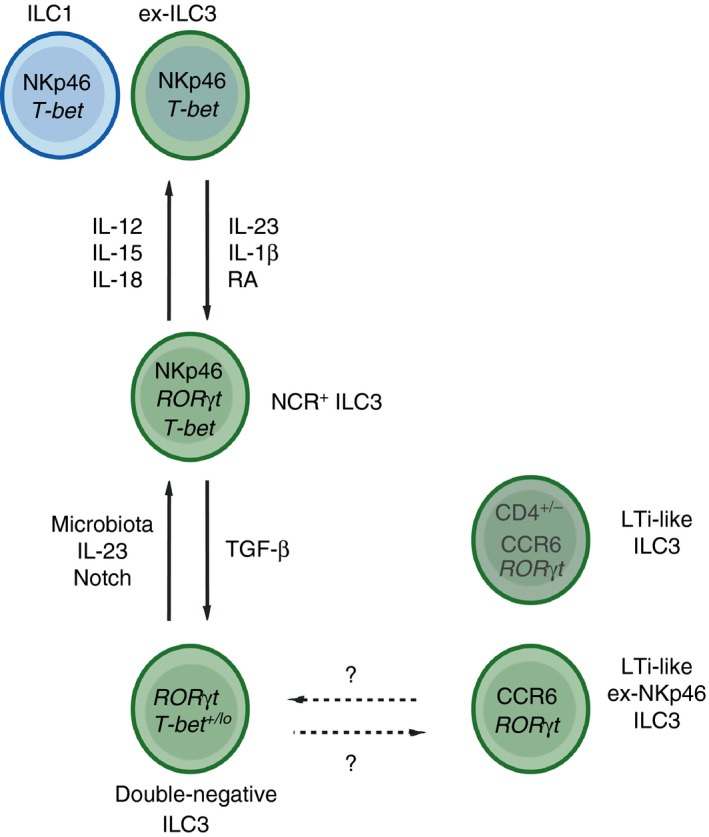
Plasticity and heterogeneity of intestinal group 3 innate lymphoid cell (ILC3). In addition to NKp46+ ILC3 and CCR6+ lymphoid tissue‐inducer (LTi) ‐like ILC3 a ‘double‐negative’ NKp46 CCR6 ILC3 population is present in the intestine. These cells act as a plastic precursor pool that gives rise to NKp46+ ILC3s in a reversible manner in response to local signals, which is regulated by a gradient of T‐bet expression. In addition, NKp46+ ILC3s may further lose retinoid‐related orphan receptor γt (ROR γt) expression in response to inflammatory cytokines and take on a phenotype that mirrors ILC1. These ‘ex‐ILC3’ retain their plasticity and are able to revert to an NKp46+ ILC3 or ‘double‐negative’ precursor phenotype upon alterations in the local cytokine milieu. LTi‐like ILC3 are thought to develop from a distinct progenitor. However, a small proportion of CCR6+ ILC3 display a history of NKp46 expression (ex‐NKp46 ILC3), suggesting that they may also be derived from tissue‐resident plastic ILC3s, although these cells largely lack expression of other LTi‐associated markers such as CD4 and MHCII. These findings blur the boundaries of ILC3 subset ontogeny and necessitate further studies to determine the relationship between bona fide LTi‐like ILC3 and those derived from plastic precursors. The high degree of reversible plasticity among ILC3s suggests a highly dynamic regulation of phenotype and function in response to environmental and infectious cues. This may be beneficial and allow transient increases in ILC3s with a pro‐inflammatory capacity when required, while allowing reversion to a more tolerogenic balance of ILC3 subsets following resolution of the infection or inflammatory insult.

References

    1. Klose CS, Artis D. Innate lymphoid cells as regulators of immunity, inflammation and tissue homeostasis. Nat Immunol 2016; 17:765–74. - PubMed
    1. Walker JA, Barlow JL, McKenzie AN. Innate lymphoid cells – how did we miss them? Nat Rev Immunol 2013; 13:75–87. - PubMed
    1. Spits H, Artis D, Colonna M, Diefenbach A, Di Santo JP, Eberl G et al Innate lymphoid cells – a proposal for uniform nomenclature. Nat Rev Immunol 2013; 13:145–9. - PubMed
    1. Diefenbach A, Colonna M, Koyasu S. Development, differentiation, and diversity of innate lymphoid cells. Immunity 2014; 41:354–65. - PMC - PubMed
    1. Klose CS, Flach M, Mohle L, Rogell L, Hoyler T, Ebert K et al Differentiation of type 1 ILCs from a common progenitor to all helper‐like innate lymphoid cell lineages. Cell 2014; 157:340–56. - PubMed

Publication types

Substances

LinkOut - more resources