


Flavivirus transmission focusing on Zika
- PMID: 27936448
- PMCID: PMC5346038
- DOI: 10.1016/j.coviro.2016.11.007
Flavivirus transmission focusing on Zika
Abstract
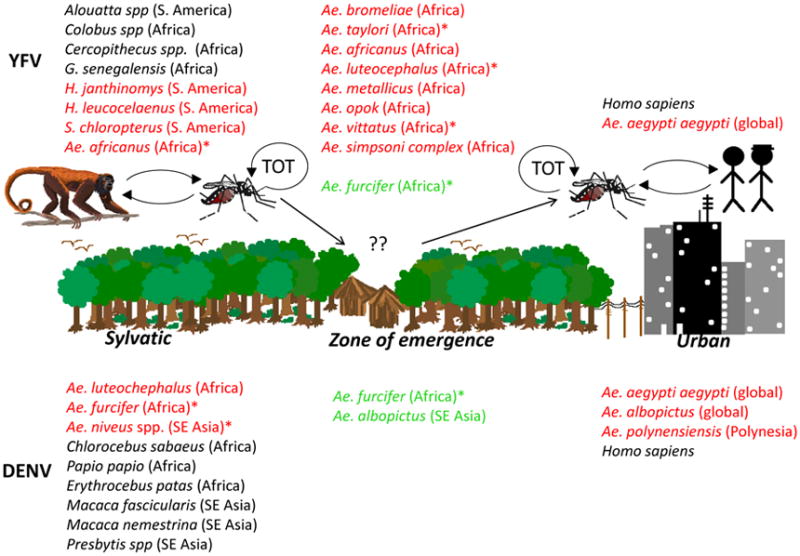
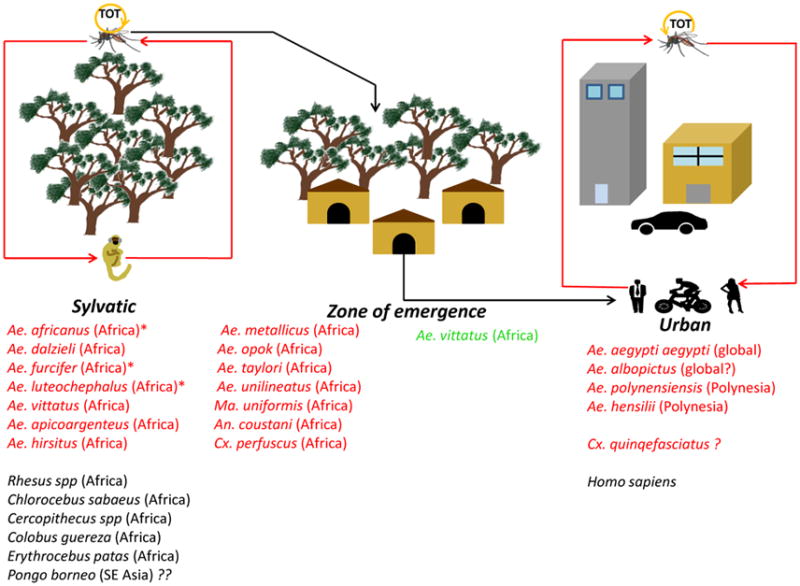
Flaviviruses are among the most diverse viruses with over 85 species recognized. Taxonomically, this genus is one of the 4 recognized genera within the family Flaviviridae. Most flaviviruses of human public health significance, for example, dengue, yellow fever and Zika viruses, are arthropod-borne (arboviruses) and have two evolutionarily and ecologically distinct transmission cycles: a sylvatic transmission cycle, where the virus circulates between zoonotic vertebrate reservoir and amplification hosts and arboreal mosquitoes; and an urban transmission cycle, where the virus circulates between humans and peridomestic Aedes spp. mosquitoes. Zika virus (ZIKV), a flavivirus closely related to West Nile, dengue, Spondweni, Japanese encephalitis and yellow fever viruses, remained in obscurity since its discovery in 1947, but has recently emerged to cause a series of epidemics in the South Pacific, and most recently reaching nearly pandemic levels with its introduction in the Americas. Available epidemiologic and experimental evidence points to Aedes aegypti as the principal urban vector, possibly supplemented by Aedes albopictus in some locations. Unfortunately, the former is one of the most difficult mosquitoes to control owing to its highly anthropophilic behavior.
Copyright © 2016 Elsevier B.V. All rights reserved.
Figures
References
-
- Dick GW, Kitchen SF, Haddow AJ. Zika virus. I. Isolations and serological specificity. Trans R Soc Trop Med Hyg. 1952;46:509–520. Seminal study that described the first isolation and characterization of Zika virus. - PubMed
-
- Macnamara FN. Zika virus: a report on three cases of human infection during an epidemic of jaundice in Nigeria. Trans R Soc Trop Med Hyg. 1954;48:139–145. - PubMed
-
- Marchette NJ, Garcia R, Rudnick A. Isolation of Zika virus from Aedes aegypti mosquitoes in Malaysia. Am J Trop Med Hyg. 1969;18:411–415. Seminal study describing the first isolation of Zika virus in the domestic Aedes aegypti mosquitoes. - PubMed
-
- Olson JG, Ksiazek TG, Suhandiman, Triwibowo Zika virus, a cause of fever in Central Java, Indonesia. Trans R Soc Trop Med Hyg. 1981;75:389–393. Seminal study describing the first human isolation of Zika virus in Asia. - PubMed
-
- Duffy MR, Chen TH, Hancock WT, Powers AM, Kool JL, Lanciotti RS, Pretrick M, Marfel M, Holzbauer S, Dubray C, et al. Zika virus outbreak on Yap Island, Federated States of Micronesia. N Engl J Med. 2009;360:2536–2543. - PubMed
Publication types
MeSH terms
Grants and funding
LinkOut - more resources
Full Text Sources
Other Literature Sources
Miscellaneous
