


What makes you tic? Translational approaches to study the role of stress and contextual triggers in Tourette syndrome
- PMID: 27939782
- PMCID: PMC5403589
- DOI: 10.1016/j.neubiorev.2016.10.003
What makes you tic? Translational approaches to study the role of stress and contextual triggers in Tourette syndrome
Abstract
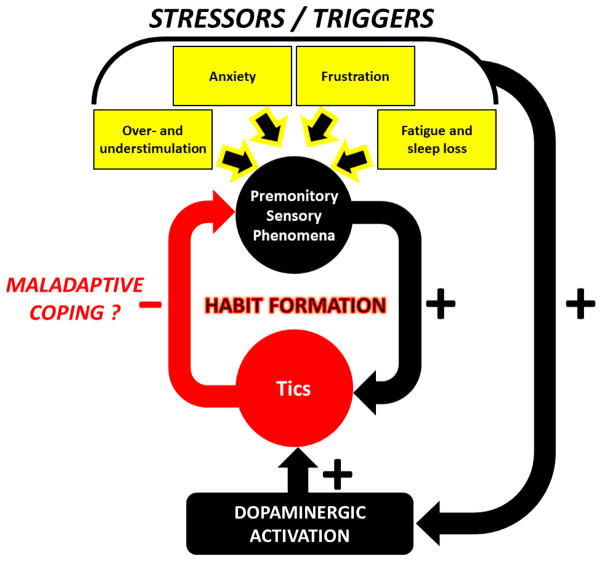
Tourette syndrome (TS) is a neurodevelopmental condition characterized by multiple, recurring motor and phonic tics. Rich empirical evidence shows that the severity of tics and associated manifestations is increased by several stressors and contextual triggers; however, the neurobiological mechanisms responsible for symptom exacerbation in TS remain poorly understood. This conceptual gap partially reflects the high phenotypic variability in tics, as well as the existing difficulties in operationalizing and standardizing stress and its effects in a clinical setting. Animal models of TS may be highly informative tools to overcome some of these limitations; these experimental preparations have already provided critical insights on key aspects of TS pathophysiology, and may prove useful to identify the neurochemical alterations induced by different stressful contingencies. In particular, emerging knowledge on the role of contextual triggers in animal models of TS may inform the development of novel pharmacological interventions to reduce tic fluctuations in this disorder.
Keywords: Animal models; Premonitory sensory phenomena; Stress; Tics; Tourette syndrome.
Copyright © 2016 Elsevier Ltd. All rights reserved.
Figures
References
-
- Abelson JF, Kwan KY, O'Roak BJ, Baek DY, Stillman AA, Morgan TM, Mathews CA, Pauls DL, Rasin MR, Gunel M, Davis NR, Ercan-Sencicek AG, Guez DH, Spertus JA, Leckman JF, Dure LS, 4th, Kurlan R, Singer HS, Gilbert DL, Farhi A, Louvi A, Lifton RP, Sestan N, State MW. Sequence variants in SLITRK1 are associated with Tourette's syndrome. Science. 2005;310:317–320. - PubMed
-
- Abercrombie ED, Keefe KA, DiFrischia DS, Zigmond MJ. Differential effect of stress on in vivo dopamine release in striatum, nucleus accumbens, and medial frontal cortex. Journal of neurochemistry. 1989;52:1655–1658. - PubMed
-
- Abler B, Walter H, Erk S. Neural correlates of frustration. Neuroreport. 2005;16:669–672. - PubMed
-
- Albin RL, Mink JW. Recent advances in Tourette syndrome research. Trends in neurosciences. 2006;29:175–182. - PubMed
Publication types
MeSH terms
Grants and funding
LinkOut - more resources
Full Text Sources
Other Literature Sources
Medical
Miscellaneous
