


Third Trimester Brain Growth in Preterm Infants Compared With In Utero Healthy Fetuses
- PMID: 27940782
- PMCID: PMC5079081
- DOI: 10.1542/peds.2016-1640
Third Trimester Brain Growth in Preterm Infants Compared With In Utero Healthy Fetuses
Abstract
Background and objectives: Compared with term infants, preterm infants have impaired brain development at term-equivalent age, even in the absence of structural brain injury. However, details regarding the onset and progression of impaired preterm brain development over the third trimester are unknown. Our primary objective was to compare third-trimester brain volumes and brain growth trajectories in ex utero preterm infants without structural brain injury and in healthy in utero fetuses. As a secondary objective, we examined risk factors associated with brain volumes in preterm infants over the third-trimester postconception.
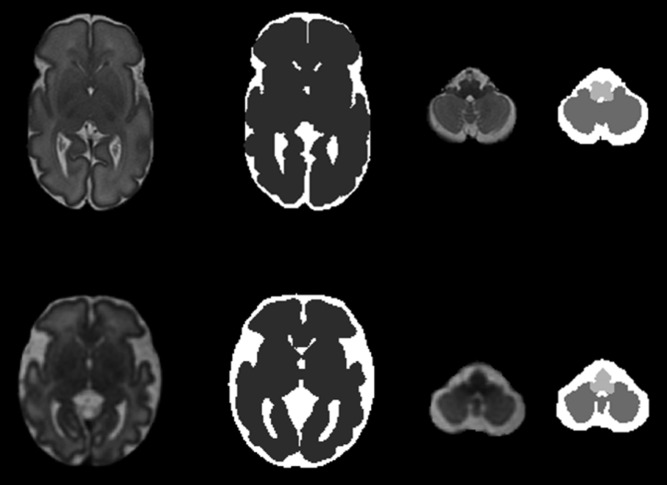
Methods: Preterm infants born before 32 weeks of gestational age (GA) and weighing <1500 g with no evidence of structural brain injury on conventional MRI and healthy pregnant women were prospectively recruited. Anatomic T2-weighted brain images of preterm infants and healthy fetuses were parcellated into the following regions: cerebrum, cerebellum, brainstem, and intracranial cavity.
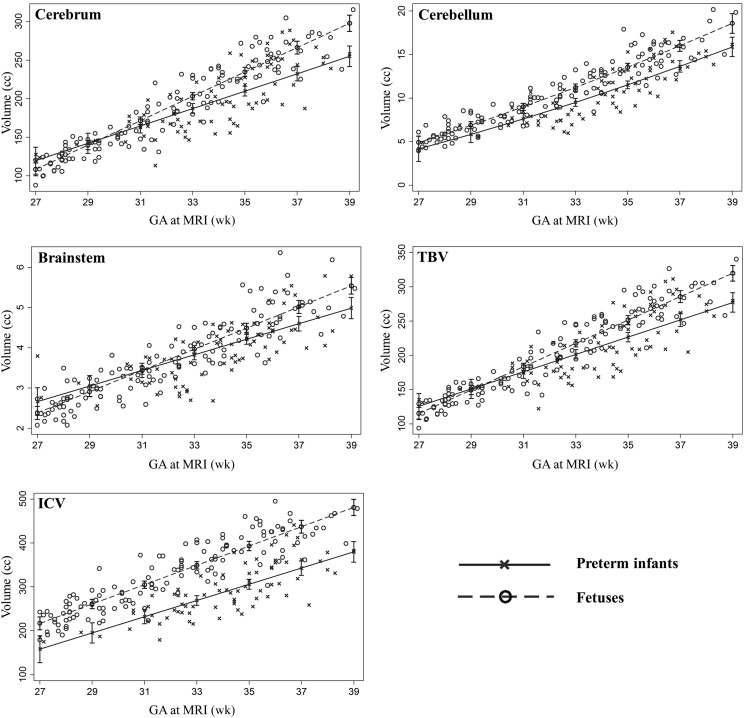
Results: We studied 205 participants (75 preterm infants and 130 healthy control fetuses) between 27 and 39 weeks' GA. Third-trimester brain volumes were reduced and brain growth trajectories were slower in the ex utero preterm group compared with the in utero healthy fetuses in the cerebrum, cerebellum, brainstem, and intracranial cavity. Clinical risk factors associated with reduced brain volumes included dexamethasone treatment, the presence of extra-axial blood on brain MRI, confirmed sepsis, and duration of oxygen support.
Conclusions: These preterm infants exhibited impaired third-trimester global and regional brain growth in the absence of cerebral/cerebellar parenchymal injury detected by using conventional MRI.
Copyright © 2016 by the American Academy of Pediatrics.
Conflict of interest statement
POTENTIAL CONFLICT OF INTEREST: The authors have indicated they have no potential conflicts of interest to disclose.
Figures
References
-
- Kidokoro H, Anderson PJ, Doyle LW, Woodward LJ, Neil JJ, Inder TE. Brain injury and altered brain growth in preterm infants: predictors and prognosis. Pediatrics. 2014;134(2). Available at: www.pediatrics.org/cgi/content/full/133/2/e444 - PubMed
-
- Ortinau C, Neil J. The neuroanatomy of prematurity: normal brain development and the impact of preterm birth. Clin Anat. 2015;28(2):168–183 - PubMed
-
- Bennet L, Van Den Heuij L, Dean JM, Drury P, Wassink G, Gunn AJ. Neural plasticity and the Kennard principle: does it work for the preterm brain? Clin Exp Pharmacol Physiol. 2013;40(11):774–784 - PubMed
Publication types
MeSH terms
Grants and funding
LinkOut - more resources
Full Text Sources
Other Literature Sources
Medical
Research Materials
