. 2017 Feb;49(2):289-295.
doi: 10.1038/ng.3746. Epub 2016 Dec 12.

SMARCB1-mediated SWI/SNF complex function is essential for enhancer regulation

Affiliations

SMARCB1-mediated SWI/SNF complex function is essential for enhancer regulation

Xiaofeng Wang et al. Nat Genet. 2017 Feb.

Abstract

SMARCB1 (also known as SNF5, INI1, and BAF47), a core subunit of the SWI/SNF (BAF) chromatin-remodeling complex, is inactivated in nearly all pediatric rhabdoid tumors. These aggressive cancers are among the most genomically stable, suggesting an epigenetic mechanism by which SMARCB1 loss drives transformation. Here we show that, despite having indistinguishable mutational landscapes, human rhabdoid tumors exhibit distinct enhancer H3K27ac signatures, which identify remnants of differentiation programs. We show that SMARCB1 is required for the integrity of SWI/SNF complexes and that its loss alters enhancer targeting-markedly impairing SWI/SNF binding to typical enhancers, particularly those required for differentiation, while maintaining SWI/SNF binding at super-enhancers. We show that these retained super-enhancers are essential for rhabdoid tumor survival, including some that are shared by all subtypes, such as SPRY1, and other lineage-specific super-enhancers, such as SOX2 in brain-derived rhabdoid tumors. Taken together, our findings identify a new chromatin-based epigenetic mechanism underlying the tumor-suppressive activity of SMARCB1.


Figures
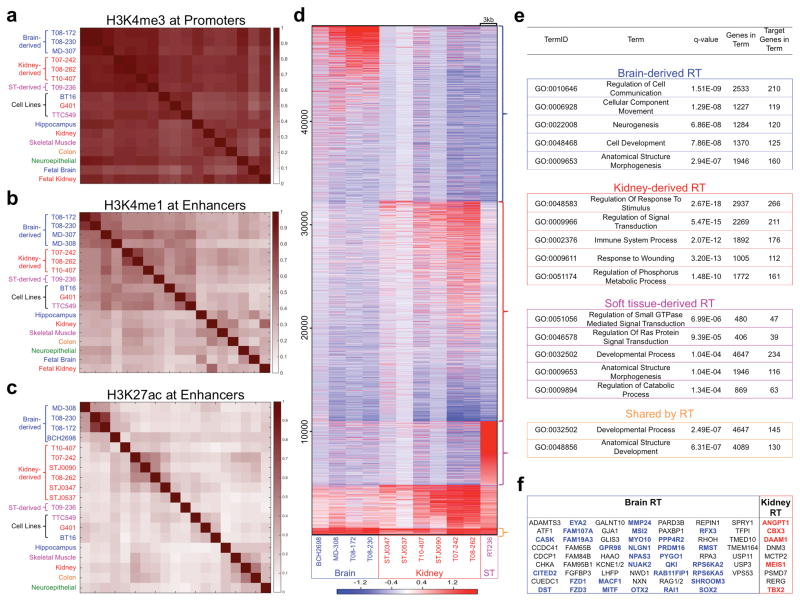
Figure 1
Figure 1. Histone modification landscape in primary rhabdoid tumors and cell lines
Rhabdoid tumors from different tissues show commonalities in H3K4me1 or H3K4me3 signal, but are clearly distinct in terms H3K27ac signal at enhancers. a. Pearson correlations of H3K4me3 signal at the union of all promoters. b. Pearson correlations of H3K4me1 signal at the union of all enhancers. c. Pearson correlations of H3K27ac signal at the union of all enhancers. d. K-means clustering of H3K27ac signal at loci called as enhancers. Brain-derived rhabdoid tumor (blue), kidney-derived rhabdoid tumor (red), and soft tissue-derived rhabdoid tumor (purple) all had enhancers unique to each respective tissue. e. Selected terms from gene ontology analyses of the nearest genes to the top 2000 enhancers found in each cluster in (d) with a full list of top gene ontology terms in Supplementary Table 1. f. SE associated genes common across and specific to brain or kidney rhabdoid tumors. Genes putatively involved in the developmental processes of these respective tissues are bolded and in color.
Figure 2
Figure 2. SMARCB1 is essential in maintaining the SWI/SNF complex integrity
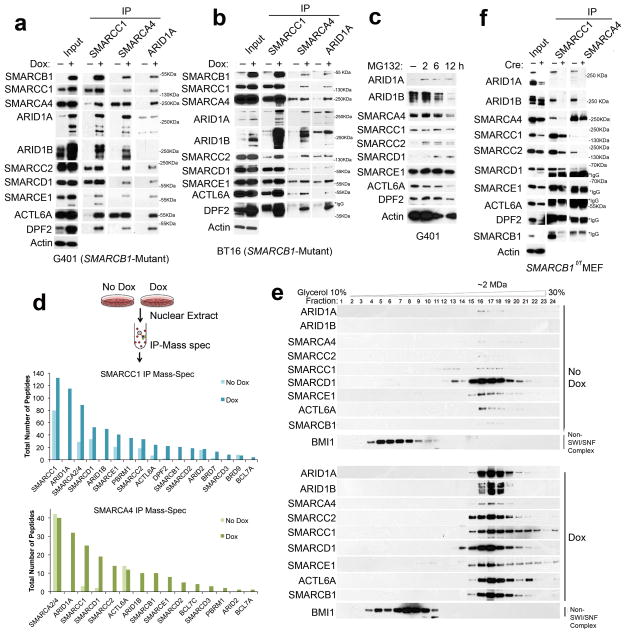
a–b. Immunoprecipitation (IP) of the SWI/SNF complex subunits SMARCC1, SMARCA4, or ARID1A from the nuclear extracts of G401 (a) and BT16 (b) cell lines with or without Doxycycline (Dox)-induced SMARCB1 re-expression. Immunoblotted for subunits SMARCB1, SMARCC1, SMARCA4, ARID1A, ARID1B, SMARCC2, SMARCD1, SMARCE1, ACTL6A, and DPF2. Actin is a loading control. c. Mass spectrometry showing increased recovered peptides of SWI/SNF complex subunits by IP of SMARCA4 and SMARCC1 in G401 cells after SMARCB1 re-expression (Dox vs. No Dox). d. Glycerol sedimentation (10–30%) assay of SWI/SNF complex (~2MDa) from SMARCB1-deficient G401 cells without (top half) or with Dox (bottom half) immunoblotted for the indicated SWI/SNF complex subunits. BMI1 is a PRC1 complex subunit serving as a control. e. Immunoprecipitation (IP) of the SWI/SNF complex by SMARCC1 or SMARCA4 from the nuclear extracts of WT or Smarcb1 deficient mouse embryonic fibroblasts immunoblotted for the indicated SWI/SNF complex subunits.
Figure 3
Figure 3. SMARCB1 re-expression alters the SWI/SNF complex targeting at typical enhancers
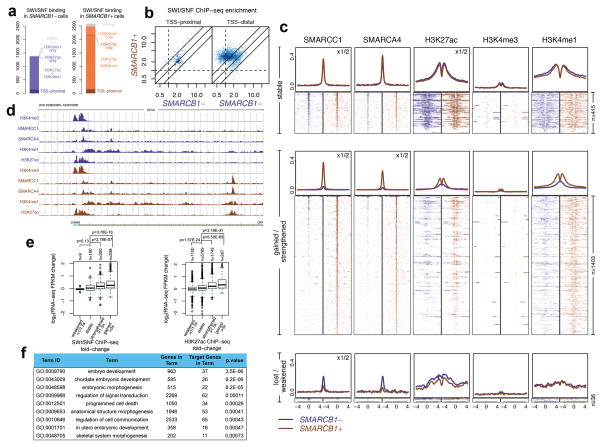
a. Number of SWI/SNF (SMARCC1 and SMARCA4) binding sites in regions of enrichment of different histone marks in G401 cells without or with SMARCB1 re-expression. b. Average enrichment of SMARCC1 and SMARCA4 without vs. with SMARCB1 re-expression in TSS-distal or TSS-proximal SWI/SNF binding sites. c. Heatmaps depicting SMARCC1, SMARCA4, H3K27ac, H3K4me1, and H3K4me3 signal intensities for TSS-distal SWI/SNF binding sites, grouped by change upon SMARCB1 re-expression. The rows show 9 kb regions, centered on SMARCC1/SMARCA4 peaks, ranked by overall signal intensities of SMARCC1/SMARCA4. Average profiles for each heatmap is shown above, where different y-axis ranges are denoted as 1/2x or 1/4x. d. Representative screenshot of SMARCC1, SMARCA4, H3K4me1, H3K4me3, and H3K27Ac signal without or with SMARCB1 re-expression in G401 cells showing increased SMARCC1/SMARCA4 binding upon SMARCB1 re-expression accompanied with increased and flanking H3K27ac and H3K4me1 marks at enhancers. e. Correlation of gene expression changes with SMARCC1/SMARCA4 binding or H3K27ac signal at TSS-distal binding sites in G401 cells upon Dox treatment. f. Gene Ontology (GO) analysis of genes proximal to enhancers with increased SMARCC1/SMARCA4 signal upon Dox treatment.
Figure 4
Figure 4. Residual SWI/SNF complexes are specifically maintained at super-enhancers in SMARCB1-deficient rhabdoid tumors
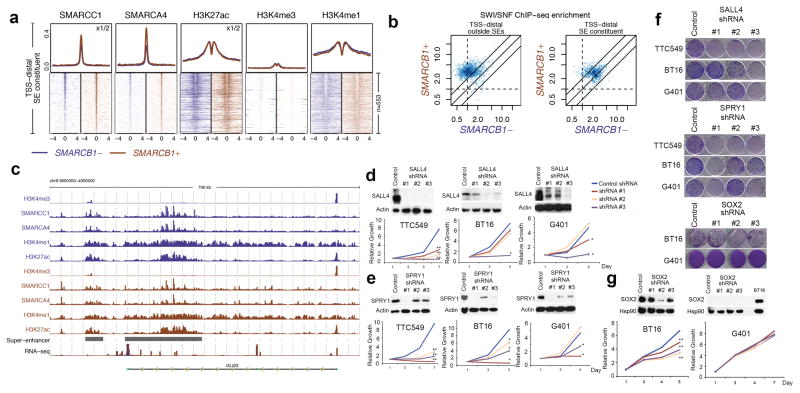
a. Heatmaps depicting SMARCC1, SMARCA4, H3K27ac, H3K4me1, and H3K4me3 signal intensities for SMARCC1/SMARCA4 bound within super-enhancers. b. Scatter plots showing change of average SMARCC1/SMARCA4 signal for TSS-proximal binding sites or TSS-distal ones split to outside and inside super-enhancers. c. Representative screenshot in G401 cells showing limited changes SMARCC1, SMARCA4, H3K27ac, or H3K4me1 upon SMARCB1 re-expression inside super-enhancers, in contrast to outside. d–g. Knockdown of SALL4 (d) or SPRY1 (e) in G401, BT16, and TTC549 cells affects cell proliferation and colony forming abilities (f), while knockdown of SOX2 only affect the proliferation and colony forming abilities of BT16 but not G401 cells (g and f). Error bar means s.d.; **: P < 0.001; *: P < 0.05 (t-test, two-side; n=3)
Figure 5
Figure 5. Working model
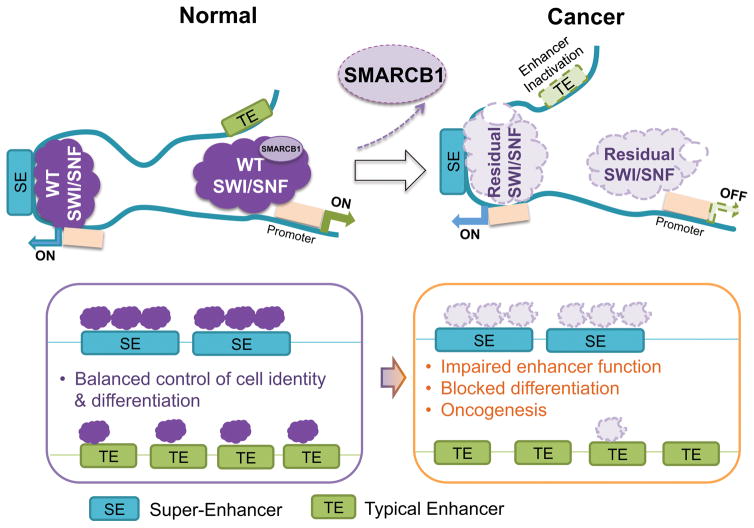
SMARCB1 functions to stabilize the SWI/SNF complex, thus enabling it to bind and facilitate enhancer formation and function. Loss of SMARCB1 results in markedly reduced levels of the SWI/SNF complex, which results in reduced genome-wide targeting at regular enhancers thus impairing their functions. However, the small amount of residual SWI/SNF complex preferentially present at super-enhancers is key to the maintenance of aberrant cell identity.

References

    1. Wilson BG, Roberts CWM. SWI/SNF nucleosome remodellers and cancer. Nat RevCancer. 2011;11:481–92. - PubMed
    1. Wu JI, Lessard J, Crabtree GR. Understanding the words of chromatin regulation. Cell. 2009;136:200–6. - PMC - PubMed
    1. Biegel JA, et al. Germ-line and acquired mutations of INI1 in atypical teratoid and rhabdoid tumors. Cancer Res. 1999;59:74–9. - PubMed
    1. Versteege I, et al. Truncating mutations of hSNF5/INI1 in aggressive paediatric cancer. Nature. 1998;394:203–6. - PubMed
    1. Eaton KW, Tooke LS, Wainwright LM, Judkins AR, Biegel JA. Spectrum of SMARCB1/INI1 mutations in familial and sporadic rhabdoid tumors. Pediatr Blood Cancer. 2011;56:7–15. - PMC - PubMed

MeSH terms