Review
. 2016 Dec;6(4):407-425.
doi: 10.1086/688890.

Unique aspects of the developing lung circulation: structural development and regulation of vasomotor tone

Affiliations
Review

Unique aspects of the developing lung circulation: structural development and regulation of vasomotor tone

Yuangsheng Gao et al. Pulm Circ. 2016 Dec.

Abstract

This review summarizes our current knowledge on lung vasculogenesis and angiogenesis during normal lung development and the regulation of fetal and postnatal pulmonary vascular tone. In comparison to that of the adult, the pulmonary circulation of the fetus and newborn displays many unique characteristics. Moreover, altered development of pulmonary vasculature plays a more prominent role in compromised pulmonary vasoreactivity than in the adult. Clinically, a better understanding of the developmental changes in pulmonary vasculature and vasomotor tone and the mechanisms that are disrupted in disease states can lead to the development of new therapies for lung diseases characterized by impaired alveolar structure and pulmonary hypertension.

Keywords: endothelial; fetal; newborn; pulmonary circulation; smooth muscle.


Figures
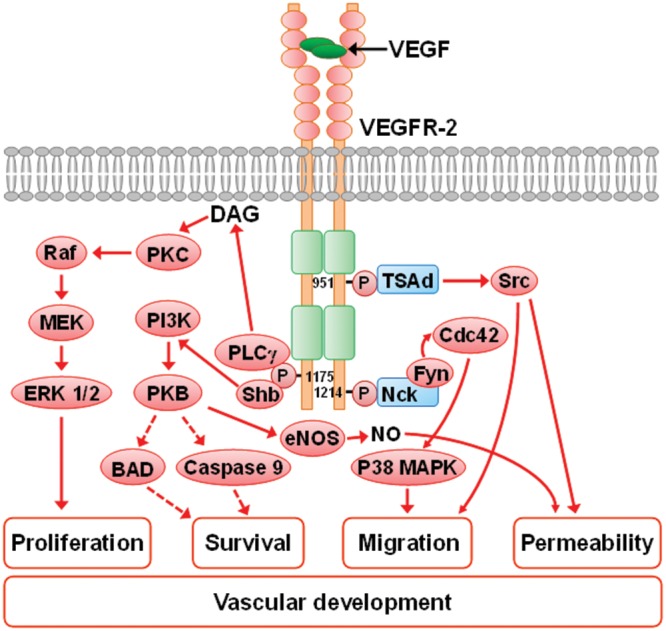
Figure 1
Figure 1
Scheme depicting the possible mechanism of VEGFR-2-mediated vascular effects (cell proliferation, survival, migration, and enhanced permeability) related to vascular formation. VEGFR-2 is composed of an extracellular domain containing seven immunoglobulin-like domains, a transmembrane domain, and an intracellular domain of two kinase domains separated by a kinase-insert domain. The binding of the VEGF dimer to the receptor leads to the dimerization and autophosphorylation of specific intracellular tyrosine residues of the receptors. The phosphorylation of Y1175 recruits PLCγ, resulting in DAG release and activation of PKC and the Raf-MEK-ERK 1/2 signaling pathway and thus in stimulated cell proliferation. The phosphorylated Y1175 may also recruit adaptor protein Shb, which leads to activation of PI3K-PKB signaling; consequently, BAD and caspase are suppressed, which results in increased cell survival. Increased PI3K-PKB activity increases eNOS-dependent NO production, resulting in increased cell permeability, which facilitates angiogenesis through providing a proangiogenic extracellular environment. The phosphorylation of Y951 provides a binding site for TSAd, which causes the activation of Src, leading to increased cell migration and permeability. Increased cell migration also results from activation of Cdc42-p38 MAPK as a result of the phosphorylation of Y1214 and the formation of the Nck-Fyn complex. Solid arrows indicate activation and dashed arrows inhibition. BAD: B-cell lymphoma 2-associated death promoter; Cdc42: cell division cycle 42; DAG: diacylglycerol; eNOS: endothelial nitric oxide synthase; ERK 1/2: extracellular signal–regulated protein kinase 1 and 2; Fyn: proto-oncogene tyrosine-protein kinase Fyn; MEK: mitogen-activated protein kinase; Nck: Nck adaptor protein 1; NO, nitric oxide; p38 MAPK: p38 mitogen-activated protein kinase; PI3K: phosphatidylinositol-4,5-bisphosphate 3-kinase; PKB: protein kinase B, also known as Akt; PKC: protein kinase C; PLCγ: phosphoinositide phospholipase C-γ; Raf: rapidly accelerated fibrosarcoma kinases; Shb: SH2-domain-containing adaptor protein B; Src: tyrosine-protein kinase CSK; TSAd: T cell-specific adaptor molecule; VEGF: vascular endothelial growth factor; VEGFR-2: VEGF receptor 2.
Figure 2
Figure 2
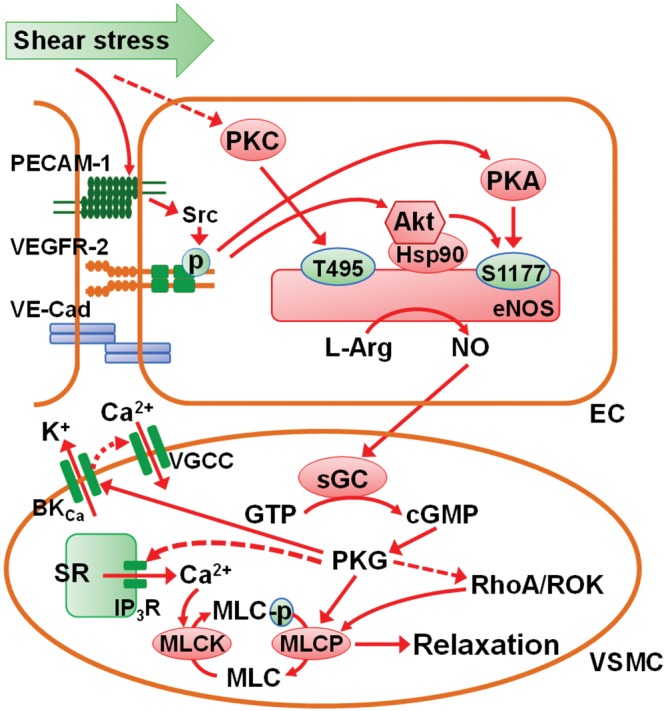
Mechanism for shear stress–induced activation of eNOS- and NO-mediated relaxation of vascular smooth muscle cells (VSMCs). A complex consisting of PECAM-1, VE-cadherin, and VEGFR-2 localized at cell-cell junctions serves as a mechanotransducer for shear stress. The tension exerted by shear stress on PECAM-1 activates a Src family kinase, resulting in ligand-independent transactivation of VEGFR-2, followed by activation of Akt (also known as protein kinase B), phosphorylation of serine 1177 (S1177) of eNOS, and production of NO. Activation of VEGFR-2 can also cause S1177 phosphorylation via PKA. Heat shock protein 90 (Hsp90), when associated with eNOS, can recruit Akt into the eNOS complex and maintains Akt activity. In contrast to S1177, the phosphorylated threonine 495 (T495) of eNOS exerts inhibitory effect on the enzyme. T495 can also be phosphorylated by PKC. Shear stress may enhance eNOS activity by inhibiting PKC activity. NO released from the endothelial cells (ECs) can readily diffuse into the underlying VSMCs, where it activates sGC, resulting in the conversion of guanosine triphosphate (GTP) to cGMP (cyclic guanosine monophosphate). The elevated cGMP causes vasodilatation, primarily via PKG, by reducing the intracellular Ca2+ concentration and decreasing the sensitivity of myofilaments to Ca2+. PKG stimulates Ca2+-activated K+ (BKCa) channels, resulting in membrane hyperpolarization and suppression of Ca2+ entry. PKG also reduces the release of Ca2+ from sarcoplasmic reticulum (SR) into cytosol by inhibiting IP3 receptor (IP3R) activity. The decreased cytosolic Ca2+ concentration leads to diminished activity of myosin light-chain kinase (MLCK), decreased phosphorylation of myosin light chain (MLC), and reduced contractility. PKG causes reduced Ca2+ sensitivity of myofilaments by directly stimulating the activity of myosin light-chain phosphatase (MLCP) as well as interfering with the inhibitory action of RhoA/Rho kinase (ROK) signaling on MLCP. These actions leads to increased dephosphorylation of MLC and thus relaxation of VSMCs. Solid arrows indicate activation and dashed arrows inhibition. eNOS: endothelial nitric oxide synthase; IP3R: inositol 1,4,5-trisphosphate receptor; L-Arg: l-arginine; NO: nitric oxide; PECAM-1: platelet endothelial cell adhesion molecule; PKA: protein kinase A; PKC: protein kinase C; PKG: cGMP-dependent protein kinase; sGC: soluble guanylyl cyclase; Src: tyrosine-protein kinase CSK; VGCC: voltage-gated Ca2+ channel; VE-cad: vascular endothelial cadherin; VEGFR-2: vascular endothelial growth factor receptor 2.
Figure 3
Figure 3
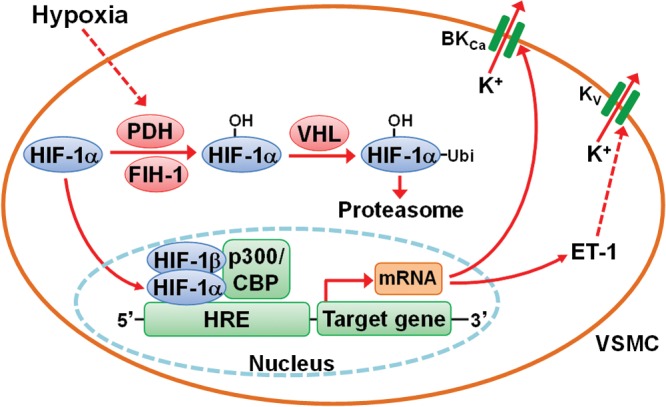
Role of hypoxia-inducible factor-1 (HIF-1) on the expression of Ca2+-activated K+ (BKCa) and voltage gated K+ (Kv) channels in pulmonary arterial smooth muscle cells (PASMCs). In mammalian cells, including PASMCs, prolyl hydroxylase domain–containing enzyme (PHD) and factor inhibiting HIF-1 (FIH-1) act as cellular oxygen sensors and control the abundance of the α isoform of HIF-1 (HIF-1α). Under normoxia, HIF-1α is hydroxylated by PHD and FIH-1 and ubiquitinated by the von Hippel–Lindau protein (VHL), resulting in proteasomal degradation. The activities of PHD and FIH-1 depend on the presence of oxygen, and hence these enzymes are inhibited under hypoxic conditions, leading to reduced degradation of HIF-1α. Consequently, HIF-1α is translocated into the nucleus, dimerizes with the β isoform of HIF-1 (HIF-1β), forms a complex with the transcriptional coactivator p300/CBP and binds to hypoxia-responsive elements (HRE) of HIF target genes to induce the expression of BKCa. HIF also promotes the expression of ET-1, while increased ET-1 suppresses the expression of Kv channels. Solid arrows indicate activation and dashed arrows inhibition. CBP: cAMP-response element-binding protein (CREB)–binding protein; ET-1: endothelin 1; Ubi: ubiquitin.

References

    1. Roth-Kleiner M, Post M. Similarities and dissimilarities of branching and septation during lung development. Pediatr Pulmonol 2005;40(2):113–134. - PubMed
    1. Herriges M, Morrisey EE. Lung development: orchestrating the generation and regeneration of a complex organ. Development 2014;141(3):502–513. - PMC - PubMed
    1. Gao Y, Raj JU. Regulation of the pulmonary circulation in the fetus and newborn. Physiol Rev 2010;90(4):1291–1335. - PubMed
    1. Metzger RJ, Klein OD, Martin GR, Krasnow MA. The branching programme of mouse lung development. Nature 2008;453(7196):745–750. - PMC - PubMed
    1. Pereda J, Sulz L, San Martin S, Godoy-Guzmán C. The human lung during the embryonic period: vasculogenesis and primitive erythroblasts circulation. J Anat 2013;222(5):487–494. - PMC - PubMed

LinkOut - more resources