Review
doi: 10.21037/jtd.2016.08.47.
Carinal resection and sleeve pneumonectomy
Affiliations
- PMID: 27942410
- PMCID: PMC5124595
- DOI: 10.21037/jtd.2016.08.47
Item in Clipboard
Review
Carinal resection and sleeve pneumonectomy
J Thorac Dis.
2016 Nov.
Abstract
Carinal resection (CR) and sleeve pneumonectomy (SP) are one of the challenging issues in thoracic surgery and performed rarely. In spite of the knowledge of the technique, the incidence of postoperative complications is higher compared to standard resections. Adequate patient selection, improved anesthetic management, surgical technique and better postoperative management might reduce the rate of postoperative morbidity and mortality.
Keywords: Sleeve pneumonectomy (SP); carina resection; carinal pneumonectomy; lung cancer.
Conflict of interest statement
The authors have no conflicts of interest to declare.
Figures
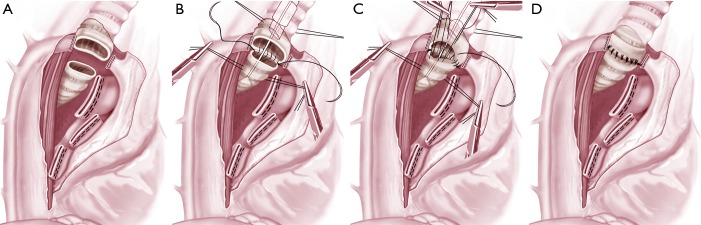
Schematic presentation of right sleeve pneumonectomy. (A) The pulmonary artery and veins are divided with a vascular stapler. The azygos vein is divided with a stapler and the vena cava superior is mobilized in order to obtain a better exposure. The distal trachea and the left main bronchus are exposed, mobilized, and encircled with tapes; (B) first the stay suture at the contralateral edge is tied and the membranous part is sutured in a running fashion beginning from the far edge. After completing the membranous part the stay suture on the near edge is tied; (C) for the reconstruction of the cartilaginous part we start from the far edge with already knotted suture of this edge with 2 or 3 continuous stiches and then insert interrupted sutures; (D) the sutures are tied after they all have been inserted.
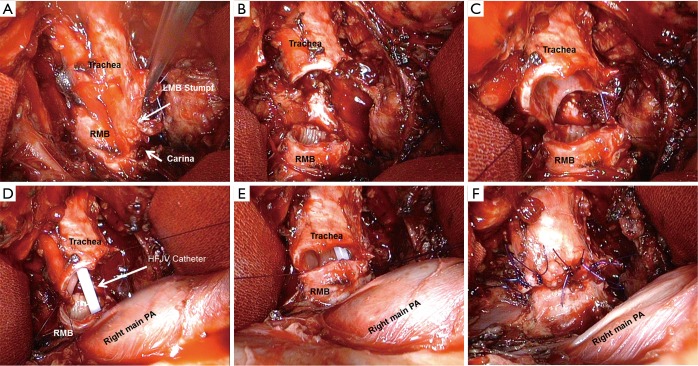
Carina resection and anastomosis between trachea and right main bronchus using transsternal transmediastinal approach in a patient with a bronchopleural fistula following left pneumonectomy. The operation was done under veno-arterial extracorporeal life support and jet ventilation. The technical steps are shown in the figure through (A) and (F).
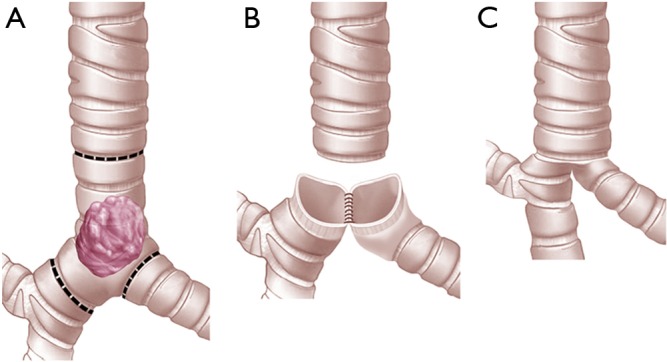
For carina resection with “neo-carina” formation first we insert the first stich between the cartilaginous and membranous portion of the two main bronchi. After knotting the cartilaginous part which is in contact with each other is approximated in a running suture (neo-carina). Then the membranous part of the trachea is reconstructed with the membranous part of the both bronchi with a running suture beginning from the far edge and coming to the near edge. The anterior wall (cartilaginous portion) is completed with interrupted sutures placed and tied at the end.
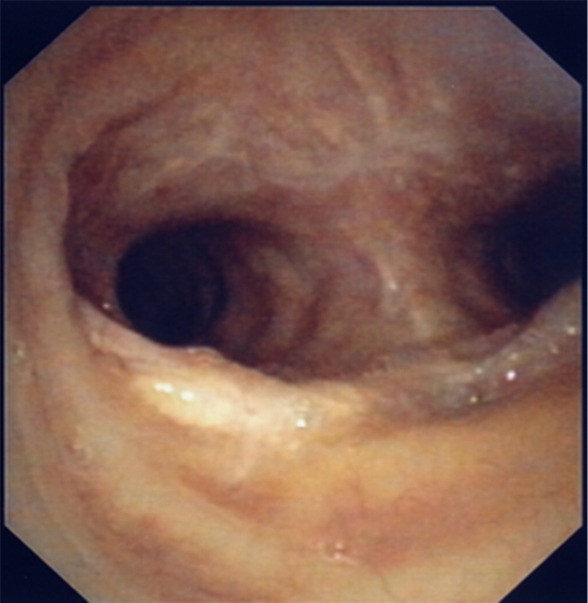
Bronchoscopic view of neocarina 13 months after carina resection.
References
-
- Perelman MI, Koroleva NS. Primary tumors of the trachea. In: Grillo HC, Eschapasse H. editors. Major challenges. Philadelphia, PA: Saunders, 1987:91-106.
Publication types
LinkOut - more resources
Full Text Sources
Other Literature Sources