Review
. 2016 Nov;5(6):544-555.
doi: 10.21037/acs.2016.03.16.

Robotic mitral valve surgery: overview, methodology, results, and perspective

Affiliations
Review

Robotic mitral valve surgery: overview, methodology, results, and perspective

W Randolph Chitwood Jr. Ann Cardiothorac Surg. 2016 Nov.

Abstract

Robotic mitral valve repair began in 1998 and has advanced remarkably. It arose from an interest in reducing patient trauma by operating through smaller incisions with videoscopic assistance. In the United States, following two clinical trials, the FDA approved the daVinci Surgical System in 2002 for intra-cardiac surgery. This device has undergone three iterations, eventuating in the current daVinci XI. At present it is the only robotic device approved for mitral valve surgery. Many larger centers have adopted its use as part of their routine mitral valve repair armamentarium. Although these operations have longer perfusion and arrest times, complications have been either similar or less than other traditional methods. Preoperative screening is paramount and leads to optimal patient selection and outcomes. There are clear contraindications, both relative and absolute, that must be considered. Three-dimensional (3D) echocardiographic studies optimally guide surgeons in operative planning. Herein, we describe the selection criteria as well as our operative management during a robotic mitral valve repair. Major complications are detailed with tips to avoid their occurrence. Operative outcomes from the author's series as well as those from the largest experiences in the United States are described. They show that robotic mitral valve repair is safe and effective, as well as economically reasonable due to lower costs of hospitalization. Thus, the future of this operative technique is bright for centers adopting the "heart team" approach, adequate clinical volume and a dedicated and experienced mitral repair surgeon.

Keywords: Robot; daVinci system; mitral valve; repair; robot-assisted.


Conflict of interest statement

The author has no conflicts of interest to declare.

Figures
Video 1
Video 1
Robotic mitral valve surgery: overview, methodology, results, and perspective.
Figure 1
Figure 1
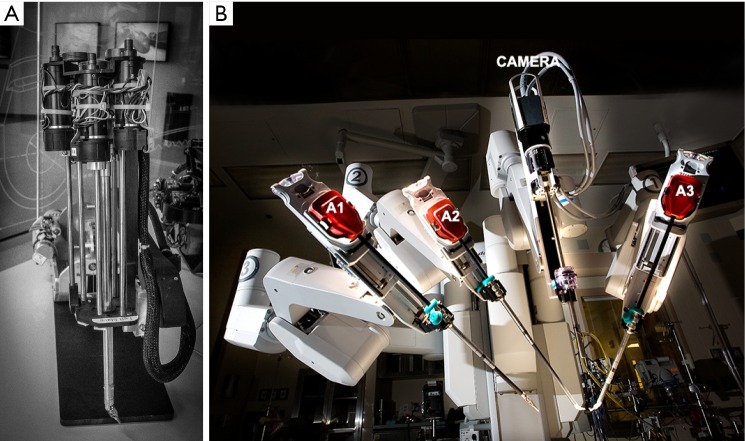
(A) “Lenny” [1995]—The articulated robotic arm predicate of the daVinci System; (B) the third generation daVinci SI instrument arm system (A1-A3) used by the author [2015].
Figure 2
Figure 2
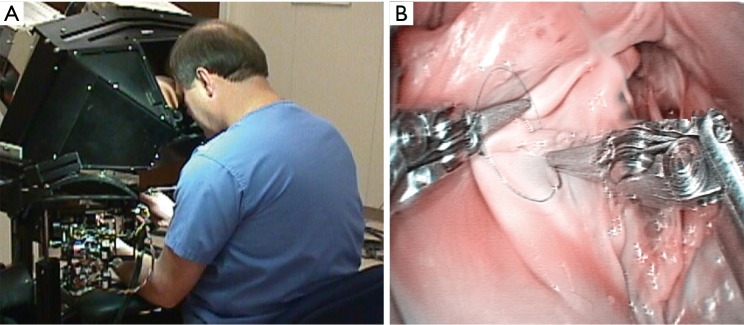
First prototype of the daVinci System [1997]. (A) The author testing the first surgeon console; (B) early instrument wrists for the daVinci prototype.
Figure 3
Figure 3
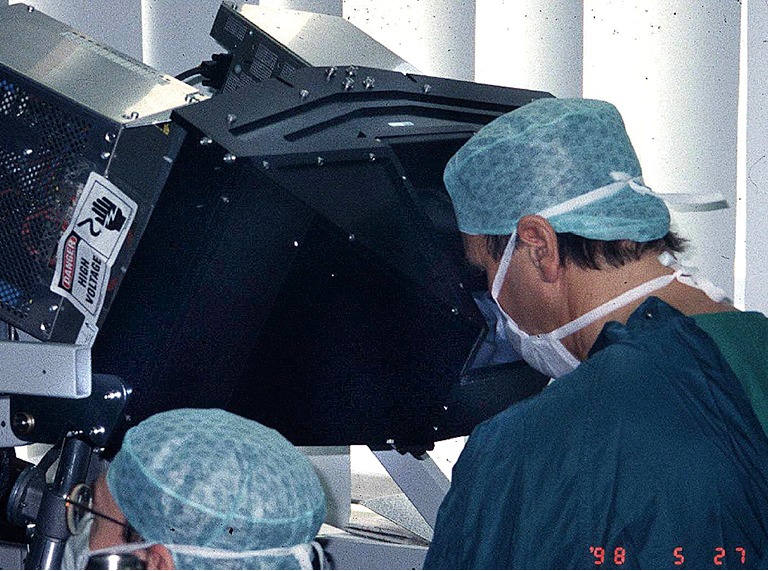
Friedrich Mohr MD performing the first series of mitral valve repairs with the daVinci prototype at the Leipzig Heart Center in late May of 1998.
Figure 4
Figure 4
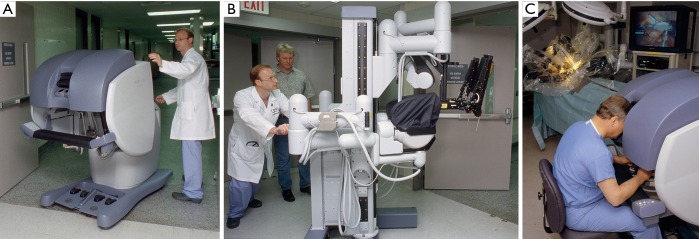
First commercial daVinci System purchased in the United States [1999]. This was used for the initial FDA mitral repair clinical trials. Dr. L. Wiley Nifong is shown unloading the (A) surgeon console and (B) instrument cart (C) the first daVinci System setup in the laboratory. The author is shown at the operating console.
Figure 5
Figure 5
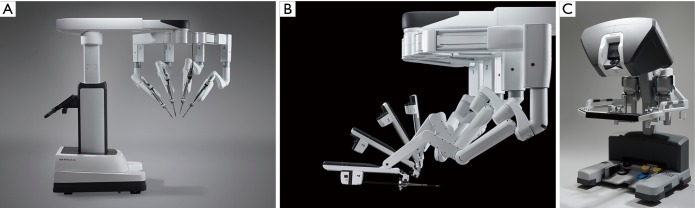
The daVinci XI surgical system. (A) The new instrument cart is pictured and shows the (B) additional “elbow” joint that enables better tableside positioning; (C) surgeon operating console.
Figure 6
Figure 6
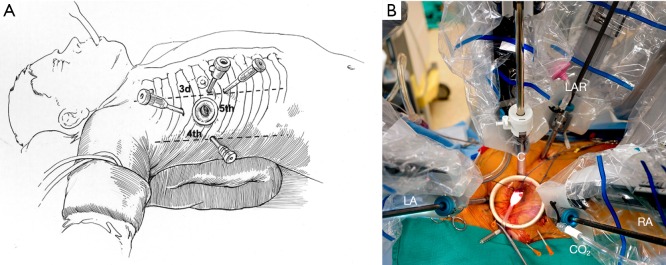
(A) Port placement for a robotic mitral valve repair; (B) articulated instruments and the 3-D camera have been inserted in preparation for a robotic mitral valve repair. The cross clamp has not been placed yet. LA, left arm; RA, right arm; LAR, left atrial retractor; C, camera, CO2 cannula is hooked to the right arm. (Permission of Author—Atlas of Robotic Cardiac Surgery).
Figure 7
Figure 7
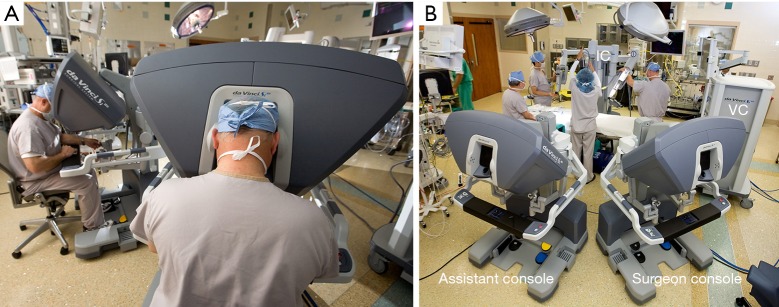
(A) The surgeon and assistant/learner are seen at the daVinci SI operating console; (B) the daVinci SI and XI both have dual surgeon operating console capabilities. The instrument (IC) and vision carts (VC) are shown.
Figure 8
Figure 8
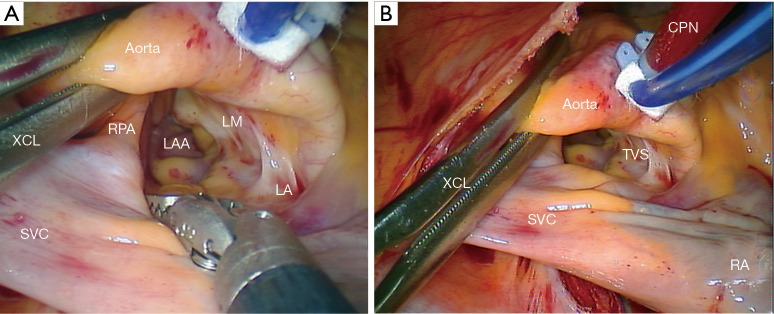
The transthoracic aortic cross clamp has been passed through the transverse sinus and deployed. (A) Details of the transverse sinus are shown; (B) the transthoracic cross clamp (XCL) is shown with respect to the cardioplegia needle (CPN). XCL, transthoracic cross clamp; RPA, right pulmonary artery; SVC, superior vena cava; LAA, left atrial appendage; LA, left atrial roof; LM, Left main coronary artery; TVS, transverse sinus.
Figure 9
Figure 9
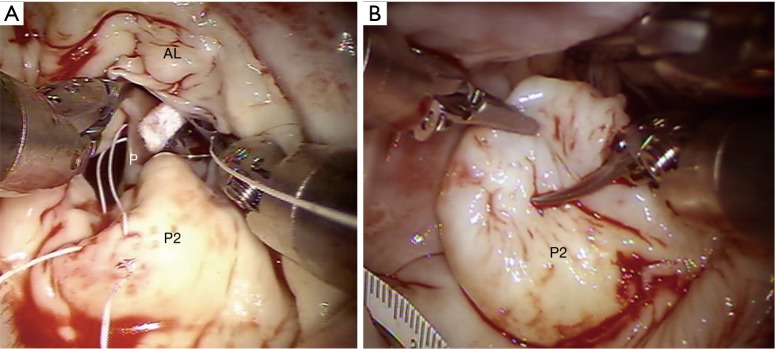
Robotic mitral repair. (A) Example of neochord implantation between the anterior papillary muscle P, and P2 of the posterior leaflet; (B) example of a partial P2 resection. AL, anterior leaflet.
Figure 10
Figure 10
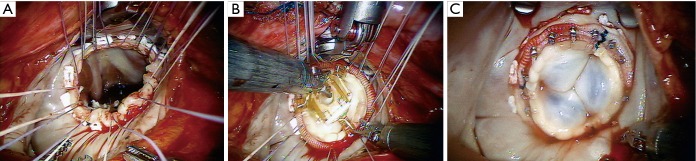
Robotic mitral replacement. (A) supra-annular sutures have been placed robotically and exteriorized for sewing cuff placement; (B) robotically seated bioprosthetic valve; (C) completed valve replacement with Cor-knot suture attachment (LSI Solutions, Victor, NY, USA).

References

    1. Pompili MF, Stevens JH, Burdon TA, et al. Port-access mitral valve replacement in dogs. J Thorac Cardiovasc Surg 1996;112:1268-74. 10.1016/S0022-5223(96)70140-X - DOI - PubMed
    1. Fann JI, Pompili MF, Burdon TA, et al. Minimally invasive mitral valve surgery. Semin Thorac Cardiovasc Surg 1997;9:320-30. - PubMed
    1. Navia JL, Cosgrove DM, 3rd. Minimally invasive mitral valve operations. Ann Thorac Surg 1996;62:1542-4. 10.1016/0003-4975(96)00779-5 - DOI - PubMed
    1. Dávila JC. The birth of intracardiac surgery: a semicentennial tribute (June 10, 1948-1998). Ann Thorac Surg 1998;65:1809-20. - PubMed
    1. Harken DE, Glidden EM. Experiments in Intracardiac Surgery. II. Intracardiac Visualization. J Thorac Surg 1943;12:566-72.

LinkOut - more resources