Review
. 2017 Feb:22:36-43.
doi: 10.1016/j.coviro.2016.11.012. Epub 2016 Dec 9.

Protect this house: cytosolic sensing of viruses

Affiliations
Review

Protect this house: cytosolic sensing of viruses

Michael J McFadden et al. Curr Opin Virol. 2017 Feb.

Abstract

The ability to recognize invading viral pathogens and to distinguish their components from those of the host cell is critical to initiate the innate immune response. The efficiency of this detection is an important factor in determining the susceptibility of the cell to viral infection. Innate sensing of viruses is, therefore, an indispensable step in the line of defense for cells and organisms. Recent discoveries have uncovered novel sensors of viral components and hallmarks of infection, as well as mechanisms by which cells discriminate between self and non-self. This review highlights the mechanisms used by cells to detect viral pathogens in the cytosol, and recent advances in the field of cytosolic sensing of viruses.


Figures

None
Graphical abstract
Figure 1
Figure 1
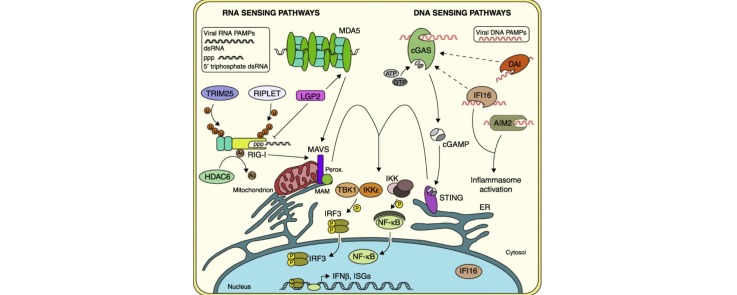
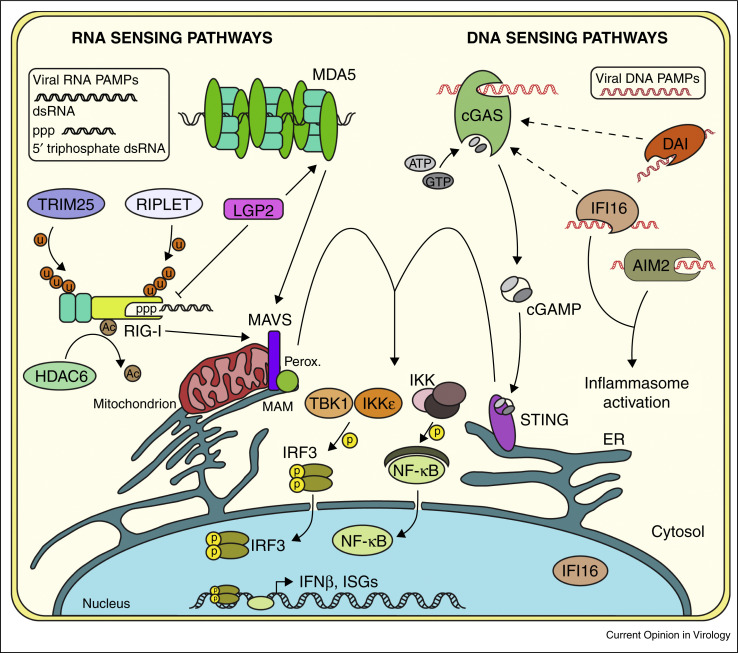
Major pattern recognition receptors (PRRs) that sense RNA and DNA virus pathogen associated molecular patterns (PAMPs) in the cytosol. Following RIG-I sensing of short dsRNA, this sensor is further activated through K63-linked ubiquitination by TRIM25 and RIPLET, as well as through lysine deacetylation by HDAC6. Following sensing of long dsRNA, MDA5 oligomerizes along the dsRNA. Both RIG-I and MDA5 activate signaling through the adaptor MAVS located on mitochondria, mitochondrial-associated ER membranes (MAM), and peroxisomes (perox.), leading to the activation and nuclear translocation of IRF3 and NF-κB and the production of type I IFN and ISGs. Viral DNA PAMPs are sensed by cGAS which catalyzes the production of cGAMP after binding to DNA. cGAMP then signals through the adaptor STING, located on ER membranes to activate IRF3 and NF-κB. Other viral DNA sensors in the cytosol such as DAI and IFI16 are also postulated to function through this pathway. Activation of IFI16 or AIM2 following viral DNA detection leads to inflammasome activation.

References

    1. Beachboard D.C., Horner S.M. Innate immune evasion strategies of DNA and RNA viruses. Curr Opin Microbiol. 2016;32:113–119. - PMC - PubMed
    1. Chan Y.K., Gack M.U. Viral evasion of intracellular DNA and RNA sensing. Nat Rev Microbiol. 2016;14:360–373. - PMC - PubMed
    1. Gack M.U. Mechanisms of RIG-I-like receptor activation and manipulation by viral pathogens. J Virol. 2014;88:5213–5216. - PMC - PubMed
    1. Hou F., Sun L., Zheng H., Skaug B., Jiang Q.X., Chen Z.J. MAVS forms functional prion-like aggregates to activate and propagate antiviral innate immune response. Cell. 2011;146:448–461. - PMC - PubMed
    1. Liu S., Chen J., Cai X., Wu J., Chen X., Wu Y.T., Sun L., Chen Z.J. MAVS recruits multiple ubiquitin E3 ligases to activate antiviral signaling cascades. Elife. 2013;2:e00785. - PMC - PubMed

Publication types

Substances

LinkOut - more resources