


Three-dimensional surface and ultrasound imaging for daily IGRT of prostate cancer
- PMID: 27955693
- PMCID: PMC5154119
- DOI: 10.1186/s13014-016-0734-3
Three-dimensional surface and ultrasound imaging for daily IGRT of prostate cancer
Abstract
Background: Image guided radiotherapy (IGRT) is an essential pre-requisite for delivering high precision radiotherapy. We compared daily variation detected by two non-ionizing imaging modalities (surface imaging and trans-abdominal ultrasound, US) to verify prostate patient setup and internal organ variations.
Methods: Forty patients with organ confined prostate cancer and candidates to curative radiotherapy were enrolled in this prospective study. At each treatment session, after laser alignment, all patients received imaging by a 3D-surface and a 3D-US system. The shifts along the three directions (anterior-posterior AP, cranial-caudal CC, and later-lateral LL) were measured in terms of systematic and random errors. Then, we performed statistical analysis on the differences and the possible correlations between the two modalities.
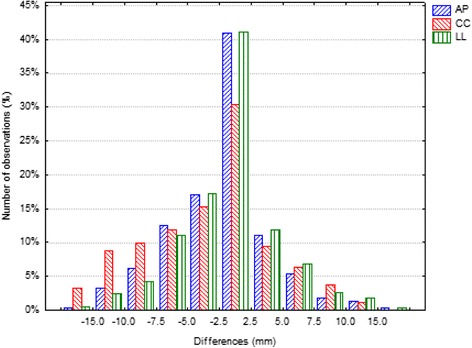
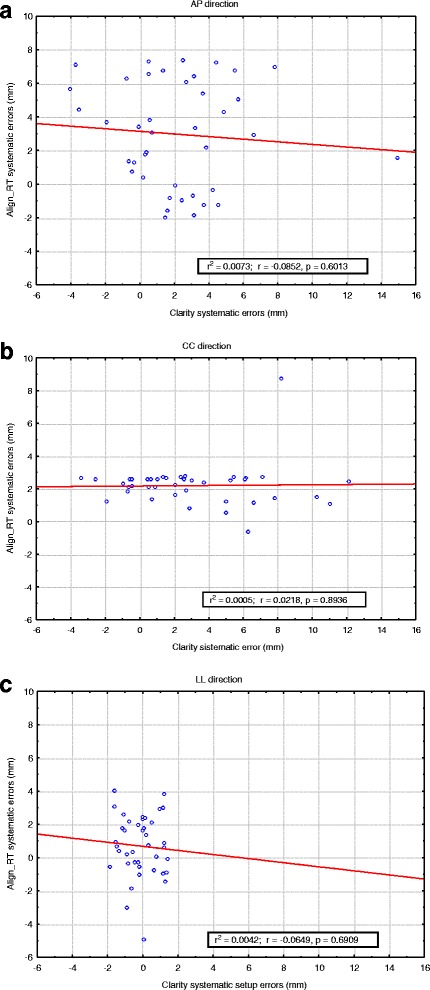
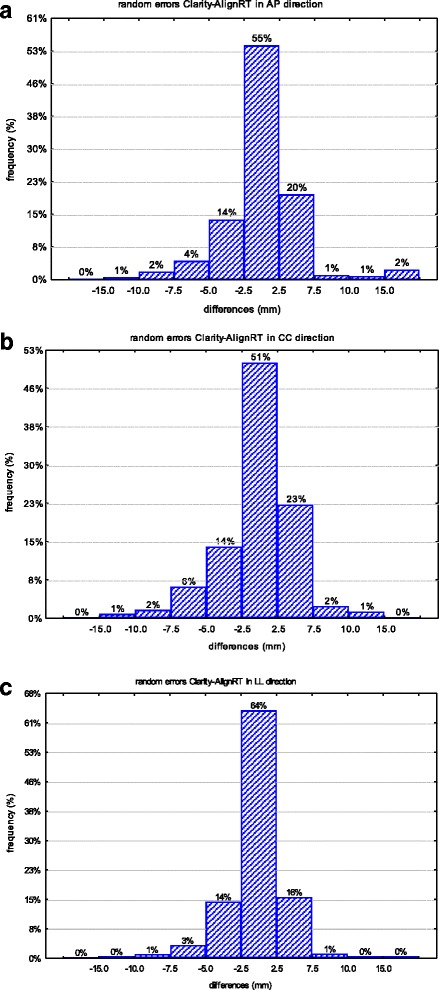
Results: For both IGRT modalities, surface imaging and US, 1318 acquisitions were collected. According with Shapiro Wilk test, the positioning error distributions were not Gaussian for both modalities. The differences between the systematic errors detected by the two modalities were statistically significant only in LL direction (p < 0.05), while the differences between the random errors were not statistically significant in any directions. The 95% confidence interval of the residual errors obtained by subtracting the random errors detected with surface images to those detected with US was included in the range from -7 mm to 7 mm corresponding to the minimum PTV margin adopted in AP direction in our clinical routine.
Conclusions: From our data, it emerges that setup misalignments measured by surface imaging can be predictive of US displacements after the adjustment for systematic errors. Moreover, surface imaging can detect setup errors predictive of registration errors measured by US. This data suggest that the two IGRT modalities could be considered as complementary to each other and could represent a daily "low-cost" and non-invasive IGRT modality in prostate cancer patients.
Keywords: 3D-surface imaging; 3D-ultrasound; Image-guided radiotherapy; Prostate cancer.
Figures
References
-
- Soete G, Verellen D, Storme G. Image guided radiotherapy for prostate cancer. Bull Cancer. 2008;95:374. - PubMed
-
- Korreman S, Rasch C, McNair H, Verellen D, Oelfke U, Maingon P, et al. The European Society of Therapeutic Radiology and Oncology-European Institute of Radiotherapy (ESTRO-EIR) report on 3D CT-based in-room image guidance systems: a practical and technical review and guide. Radiother Oncol. 2010;94:129–44. doi: 10.1016/j.radonc.2010.01.004. - DOI - PubMed
MeSH terms
LinkOut - more resources
Full Text Sources
Other Literature Sources
Medical
