. 2016 Dec;28(12):2905-2915.
doi: 10.1105/tpc.16.00532. Epub 2016 Dec 12.

Epigenetic Regulation of the Sex Determination Gene MeGI in Polyploid Persimmon

Affiliations

Epigenetic Regulation of the Sex Determination Gene MeGI in Polyploid Persimmon

Takashi Akagi et al. Plant Cell. 2016 Dec.

Abstract

Epigenetic regulation can add a flexible layer to genetic variation, potentially enabling long-term but reversible cis-regulatory changes to an allele while maintaining its DNA sequence. Here, we present a case in which alternative epigenetic states lead to reversible sex determination in the hexaploid persimmon Diospyros kaki Previously, we elucidated the molecular mechanism of sex determination in diploid persimmon and demonstrated the action of a Y-encoded sex determinant pseudogene called OGI, which produces small RNAs targeting the autosomal gene MeGI, resulting in separate male and female individuals (dioecy). We contrast these findings with the discovery, in hexaploid persimmon, of an additional layer of regulation in the form of DNA methylation of the MeGI promoter associated with the production of both male and female flowers in genetically male trees. Consistent with this model, developing male buds exhibited higher methylation levels across the MeGI promoter than developing female flowers from either monoecious or female trees. Additionally, a DNA methylation inhibitor induced developing male buds to form feminized flowers. Concurrently, in Y-chromosome-carrying trees, the expression of OGI is silenced by the presence of a SINE (short interspersed nuclear element)-like insertion in the OGI promoter. Our findings provide an example of an adaptive scenario involving epigenetic plasticity.


Figures

Figure 1.
Figure 1.
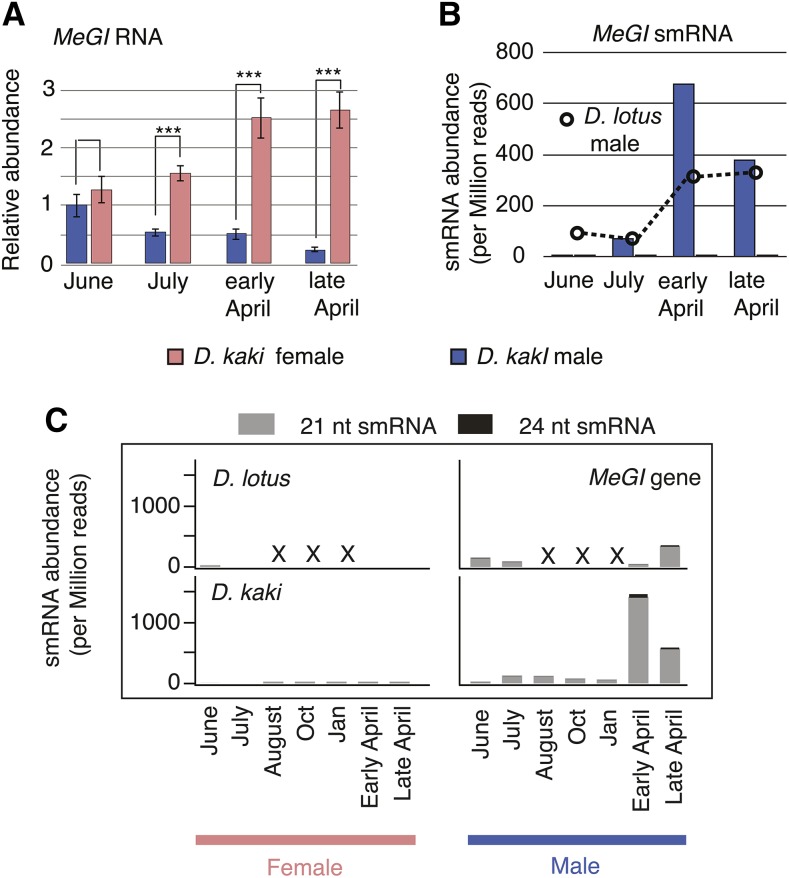
Comparison of MeGI RNA and Small RNA Expression in Diploid and Hexaploid Persimmon. (A) RT-PCR analysis of the expression of MeGI RNA during primordia formation and flower development in monoecious D. kaki. Male buds/flowers exhibited significantly lower MeGI expression than female buds/flowers (***P < 0.001, paired Student’s t test), which is consistent with previous observations in D. lotus (Akagi et al., 2014a). The average of two to four biological replicates is represented by the height of the bars; sd values are indicated as well. (B) Expression of MeGI smRNA during primordia formation and flower development, in monoecious D. kaki, as well as in male flowers of dioecious D. lotus. (C) The 21- and 24-nucleotide smMeGI abundance in male and female buds/flowers of dioecious D. lotus and monoecious D. kaki throughout the year. “X” indicates a missing data point.
Figure 2.
Figure 2.
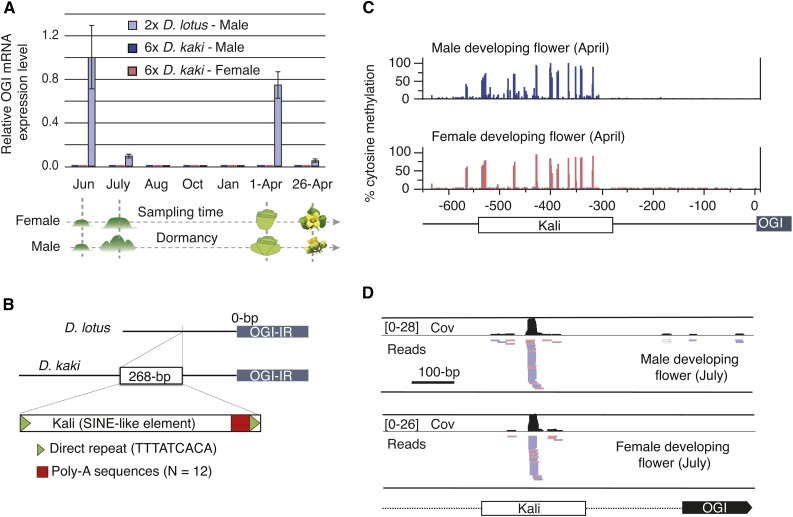
Characterization of OGI RNA and Small RNA Expression. (A) RT-PCR analysis of the expression of OGI mRNA during primordia formation and flower development in monoecious D. kaki and dioecious D. lotus. The average of two to four biological replicates is represented by the height of the bars; sd values are indicated as well. (B) Schematic structure of the OGI promoter region and the Kali insertion. (C) Cytosine methylation levels across the OGI promoter in developing flowers from hexaploid D. kaki cv Taishu. Each bar represents the methylation level of one cytosine residue in either the sense or antisense strand. The position of the SINE element relative to the start codon of the OGI pseudogene is represented at the bottom. (D) The 24-nucleotide small RNA accumulation on the Kali SINE-like insertion in the OGI promoter. For both samples, the coverage track is shown in black above the smRNA mapping tracks. Nearly all smRNAs that mapped to the Kali SINE-like region were 24 nucleotides long (Supplemental Figure 4). Mapped reads are shown in different colors depending on their mapping quality, with unambiguously mapped reads shown in pink (forward mapped reads) or blue (reversely mapped reads) and ambiguously mapped reads shown in gray.
Figure 3.
Figure 3.
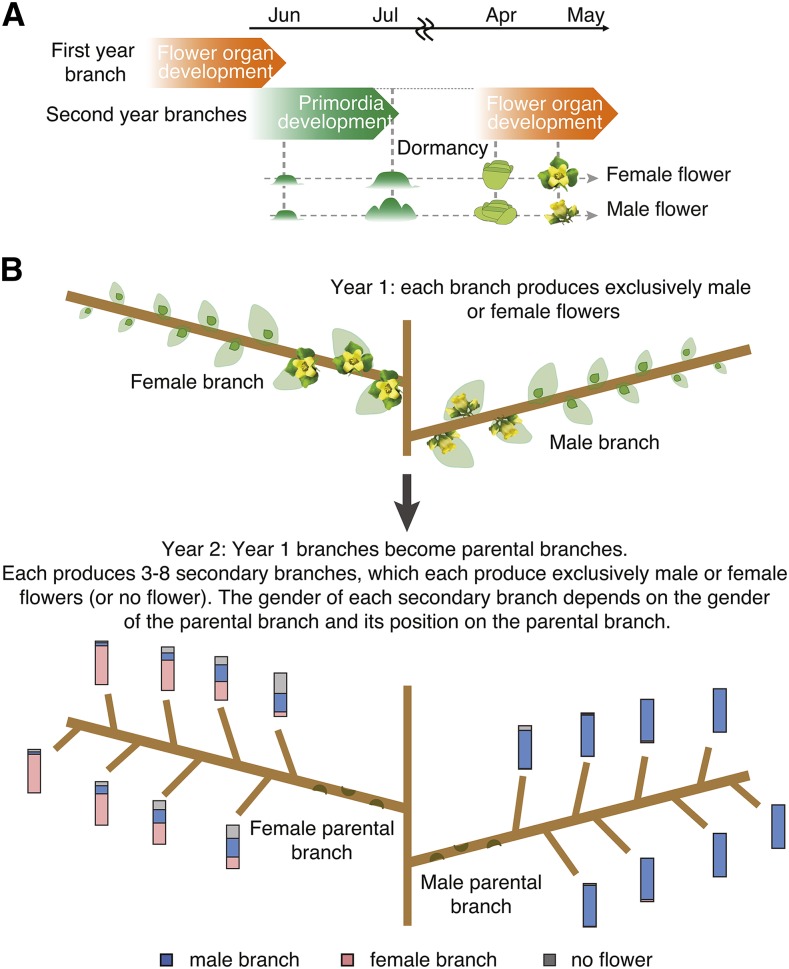
Male and Female Flower Development and Transitions in Monoecious D. kaki. (A) Annual cycle of bud/flower development. The initial development of floral buds occurs in June, at which point primordial development starts and male and female primordia become distinguishable. Consistent with flower development in diploid D. lotus (Akagi et al., 2014a), female primordia exhibit a simple “solitary” structure, while male primordia exhibit trifurcated architecture (Supplemental Figure 1). Buds then enter dormancy until April of the next year, at which point flowers start to develop. (B) Trends in male and female flower development in the next annual cycle (see Methods). Apical buds on branches carrying female flowers most often develop into female flowers (>80%), while medial buds on those same branches can be male or female. On the other hand, buds from male parent branches strongly tend to develop into male branches irrespective of their position on the parental branch (>95%). For each branch, the relative percentages of male (blue), female (pink), and branches with no flowers (gray) are represented as stacked bars.
Figure 4.
Figure 4.
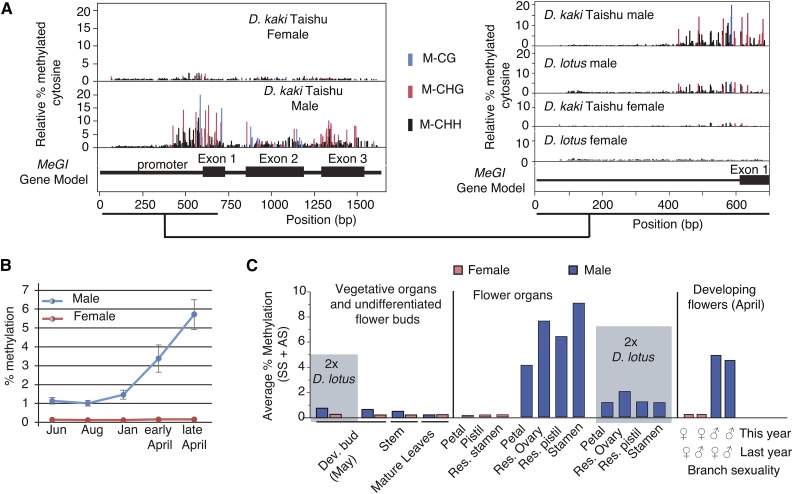
DNA Methylation on the MeGI Promoter. (A) Variation in DNA methylation levels across the MeGI gene and promoter region in developing male and female flowers of monoecious D. kaki (left panel) and across the MeGI promoter region in both diploid dioecious D. lotus and hexaploid monoecious D. kaki (right panel). Different colors represent the different sequence contexts (CH, CHG, and CHH). The gene model is shown at the bottom of each panel. Methylation data values at each position were normalized based on the control gene MatK (see Methods). (B) Average DNA methylation values across the MeGI promoter, in male and female buds and flowers of monoecious D. kaki. The percentages of methylated cytosine at all cytosine positions were averaged over the 300 bp upstream of the start codon. Gray bars indicate sd values. (C) Male organ predominant methylation patterns. The percentage of methylated cytosine at all cytosine positions was averaged over the 200 bp upstream of the start codon. Methylation is visible in male organs but not in female organs (middle panel). Methylation is also consistent with the gender of the current year’s flowers, even if the previous year’s flowers were of the opposite gender (four right-most bars). All samples are from monoecious hexaploid D. kaki, cv Taishu, with the exception of the bars in the two blue boxes, which represent diploid D. lotus samples, as indicated. Methylation data values at each position were normalized based on the control gene MatK (see Methods), with the exception of the last four bars (developing flower samples), for which samples were no longer available to measure methylation percentages on the MatK locus.
Figure 5.
Figure 5.
Effect of the Methylation Inhibitor Zebularine on Flower Development. Feminization of male flowers in monoecious D. kaki, cv Zenjimaru, after zebularine treatment compared with control male flowers. (A) Male flowers exhibited elongated styles and formed normal ovules including immature embryos. At, anther; Em, embryo; Ov, ovule; Pn, pistinode; Sg, stigma; St, style. Bars = 2 mm. For both the zebularine-treated and control flowers, images on the right are close-up photographs of the samples on the left. (B) Pollen germination was reduced in zebularine-treated male flowers, in comparison to the control male flowers (P < 0.00001, Student’s t test). Each mean value was calculated from five flowers, which each contained data from 200 to 300 pollen grains. Standard errors are indicated.
Figure 6.
Figure 6.
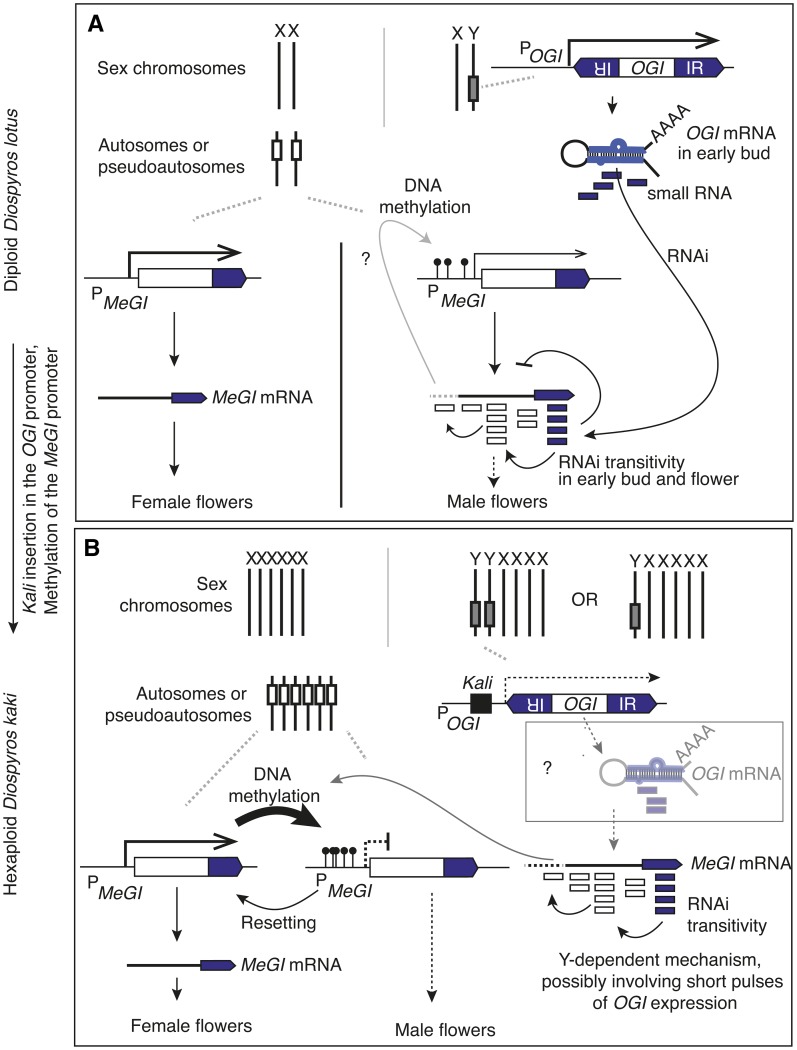
Summary and Evolutionary Model of Sex Determination in Diospyros. (A) Genetic sex determination in diploid D. lotus. Heterogametic individuals are always male. The Y chromosome carries OGI, a male-specific gene whose inverted repeat transcript results in a hairpin RNA processed into small 21-nucleotide RNA. The OGI small RNA triggers RNAi and possibly also methylation on the homologous target MeGI, resulting in suppression of the feminizing factor. (B) Epigenetic sex determination in genetic males of D. kaki. The presence, in the OGI promoter, of the SINE element Kali and the associated near inactivation of OGI expression allow for a more flexible reversible regulation of MeGI expression and the production of both male and female flowers in genetically male trees.

Comment in

References

    1. Akagi T., Henry I.M., Tao R., Comai L. (2014a). Plant genetics. A Y-chromosome-encoded small RNA acts as a sex determinant in persimmons. Science 346: 646–650. - PubMed
    1. Akagi T., Kibe T., Morimura H., Kajita K., Tsujimoto T., Nishiyama S., Kawai T., Yamane H., Tao R. (2014b). Development of molecular markers associated with sexuality in Diospyros lotus L. and their application in D. kaki Thunb. J. Jpn. Soc. Hortic. Sci. 76: 214–221.
    1. Blevins T., Podicheti R., Mishra V., Marasco M., Wang J., Rusch D., Tang H., Pikaard C.S. (2015). Identification of Pol IV and RDR2-dependent precursors of 24 nt siRNAs guiding de novo DNA methylation in Arabidopsis. eLife 4: e09591. - PMC - PubMed
    1. Borges F., Martienssen R.A. (2015). The expanding world of small RNAs in plants. Nat. Rev. Mol. Cell Biol. 16: 727–741. - PMC - PubMed
    1. Chen Z.J. (2007). Genetic and epigenetic mechanisms for gene expression and phenotypic variation in plant polyploids. Annu. Rev. Plant Biol. 58: 377–406. - PMC - PubMed

Publication types

MeSH terms