. 2016 Dec 27;113(52):15084-15089.
doi: 10.1073/pnas.1617929114. Epub 2016 Dec 12.

The IDH2 R172K mutation associated with angioimmunoblastic T-cell lymphoma produces 2HG in T cells and impacts lymphoid development

Affiliations

The IDH2 R172K mutation associated with angioimmunoblastic T-cell lymphoma produces 2HG in T cells and impacts lymphoid development

François Lemonnier et al. Proc Natl Acad Sci U S A. .

Abstract

Oncogenic isocitrate dehydrogenase (IDH)1 and IDH2 mutations at three hotspot arginine residues cause an enzymatic gain of function that leads to the production and accumulation of the metabolite 2-hydroxyglutarate (2HG), which contributes to the development of a number of malignancies. In the hematopoietic system, mutations in IDH1 at arginine (R) 132 and in IDH2 at R140 and R172 are commonly observed in acute myeloid leukemia, and elevated 2HG is observed in cells and serum. However, in angioimmunoblastic T-cell lymphoma (AITL), mutations are almost exclusively restricted to IDH2 R172, and levels of 2HG have not been comprehensively measured. In this study, we investigate the expression pattern of mutant IDH2 in the AITL tumor microenvironment and measure levels of 2HG in tissue and serum of AITL patients. We find that mutant IDH2 expression is restricted to the malignant T-cell component of AITL, and that 2HG is elevated in tumor tissue and serum of patients. We also investigate the differences between the three hotspot mutation sites in IDH1 and IDH2 using conditional knock-in mouse models. These studies show that in the lymphoid system, mutations in IDH2 at R172 produce high levels of 2HG compared with mutations at the other two sites and that lymphoid development is impaired in these animals. These data provide evidence that IDH2 R172 mutations may be the only variants present in AITL because of their capacity to produce significant amounts of the oncometabolite 2HG in the cell of origin of this disease.

Keywords: 2-hydroxyglutarate; AITL; T cell; isocitrate dehydrogenase; lymphoma.


Conflict of interest statement

The authors declare no conflict of interest.

Figures
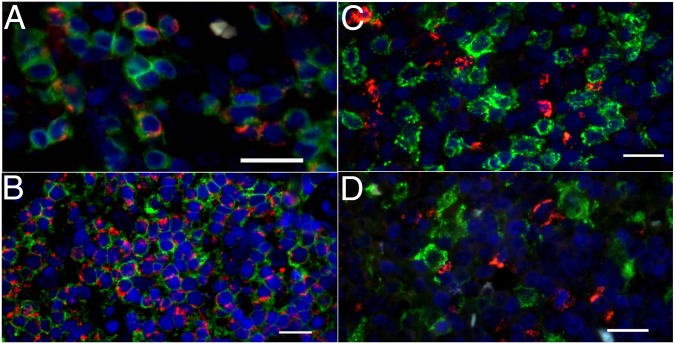
Fig. 1.
Fig. 1.
IDH2R172K mutant protein is present in malignant AITL T cells with a TFH phenotype. Immunofluorescence double staining for IDH2R172K (red) and CD3 (green) (A), IDH2R172K (red) and ICOS (green) (B), double staining IDH2R172K (red) and CD8 (green) (C), and IDH1R172K (red) and CD163 (green) (D). All images were acquired at 40× magnification. DAPI counterstaining for nuclei is shown in blue for all images. (Scale bars: 20 μm.)
Fig. 2.
Fig. 2.
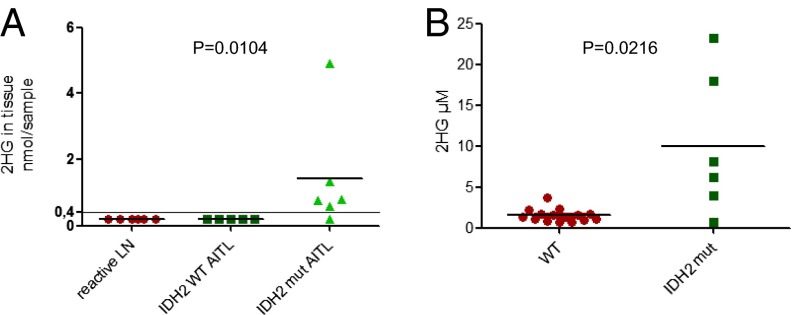
IDH2-mutated AITL tumors produce 2HG that is detectable in tissue and serum. (A) 2HG concentration in tissue obtained from reactive lymph nodes (LN) and tissue from IDH2 WT and IDH2 mutant AITL tumors. (B) 2HG in the serum of AITL patients of the indicated mutational status. The Mann–Whitney test was used to compare WT AITL versus mutated AITL.
Fig. 3.
Fig. 3.
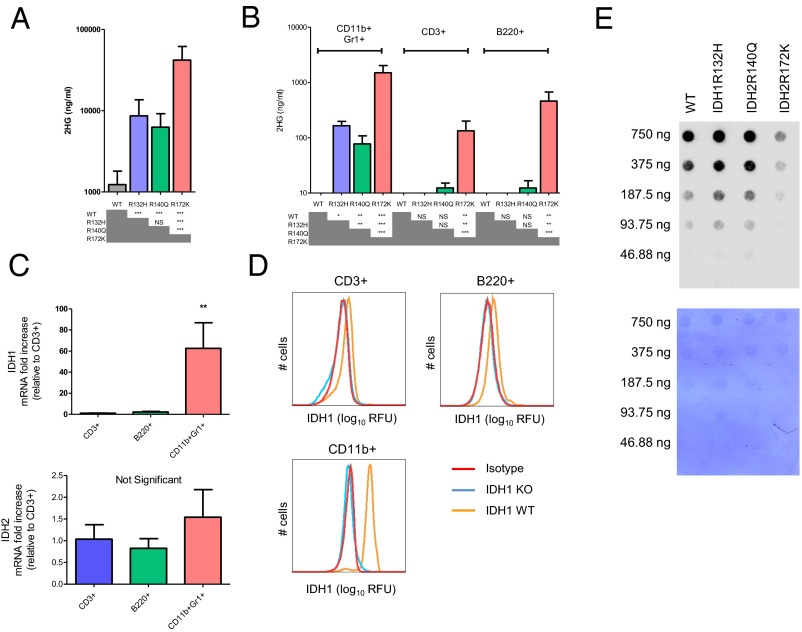
2HG production depends on the specific Idh mutation and the cell context. (A) 2HG level measured by mass spectrometry in serum of IDH KI mice aged 3–6 mo of the indicated genotypes. (B) 2HG level in 500,000 CD11b+Gr1+ myeloid, CD3+ T, and B220+ B cells. (C) Quantitative RT-PCR measurement of IDH1 and IDH2 expression in CD11b+ Gr1+ myeloid cells, CD3+ T cells, and B220+ B cells. RPS9 is used as a housekeeping gene, and results are shown relative to T cells. Results from three independent experiments are shown. In AC, bars represent the mean and error bars represent SD. Two-tailed Student's t tests were performed to determine statistical significance by using the Bonferroni correction for multiple comparisons. (D) FACS analysis of IDH1 expression in the indicated cell types derived from bone marrow and spleen of IDH1 KO or IDH1 WT mice compared with isotype control. ANOVA with Tukey's multiple comparison correction was used to determine statistical significance. (E) Dot blot measurement of the level of 5hmC in T cells from IDH KI mice of the indicated genotypes. DNA loading control is shown in Lower. *P < 0.05, **P < 0.01, and ***P < 0.001. NS, not significant.
Fig. 4.
Fig. 4.
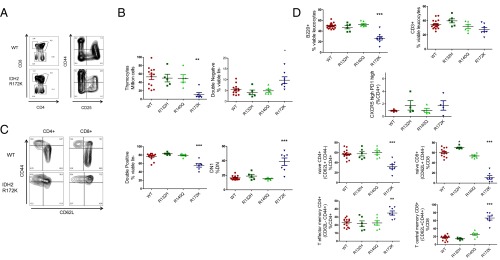
IDH2 R172K mutant impairs lymphoid development and T-cell differentiation. (A) Representative FACS profiles of WT and IDH2R172 thymocytes. (B) Quantification of thymocyte number, Lin CD4+ CD8+ double positive proportion, Lin CD4 CD8 double negative proportion, and type I double negative (DN1) proportion, defined as Lin CD4 CD8 CD44+ CD25 thymocytes. The Lin population was CD11b, Ter119, Gr1, B220, NK1.1 CD11c. (C) Representative FACS profile of WT and IDH2R172K CD4+ and CD8+ T-cell differentiation in spleen. (D) Quantification of lymphoid population in the spleen: B220+ B cells; CD3+ T cells; TFH cells defined as CD4+ PD1 high CXCR5 high, naive CD4+ and CD8+ T cells defined as CD62L+ and CD44; CD4+ T-effector memory cells defined as CD62L, CD44+, and CD4+; CD8+ central memory T cells, defined as CD62L+ CD44+ and CD8+. ANOVA test with Dunnett's multiple comparison test (each KI was compared with WT) were performed, and *P < 0.05, **P < 0.01, and ***P < 0.001.

References

    1. Cairns RA, Mak TW. Oncogenic isocitrate dehydrogenase mutations: Mechanisms, models, and clinical opportunities. Cancer Discov. 2013;3(7):730–741. - PubMed
    1. Dang L, et al. Cancer-associated IDH1 mutations produce 2-hydroxyglutarate. Nature. 2009;462(7274):739–744. - PMC - PubMed
    1. Ward PS, et al. The common feature of leukemia-associated IDH1 and IDH2 mutations is a neomorphic enzyme activity converting alpha-ketoglutarate to 2-hydroxyglutarate. Cancer Cell. 2010;17(3):225–234. - PMC - PubMed
    1. Chowdhury R, et al. The oncometabolite 2-hydroxyglutarate inhibits histone lysine demethylases. EMBO Rep. 2011;12(5):463–469. - PMC - PubMed
    1. Figueroa ME, et al. Leukemic IDH1 and IDH2 mutations result in a hypermethylation phenotype, disrupt TET2 function, and impair hematopoietic differentiation. Cancer Cell. 2010;18(6):553–567. - PMC - PubMed

Publication types

Grants and funding