. 2016 Dec 13:6:38764.
doi: 10.1038/srep38764.

A genome-wide screen of bacterial mutants that enhance dauer formation in C. elegans

Affiliations

A genome-wide screen of bacterial mutants that enhance dauer formation in C. elegans

Amit Khanna et al. Sci Rep. .

Abstract

Molecular pathways involved in dauer formation, an alternate larval stage that allows Caenorhabditis elegans to survive adverse environmental conditions during development, also modulate longevity and metabolism. The decision to proceed with reproductive development or undergo diapause depends on food abundance, population density, and temperature. In recent years, the chemical identities of pheromone signals that modulate dauer entry have been characterized. However, signals derived from bacteria, the major source of nutrients for C. elegans, remain poorly characterized. To systematically identify bacterial components that influence dauer formation and aging in C. elegans, we utilized the individual gene deletion mutants in E. coli (K12). We identified 56 diverse E. coli deletion mutants that enhance dauer formation in an insulin-like receptor mutant (daf-2) background. We describe the mechanism of action of a bacterial mutant cyaA, that is defective in the production of cyclic AMP, which extends lifespan and enhances dauer formation through the modulation of TGF-β (daf-7) signaling in C. elegans. Our results demonstrate the importance of bacterial components in influencing developmental decisions and lifespan in C. elegans. Furthermore, we demonstrate that C. elegans is a useful model to study bacterial-host interactions.


Conflict of interest statement

The authors declare no competing financial interests.

Figures
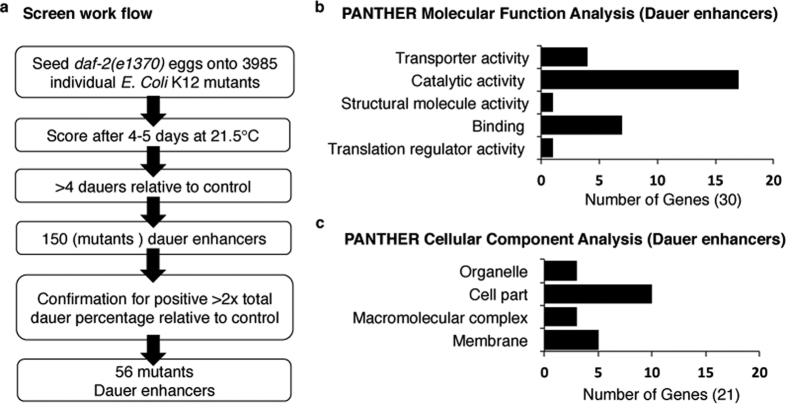
Figure 1
Figure 1. Schematic of the E. coli knockout screen for dauer formation in C. elegans and functional classifications of identified bacterial genes.
(a) Schematic of the workflow of E. coli knockout screen for dauer enhancement in C. elegans. The screen resulted in 56 mutant bacterial strains enhancing dauer formation in the worm. The knockout candidates and associated statistical information are available on Table 1. (b) Functional classification of candidate genes (dauer enhancers) from the screen. The molecular function analysis of the candidate genes was done using PANTHER pathway database. (c) The cellular component analysis of these genes was done using PANTHER pathway database. For details pertaining to biological function analysis and enrichment analysis see Fig. S1.
Figure 2
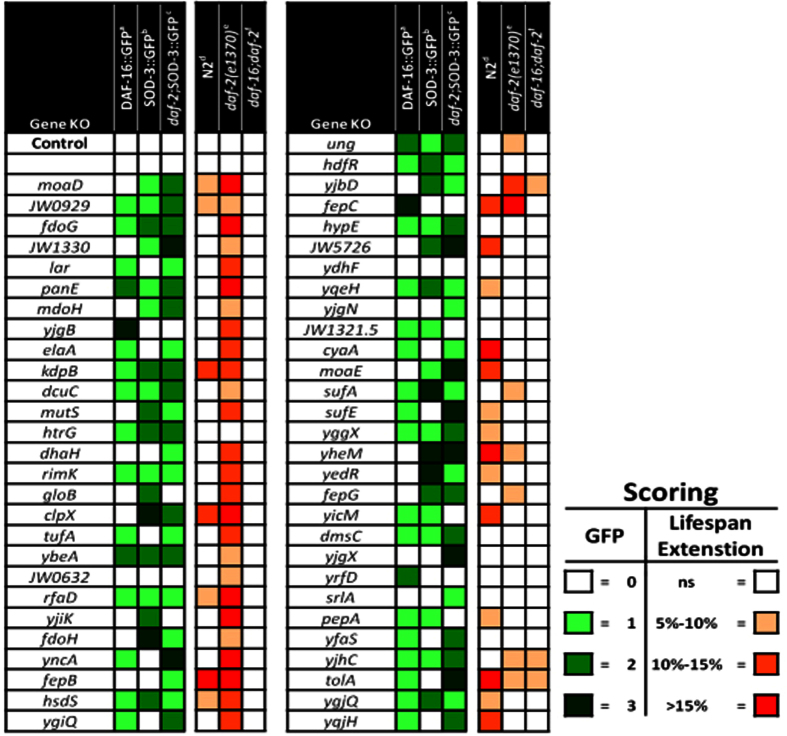
Figure 2. Analysis of DAF-16 activation and lifespan extension in bacterial knockouts that enhance C. elegans dauer formation.
Heat map showing various phenotypes observed with bacterial mutants (left to right). (a) Semi-quantitative analysis of DAF-16 nuclear localization is shown following feeding on listed E. coli knockouts. Increased green shading correlates with increasing nuclear localization of DAF-16. (Fig. S2) (b) sod-3p::GFP expression is shown following feeding on listed E. coli knockouts. Increased green shading correlates with increasing sod-3p::GFP expression. (c) daf-2(e1370); sod-3p::GFP expression is shown following feeding on listed E. coli knockouts. Increased green shading correlates with increasing daf-2(e1370);sod-3p::GFP expression. In each visual marker (ac) knockout strains are given a score relative to its K-12 control, which was consistently set at a score of 0 (white shading). (df) Lifespan analysis of respective worm strains following feeding on bacterial knockout strains throughout life. Deeper red shading indicates increased average lifespan compared to K-12 control strain. Representative lifespan curves and lifespan data analysis are shown in Fig. S2 and Table 2 respectively.
Figure 3
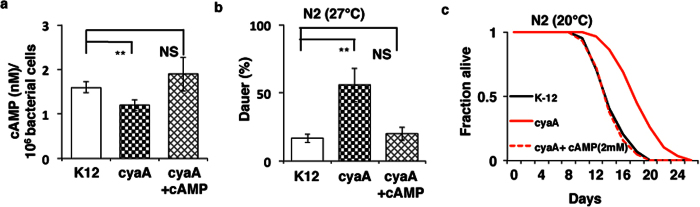
Figure 3. Feeding bacterial cyaA mutants modulates lifespan and dauer formation in C. elegans.
(a) The amount of cAMP in K-12 (control), mutant cyaA bacteria, cyaA mutant bacteria supplemented with cAMP (2 mM), (b) Bacterial knockout of cyaA enhances the dauer formation in N2 strain. Control (N2) animals fed on K-12 (control) bacteria, mutant cyaA bacteria and cyaA mutant bacteria supplemented with cAMP (2 mM) on minimal media agar plate. Data is represented as mean percent ± SD of greater than 3 biological replicates, n > 200. (c) Feeding E. coli cyaA mutants extends the lifespan of N2 strain in C. elegans. ***P < 0.0001.
Figure 4
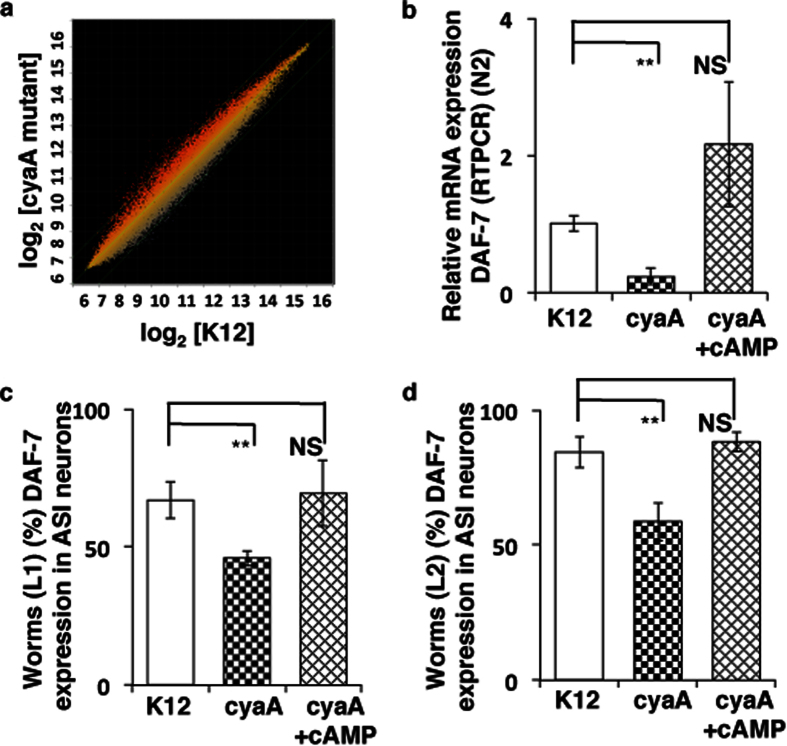
Figure 4. Feeding bacterial cyaA mutants alters DAF-7 expression in C. elegans.
(a) A scatter plot of log2 transcript probe intensities for daf-2(e1370) versus N2, and K-12 (control) versus cyaA fed control worm comparisons. Genes which show only p-values of <0.05 and fold changes >1.3 and <0.8 were shortlisted. (b) Relative expression of daf-7 mRNA in N2 animals on feeding K-12(control), cyaA mutant bacteria, and cyaA mutant bacteria supplemented with cAMP(2 mM). (c,d) cAMP induces the expression of DAF-7 in ASI neuron. The fraction of animals show DAF-7 expression at L1 and L2 stage on feeding K-12 (control), cyaA mutant bacteria, and cyaA mutant bacteria supplemented with cAMP (2 mM). The data is represented as percent mean ± S.D. of greater than 3 biological replicates, n > 200, **P < 0.0001.
Figure 5
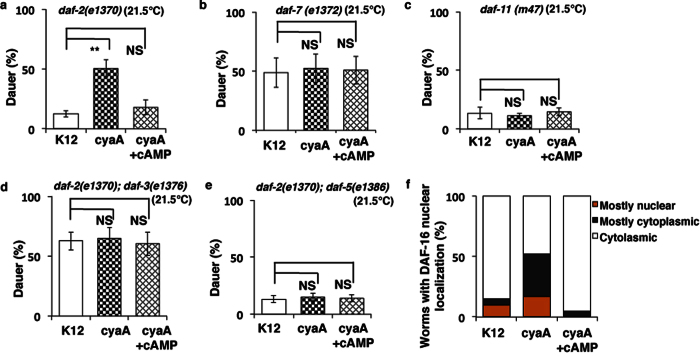
Figure 5. Bacterial cyaA mutants affect dauer formation through TGF-β pathway and DAF-16.
(a–e) Dauer formation of daf-2(e1370), daf-7(e1372), daf-11(m47) and daf-2(e1370); daf-3(e1376), daf-2(e1370); daf-5(e1386) animals on feeding K-12 (control), cyaA mutant bacteria, and cyaA mutant bacteria supplemented with cAMP (2 mM). (f) DAF-16::GFP worms in the N2 background on feeding K-12 (control), cyaA mutant bacteria, and cyaA mutant bacteria supplemented with cAMP(2 mM). Quantification of DAF-16::GFP localization on feeding K-12 (control), cyaA mutant bacteria, and cyaA mutant bacteria supplemented with cAMP(2 mM). In each case, the data is represented as mean percent ± S.D of three replicates, **P < 0.0001, n > 200.
Figure 6
Figure 6. Bacterial cyaA mutants affect lifespan through TGF-β pathway and DAF-16.
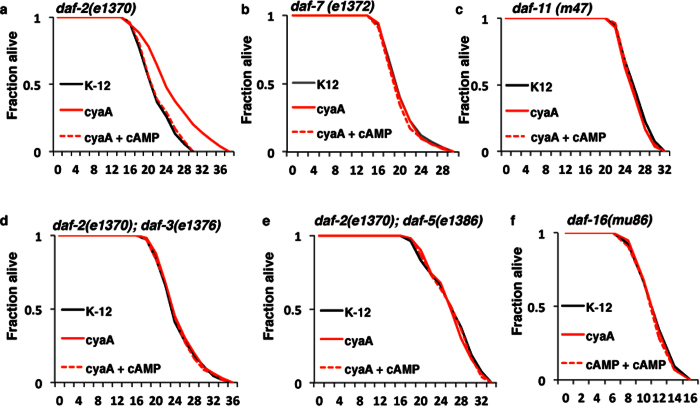
(a–f) Kaplan–Meier survival curves of synchronously aging hermaphrodite worms: daf-2(e1370), daf-7(e1372), daf-11(m47), daf-2(e1370); daf-3(e1376), daf-2(e1370); daf-5(e1386) and daf-16(mu86) animals fed on K-12 (control), cyaA mutant bacteria, and cyaA mutant bacteria supplemented with cAMP (2 mM). n = 100, **p < 0.01; average ± std. dev (n = 3).
Figure 7
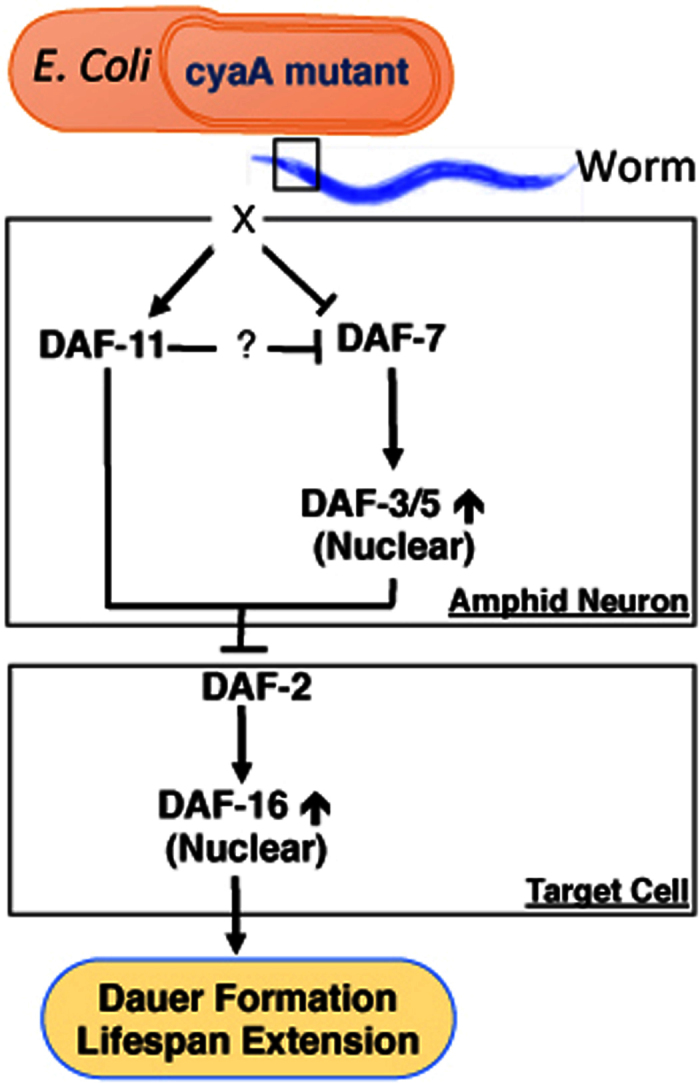
Figure 7. Model of how bacterial cAMP signaling regulates dauer formation and lifespan in worms.
Lack of bacterial cAMP inhibits the expression of DAF-7, resulting in the inhibition of DAF-3/5. This leads to the suppression of IGF-1 pathway in animals, and enhances the dauer formation and lifespan extension in DAF-16/FOXO dependent manner.

References

    1. Hashmi S. et al.. A C. elegans model to study human metabolic regulation. Nutr Metab (Lond) 10, 31, doi: 10.1186/1743-7075-10-31 (2013). - DOI - PMC - PubMed
    1. Hu P. J. Dauer. WormBook: the online review of C. elegans biology 1–19, doi: 10.1895/wormbook.1.144.1 (2007). - DOI - PMC - PubMed
    1. Golden J. W. & Riddle D. L. ACaenorhabditis elegans dauer-inducing pheromone and an antagonistic component of the food supply. J Chem Ecol 10, 1265–1280, doi: 10.1007/BF00988553 (1984). - DOI - PubMed
    1. Golden J. W. & Riddle D. L. A pheromone influences larval development in the nematode Caenorhabditis elegans. Science 218, 578–580 (1982). - PubMed
    1. Butcher R. A., Ragains J. R., Kim E. & Clardy J. A potent dauer pheromone component in Caenorhabditis elegans that acts synergistically with other components. Proceedings of the National Academy of Sciences of the United States of America 105, 14288–14292, doi: 10.1073/pnas.0806676105 (2008). - DOI - PMC - PubMed

Publication types