Case Reports
. 2016 Nov 24;375(21):2060-2066.
doi: 10.1056/NEJMoa1608085. Epub 2016 Nov 12.

Fully Implanted Brain-Computer Interface in a Locked-In Patient with ALS

Affiliations
Case Reports

Fully Implanted Brain-Computer Interface in a Locked-In Patient with ALS

Mariska J Vansteensel et al. N Engl J Med. .

Abstract

Options for people with severe paralysis who have lost the ability to communicate orally are limited. We describe a method for communication in a patient with late-stage amyotrophic lateral sclerosis (ALS), involving a fully implanted brain-computer interface that consists of subdural electrodes placed over the motor cortex and a transmitter placed subcutaneously in the left side of the thorax. By attempting to move the hand on the side opposite the implanted electrodes, the patient accurately and independently controlled a computer typing program 28 weeks after electrode placement, at the equivalent of two letters per minute. The brain-computer interface offered autonomous communication that supplemented and at times supplanted the patient's eye-tracking device. (Funded by the Government of the Netherlands and the European Union; ClinicalTrials.gov number, NCT02224469 .).


Figures
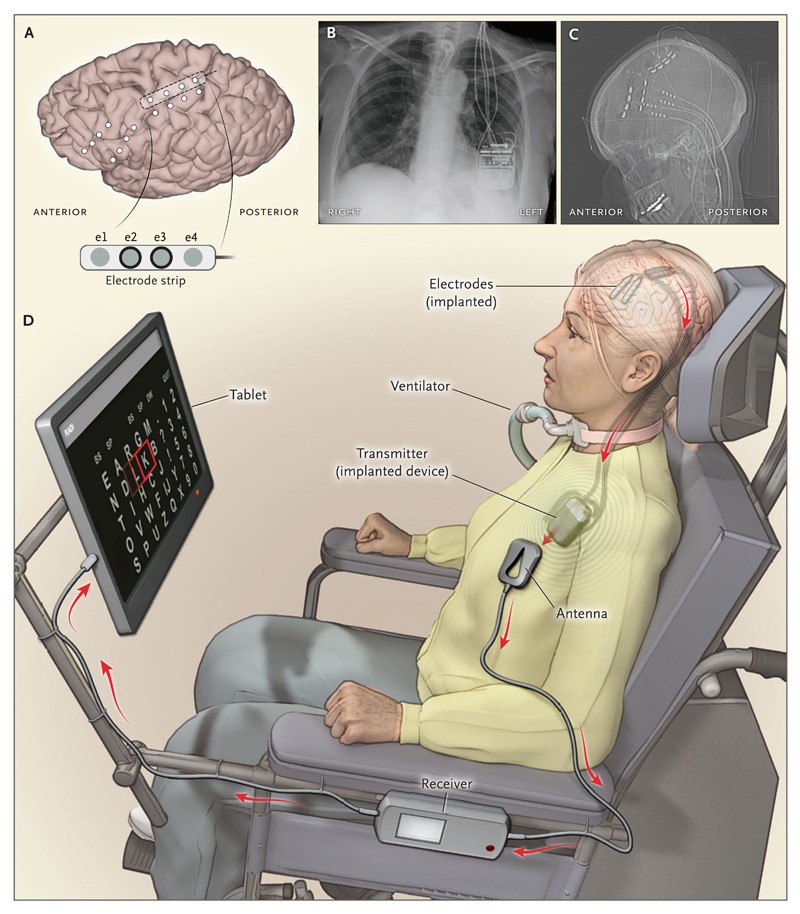
Figure 1
Figure 1. Electrode Placement and System Setup in the Brain–Computer Interface System.
Panel A shows the contact points of the electrode strips, which are indicated by white dots, over the sensorimotor and dorsolateral prefrontal cortex; the positions of electrodes were based on postoperative computed tomographic (CT) scans merged with the presurgical MRI. Electrodes e2 and e3 on the electrode strip were chosen for brain–computer interface feedback. Panel B shows a postoperative chest radiograph displaying the transmitter device (Activa PC+S, Medtronic), which was placed subcutaneously in the chest, and wires leading to the electrodes. Two of four wires were connected to the device. Panel C shows the postoperative CT scan with the locations of four electrode strips. The dots on the four wires are connectors. Panel D shows the components of the brain–computer interface system, including the transmitter, receiving antenna, receiver, and tablet.
Figure 2
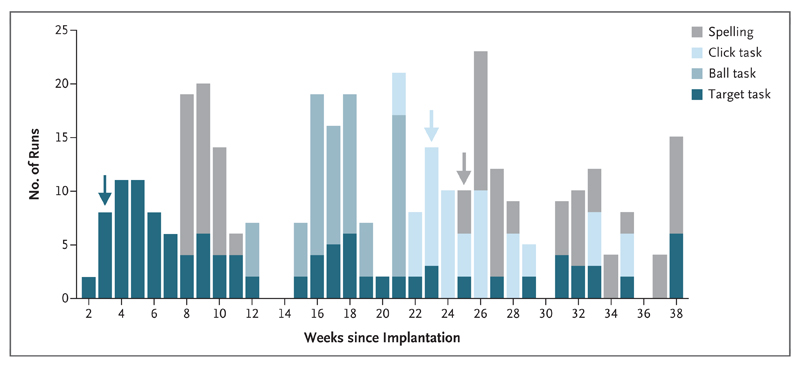
Figure 2. Overview of Training Sessions.
Two training sessions were conducted every week at the home of the patient. A total of 357 runs (with tasks that were 2 to 5 minutes in duration) were performed in 67 sessions. Shading indicates the types of tasks that were performed. Spelling was attempted in week 8, but the patient reported that excessive mental effort was required. Better decoding enabled spelling starting from week 25. Arrows with the same shading as the bars indicate the time at which parameter settings for the respective task were established, marking the onset of actual training on the task. The ball task was used only for parameter adjustment and was not subsequently used for training after the parameter settings had been fixed.
Figure 3
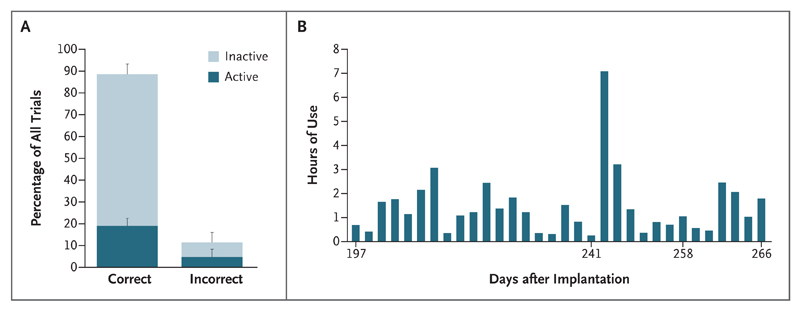
Figure 3. Spelling Performance.
Panel A shows spelling performance aggregated over all 44 spelling runs, with the mean percentage of correct and incorrect responses indicated; T bars indicate standard deviations. Correct responses included the selection of the correct letters (“active” trial) and omission of a brain click when other letters were highlighted (“inactive” trial); more inactive than active trials were performed. Panel B shows the hours per day of use of the home-use system for spelling (the system was not used daily; therefore, days are not consecutive).

Comment in

References

    1. American Congress of Rehabilitation Medicine. Recommendations for use of uniform nomenclature pertinent to patients with severe alterations in consciousness. Arch Phys Med Rehabil. 1995;76:205–9. - PubMed
    1. Chiò A, Logroscino G, Traynor BJ, et al. Global epidemiology of amyotrophic lateral sclerosis: a systematic review of the published literature. Neuroepidemiology. 2013;41:118–30. - PMC - PubMed
    1. Laureys S, Pellas F, Van Eeckhout P, et al. The locked-in syndrome: what is it like to be conscious but paralyzed and voiceless? Prog Brain Res. 2005;150:495–511. - PubMed
    1. Bruno MA, Bernheim JL, Ledoux D, Pellas F, Demertzi A, Laureys S. A survey on self-assessed well-being in a cohort of chronic locked-in syndrome patients: happy majority, miserable minority. BMJ Open. 2011;1(1):e000039. - PMC - PubMed
    1. Rousseau MC, Baumstarck K, Alessandrini M, Blandin V, Billette de Villemeur T, Auquier P. Quality of life in patients with locked-in syndrome: evolution over a 6-year period. Orphanet J Rare Dis. 2015;10:88. - PMC - PubMed

Publication types

MeSH terms

Associated data