


Development of the crop residue and rangeland burning in the 2014 National Emissions Inventory using information from multiple sources
- PMID: 27964698
- PMCID: PMC6088810
- DOI: 10.1080/10962247.2016.1268982
Development of the crop residue and rangeland burning in the 2014 National Emissions Inventory using information from multiple sources
Abstract
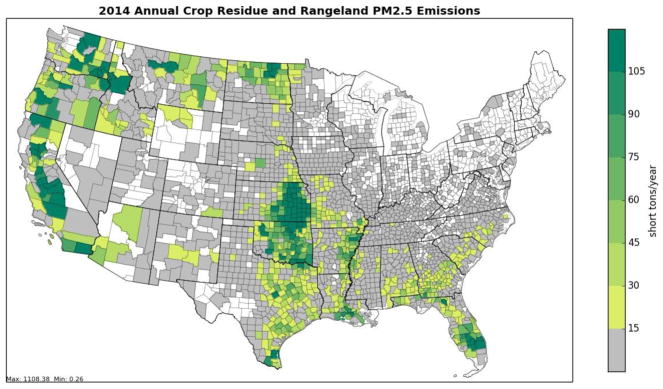
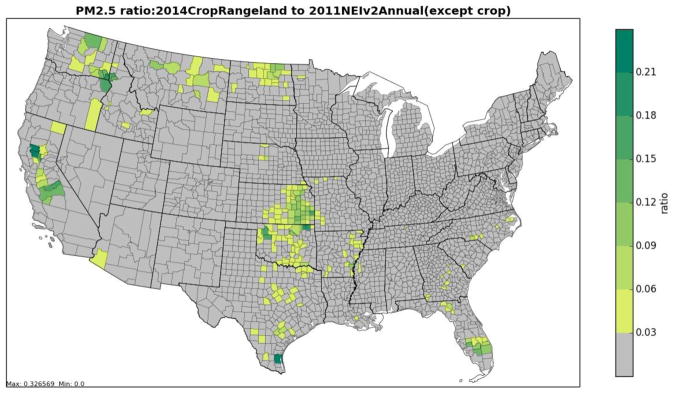
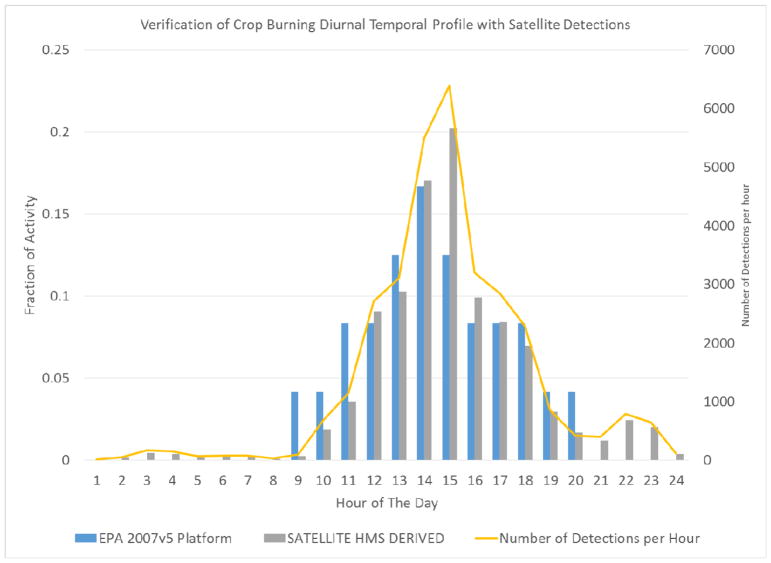
Biomass burning has been identified as an important contributor to the degradation of air quality because of its impact on ozone and particulate matter. One component of the biomass burning inventory, crop residue burning, has been poorly characterized in the National Emissions Inventory (NEI). In the 2011 NEI, wildland fires, prescribed fires, and crop residue burning collectively were the largest source of PM2.5. This paper summarizes our 2014 NEI method to estimate crop residue burning emissions and grass/pasture burning emissions using remote sensing data and field information and literature-based, crop-specific emission factors. We focus on both the postharvest and pre-harvest burning that takes place with bluegrass, corn, cotton, rice, soybeans, sugarcane and wheat. Estimates for 2014 indicate that over the continental United States (CONUS), crop residue burning excluding all areas identified as Pasture/Grass, Grassland Herbaceous, and Pasture/Hay occurred over approximately 1.5 million acres of land and produced 19,600 short tons of PM2.5. For areas identified as Pasture/Grass, Grassland Herbaceous, and Pasture/Hay, biomass burning emissions occurred over approximately 1.6 million acres of land and produced 30,000 short tons of PM2.5. This estimate compares with the 2011 NEI and 2008 NEI as follows: 2008: 49,650 short tons and 2011: 141,180 short tons. Note that in the previous two NEIs rangeland burning was not well defined and so the comparison is not exact. The remote sensing data also provided verification of our existing diurnal profile for crop residue burning emissions used in chemical transport modeling. In addition, the entire database used to estimate this sector of emissions is available on EPA's Clearinghouse for Inventories and Emission Factors (CHIEF, http://www3.epa.gov/ttn/chief/index.html ).
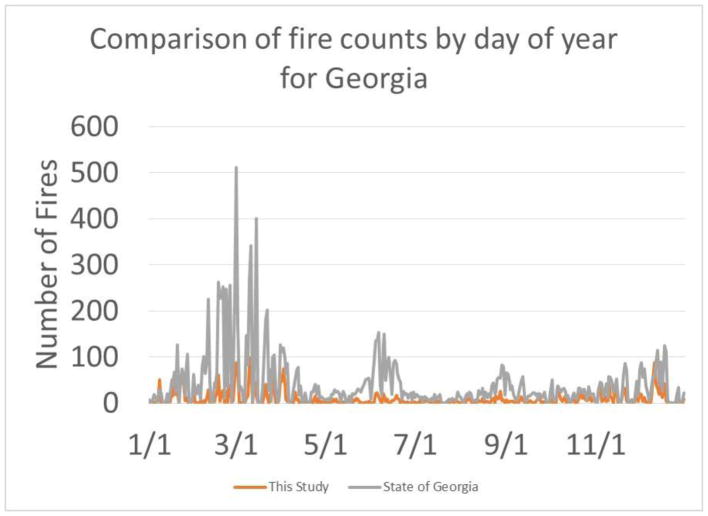
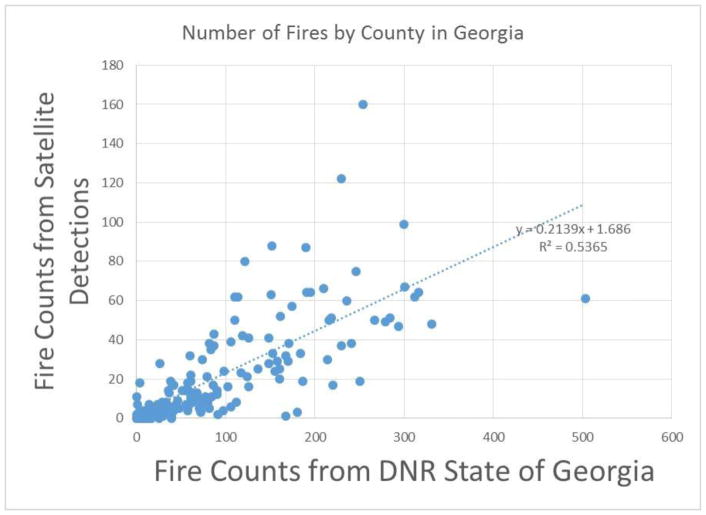
Implications: Estimates of crop residue burning and rangeland burning emissions can be improved by using satellite detections. Local information is helpful in distinguishing crop residue and rangeland burning from all other types of fires.
Figures
References
-
- Akagi SK, Yokelson RJ, Wiedinmyer C, Alvarado MJ, Reid JS, Karl T, Crounse JD, Wennberg PO. Emission factors for open and domestic biomass burning for use in atmospheric models. Atmos Chem Phys. 2011;11:4039–4072. doi: 10.5194/acp-11-4039-2011. - DOI
-
- Anderson DC, Nicely JM, Salawitch RJ, Canty TP, Dickerson RR, Hanisco TF, Wolfe GM, Apel EC, Atlas E, Bannan T, Bauguitte S, Blake NJ, Bresch JF, Campos TL, Carpenter LJ, Cohen MD, Evans M, Fernandez RP, Kahn BH, Kinnison DE, Hall SR, Harris PNR, Hornbrook RS, Lamarque J, Le Breton M, Lee JD, Percival C, Pfister L, Pierce RB, Riemer DD, Saiz-Lopez A, Stunder BJB, Thompson AM, Ullmann K, Vaughan A, Weinheimer AJ. A pervasive role for biomass burning in tropical high ozone/low water structures. Nat Commun. 2016;7:10267. doi: 10.1038/ncomms10267. - DOI - PMC - PubMed
-
- Jenkins BM, Daniel Jones A, Turn SQ, Williams RB. Particle concentrations, gas-particle partitioning, and species intercorrelations for polycyclic aromatic hydrocarbons (PAH) emitted during biomass burning. Atmos Environ. 1996;30:3825–3835. doi: 10.1016/1352-2310(96)00084-2. - DOI
MeSH terms
Substances
Grants and funding
LinkOut - more resources
Full Text Sources
Other Literature Sources
Medical
Research Materials
