. 2016 Dec 13;18(1):296.
doi: 10.1186/s13075-016-1196-6.

Differential gene and protein expression of chemokines and cytokines in synovial fluid of patients with arthritis

Affiliations

Differential gene and protein expression of chemokines and cytokines in synovial fluid of patients with arthritis

Anastasiya Muntyanu et al. Arthritis Res Ther. .

Abstract

Background: Psoriatic arthritis (PsA), an inflammatory musculoskeletal disease, develops in approximately 30% of patients with psoriasis. Previously, chemokine (C-X-C motif) ligand 10 (CXCL10) was identified as a predictive biomarker of PsA in patients with psoriasis and was reduced after development of PsA. The purpose of the present study was to explore messenger RNA (mRNA) and protein expression of CXCL10 and its receptor, chemokine (C-X-C motif) receptor 3 (CXCR3), in the joints of patients with PsA to gain insight into their role in the pathogenesis of the disease.

Methods: Sera from 47 patients with PsA and 33 healthy control subjects were compared for expression of CXCL10 by Luminex assay. Synovial fluid (SF) was obtained from patients with PsA (n = 40), osteoarthritis (OA; n = 14), gout (n = 8), and rheumatoid arthritis (RA; n = 11) during clinical care. SF mRNA and protein expression of CXCL10, interleukin-17A (IL-17A), CXCR3, TBX21, RORC and/or interferon γ (IFNγ) were compared among the above-mentioned disease groups, as well as in paired SF and serum samples from patients with PsA using real-time polymerase chain reaction and Luminex assays, respectively.

Results: Serum CXCL10 was significantly higher in patients with PsA than in control subjects (p = 0.0007). CXCL10, IL-17A, and TBX21 expression were elevated in SF cells of patients with PsA compared with those of patients with OA and gout, but not those of patients with RA. CXCR3 and RORC were elevated in PsA SF cells compared with all other patient groups. Concordant results were obtained for CXCL10 and IL-17A protein expression. IFNγ was elevated in PsA SF compared with OA SF (p = 0.015). CXCL10 protein expression was substantially increased in SF (median 7283.9 pg/ml, interquartile range [IQR] 1330-10,362 pg/ml) compared with paired serum samples (median 282.06, IQR 180.7-395.8 pg/ml; p = 0.001), whereas IFNγ was significantly reduced (SF median 6.03 pg/ml, IQR 4.47-8.94 pg/ml; versus serum median 23.70 pg/ml, IQR 3.2-104.6 pg/ml; p = 0.001).

Conclusions: CXCL10 may have an important etiological role in PsA that is analogous to that in RA, and it is a candidate biomarker to distinguish PsA from healthy individuals and from patients with OA and gout.

Keywords: Biomarkers; Chemokines; Cytokines; Psoriatic arthritis; Synovial cells; Synovial fluid.


Figures
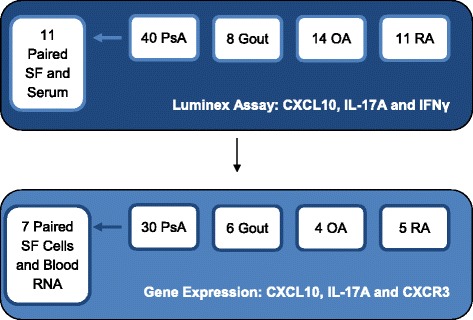
Fig. 1
Fig. 1
Summary of synovial fluid (SF) samples measured by Luminex assay (protein) and gene expression (messenger RNA). Gene expression was measured in a subset of patients analyzed with the Luminex assay. CXCL10 Chemokine (C-X-C motif) ligand 10, CXCR3 Chemokine (C-X-C motif) receptor 3, IFNγ Interferon γ, IL Interleukin, OA Osteoarthritis, PsA Psoriatic arthritis, RA Rheumatoid arthritis
Fig. 2
Fig. 2
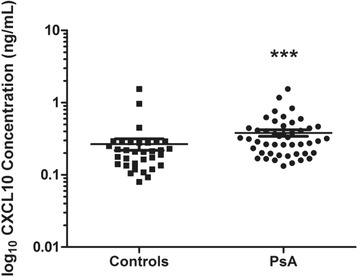
Scatter dot plot of serum chemokine (C-X-C motif) ligand 10 (CXCL10) expression from patients with psoriatic arthritis (PsA; n = 47) and healthy control subjects (n = 33). The data are presented as log10-transformed values to better visualize the absolute change in concentrations. CXCL10 levels were higher in patients with PsA (median 0.31 ng/ml, interquartile range [IQR] 0.20–0.44 ng/ml) than in healthy control subjects (median 0.21, IQR 0.14–0.28 ng/ml; p = 0.0007 by Mann-Whitney U test). ***p < 0.001
Fig. 3
Fig. 3
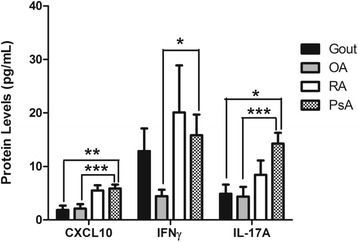
Bar graph of chemokine (C-X-C motif) ligand 10 (CXCL10), interferon γ (IFNγ), and interleukin (IL)-17A protein expression in synovial fluid (SF) from 40 patients with psoriatic arthritis (PsA), 14 with osteoarthritis (OA), 8 with gout, and 11 with rheumatoid arthritis (RA). Error bars indicate SEM. Asterisks are used to indicate significant differences between groups, where *p < 0.05, **p < 0.01, and ***p < 0.001 (Mann-Whitney U test). CXCL10 concentration was converted to nanograms per milliliter
Fig. 4
Fig. 4
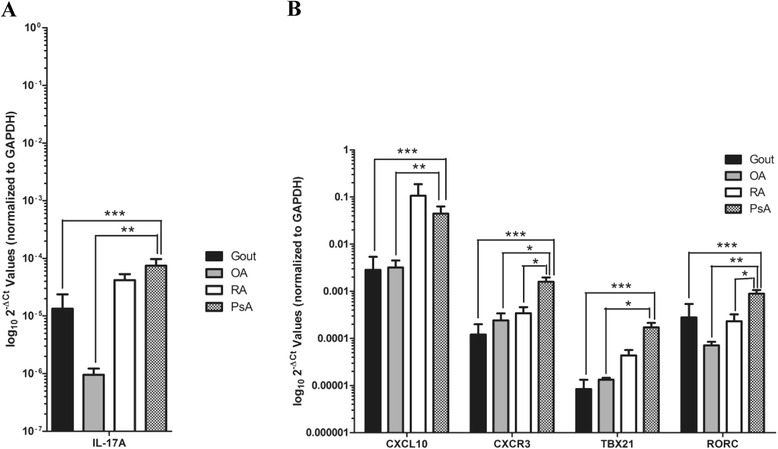
Bar graph depicting gene expression in synovial fluid (SF) cells of patients with psoriatic arthritis (PsA; n = 30), osteoarthritis (OA; n = 4), gout (n = 6), and rheumatoid arthritis (RA; n = 5). Error bars indicate SEM. Fold change was calculated using the comparative cycle threshold (ΔΔCt) method, and values are shown as log102−ΔCt values to better visualize the difference between groups (see Methods section of main text). a Interleukin-17A (IL-17A) gene expression was 37.5-fold greater (p = 1.5 × 10−5) in synovial fluid (SF) of patients with PsA than in those with OA and 19.8-fold greater (p = 1.7 × 10−4) than in those with gout. b Chemokine (C-X-C motif) ligand 10 (CXCL10) gene expression was tenfold greater (p = 0.007) in SF of patients with PsA than in those with OA and 36.2-fold greater (p = 2.6 × 10−6) than in those with gout. Chemokine (C-X-C motif) receptor 3 (CXCR3) gene expression was 5.3-fold greater (p = 0.011) in SF of patients with PsA than in those with OA, 32.3-fold greater (p = 1.2 × 10−6) than in those with gout, and 3.9-fold greater (p = 0.02) than in patients with RA. TBX21 expression was 5.6-fold greater (p = 0.029) in SF of patients with PsA than in those with OA and 25-fold greater (p = 0.0001) than in patients with gout. RORC gene expression was 8.1-fold greater (p = 0.002) in SF of patients with PsA than in those with OA, 19-fold greater (p = 0.0001) than in patients with gout, and 3.4-fold greater (p = 0.037) than in patients with RA. No difference between patients with PsA and patients with RA was found for CXCL10, TBX21, and IL-17A. Asterisks are used to indicate significant differences between groups, where *p < 0.05, **p < 0.01, and ***p < 0.001. GAPDH Glyceraldehyde 3-phosphate dehydrogenase
Fig. 5
Fig. 5
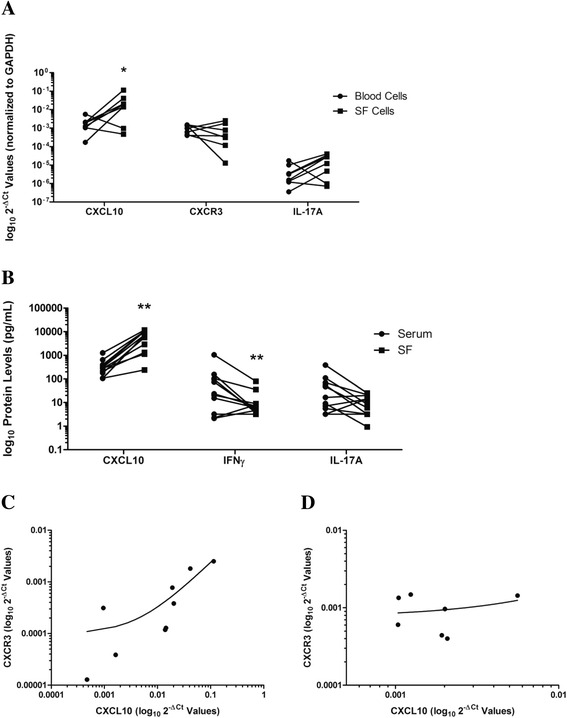
Scatter dot plots of (a) paired synovial fluid (SF) and blood gene expression and (b) protein levels of cytokine expression in patients with psoriatic arthritis (PsA). Chemokine (C-X-C motif) ligand 10 (CXCL10) gene expression was eightfold greater in SF cells (mean ΔCt = 6.55 ± 2.67) than in blood cells (mean ΔCt = 9.55 ± 1.44; p = 0.035 by paired Student’s t test; n = 8). Fold change was calculated using the comparative cycle threshold (ΔΔCt) method, and values are shown as log102−ΔCt values to better visualize the difference between groups (see Methods section of text). In paired SF and serum from 11 patients with PsA, CXCL10 levels were significantly elevated in SF, whereas interferon γ (IFNγ) levels were significantly reduced (p = 0.001 by Wilcoxon signed-rank test). CXCL10 and chemokine (C-X-C motif) receptor 3 (CXCR3) messenger RNA expression were compared in (c) SF and (d) blood, and a significant positive correlation was observed in SF (Spearman’s correlation coefficient = 0.883, p = 0.0031). Asterisks are used to indicate significant differences between groups, where * = p<0.05 and ** = p<0.01. GAPDH Glyceraldehyde 3-phosphate dehydrogenase, IL Interleukin

References

    1. Reich K, Krüger K, Mössner R, Augustin M. Epidemiology and clinical pattern of psoriatic arthritis in Germany: a prospective interdisciplinary epidemiological study of 1511 patients with plaque-type psoriasis. Br J Dermatol. 2009;160:1040–7. doi: 10.1111/j.1365-2133.2008.09023.x. - DOI - PubMed
    1. Christophers E, Barker JN, Griffiths CE, Dauden E, Milligan G, Molta C, et al. The risk of psoriatic arthritis remains constant following initial diagnosis of psoriasis among patients seen in European dermatology clinics. J Eur Acad Dermatol Venereol. 2010;24:548–54. doi: 10.1111/j.1468-3083.2009.03463.x. - DOI - PubMed
    1. Mease PJ, Gladman DD, Helliwell P, Khraishi MM, Fuiman J, Bananis E, et al. Comparative performance of psoriatic arthritis screening tools in patients with psoriasis in European/North American dermatology clinics. J Am Acad Dermatol. 2014;71:649–55. doi: 10.1016/j.jaad.2014.05.010. - DOI - PubMed
    1. Varada S, Tintle SJ, Gottlieb AB. Apremilast for the treatment of psoriatic arthritis. Expert Rev Clin Pharmacol. 2014;7:239–50. doi: 10.1586/17512433.2014.904200. - DOI - PubMed
    1. Taylor WJ. Impact of psoriatic arthritis on the patient: through the lens of the WHO International Classification of Functioning, Health, and Disability. Curr Rheumatol Rep. 2012;14:369–74. doi: 10.1007/s11926-012-0263-5. - DOI - PubMed

Publication types

Grants and funding